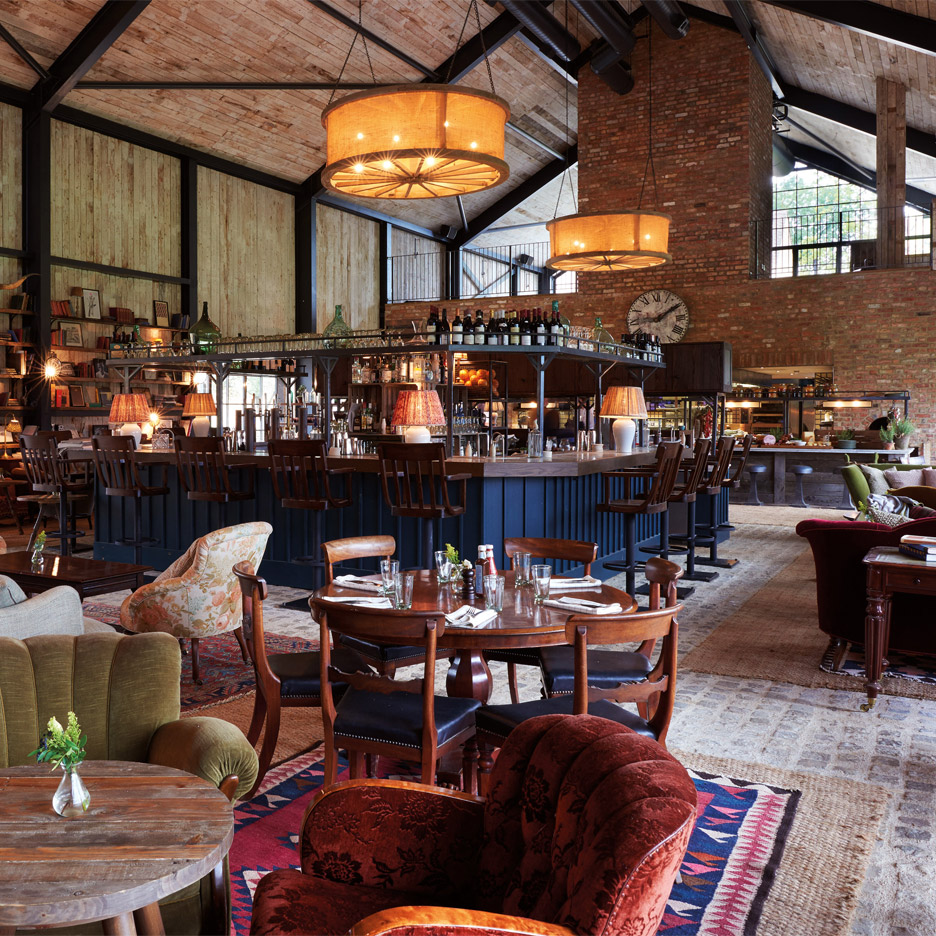
Over the past 20 years, former caterer Nick Jones has built Soho House into a global empire of private members clubs, restaurants, spas and now Soho Home, an online homewares store. He sat down with Dezeen to discuss his approach to design (+ slideshow). (more…)
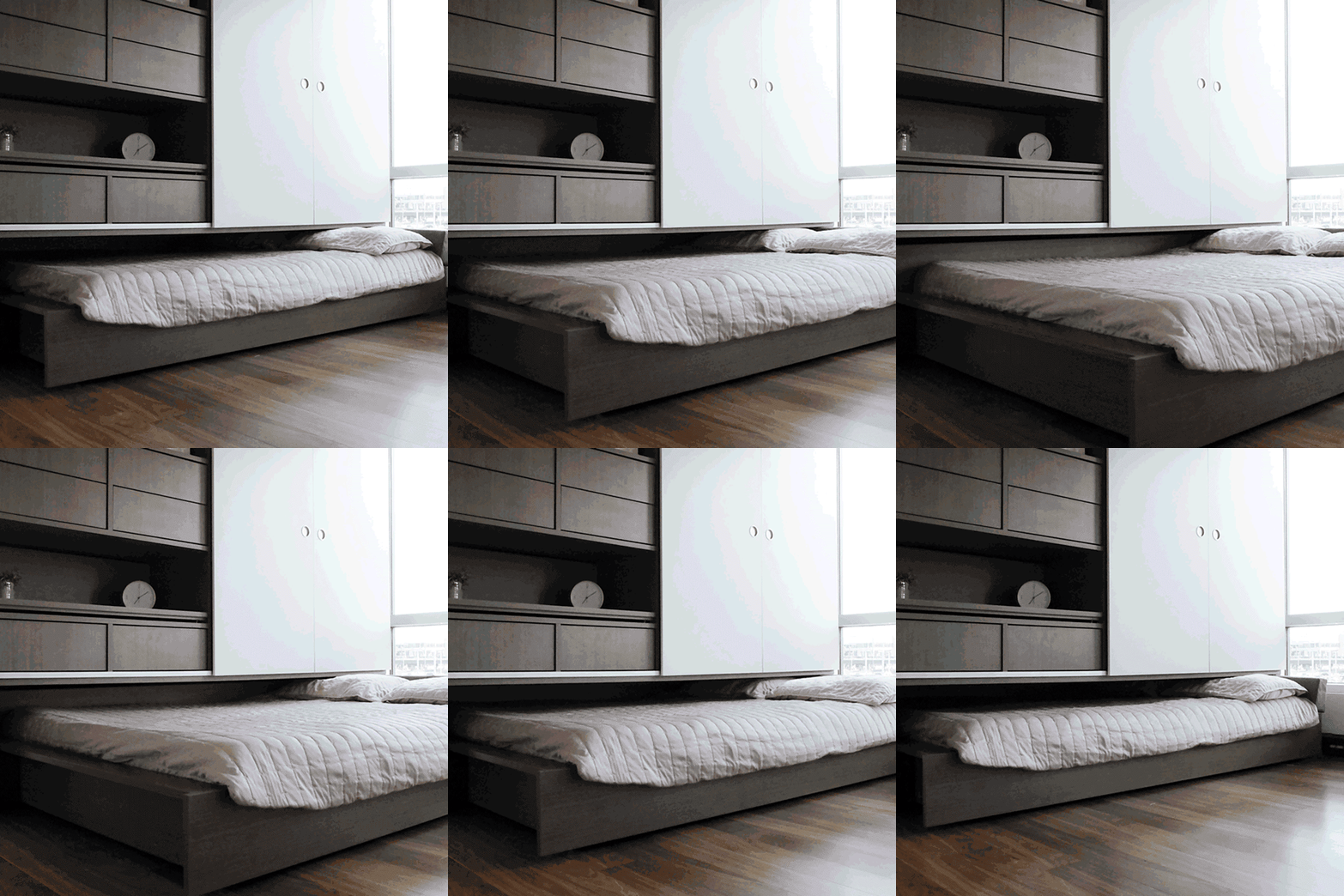
MIT Media Lab has partnered with designer Yves Béhar on a smart furniture system for micro apartments, which can turn the space into a bedroom or living room at the touch of a button (+ movie). (more…)
Zaha Hadid Architects have released plans for a 70,000 square meter (750,000 square foot) hotel and residential tower in the Marina District of Lusail City, Qatar. The design is the first of two ZHA projects commissioned by H.H. Sheikh Mohammed Bin Khalifa Al Thani for Lusail City’s integrated community master plan, which when complete will become Qatar’s first and largest sustainable city, providing entertainment, employment and accommodation for up to 450,000 residents and visitors.
ZHA’s design for the 38-story hotel and residential tower takes inspiration from the structure of the Desert Hyacinth, a flowering plant native to the Arabian Gulf. The building consists of a 9-pointed podium surrounding a central core defined by the interlacing, flowing geometries of the hyacinth.
The façade system utilizes the traditional element of the ornamental mashrabiya to protect the building from the hot Arabian climate by reducing solar gain. The building’s fluid form and calligraphic and geometric patterns also take inspiration from the region’s vernacular architecture, creating relationships between program elements by connecting domes to ceilings, ceilings to walls, and walls to floors.
To coincide with Lusail City’s environmental sustainability initiative, ZHA will be working with global engineering leaders Arup and Atelier Ten to develop a sophisticated building model to optimize building performance.
“With truly inspirational public spaces and atrium, 120 unique residences and 200 hotel rooms of Zaha Hadid’s unmistakable signature, we celebrate her remarkable legacy and continue Lusail City’s commitment to creating the region’s most sustainable, interconnected community,” said H.H. Sheikh Mohammed Bin Khalifa Al Thani, Chairman of Al Alfia Holding.
The hotel and residential tower is scheduled to be completed in 2020, with subsequent phases of the Lusail City Masterplan to be announced at a future date.
Zha Project Team: Gerry Cruz, Drew Merkle, Dennis Brezina, Alia Faisal Zayani,Alessandra Lazzoni, Matthew Le Grice, Mu Ren, Alexandra Fisher, Kwanphil Cho,Joris Pauwels, Jose Pareja Gomez, Katherina Hieger, Konstantinos Psomas, Leo Alves, Mei-Ling Lin, Nicholette Chan, Yifan Zhang
The site is located in a tropical area of lush vegetation on the outskirts of the city with a downward slope from the upper street level to the rear garden bordering a golf course. On the plot there is a single tree (Guazuma ulmifolia) native to tropical America, with large dimensions and characteristics of great presence.
The basic volume composing the design consists of a series of staggered prisms following the natural topography of the land and also placing the tree as a focal point or heart of the project. The tropical architecture is manifested by interacting with prism interiors, with semi outdoor and open spaces like terraces, pergolas, gardens, fountains, pool, and cantilevered stairs.
Section
Section
The rooms of the house are articulated and discovered on a journey that at times eliminates the feeling of boundary between inside and outside.
The use of natural elements and site are exploited to the maximum by opening great transparent views to the green horizon and closing the areas that are most exposed to the sun such as the south and west; also the concrete eaves and pergola areas are a resource used to protect from direct solar incidence and create interesting light and shade environments.
Plan
Bioclimatic strategies were implemented in all areas such as cross ventilation, employing mixed systems of aluminum window blinds and double glass sliding doors (Duovent system) with treatments to reduce solar radiation.
On the rooftop, solar panels were placed for the generation of renewable and clean energy. As for the construction system used throughout the house it was based on cellular concrete blocks on all the walls and precast slabs, thereby achieving high levels of thermal and acoustic insulation with subsequent energy savings over time. The lighting in the home is 90% LEDs, with integrated energy saving and home automation system sensors.
The material palette is designed to integrate into the surrounding green environment in a natural and warm way, along with the inclusion of tropical timber, exterior travertine floors, endemic landscape design, employment of vegetation in some exterior stone walls from stone found in the river of the region, and the inclusion of internal fountains to cool the atmosphere and provide peace and serenity.
In this article, originally published by Metropolis Magazine as “Redefining (and Redesigning) The Way WeWork,” Anne Quito visits WeWork’s offices in New York to discover how the company is using its own headquarters as the test bed for its future product offering.
In a nondescript building in New York’s Chelsea neighborhood, the global headquarters of WeWork buzzes with creative energy. In just a little over six years, the start-up at the forefront of the coworking-space rental boom has created a $16 billion operation with 50,000 members in 28 cities, with 96 locations announced for this year.
Spread across two and a half floors, the 50,000-square-foot headquarters is the home base for WeWork’s almost-700-strong New York–based staff and serves as a laboratory for its designers.
“We’re our own guinea pigs in a way,” says Devin Vermeulen, WeWork’s creative director of physical product, who designed the space with Ashley Couch, the company’s global director of interior design.
Well-appointed meeting spaces and a diversity of lounge areas to kindle social interactions are the design hallmarks of shared-office memberships. In laying out the space, the designers sought to spark the so-called propinquity effect—a 1950s social psychology theory that posits that strangers who encounter one another with some frequency tend to develop friendships. Applications of this idea, popularized by Steve Jobs at Pixar, have become fairly commonplace in many contemporary workplaces; what sets Vermeulen and Couch’s design apart is their willingness to experiment.
From finding the optimal office chairs to tweaking the cushioning of a couch, to bold architectural changes like blowing up a floor to install a staircase, the WeWork team has tried all sorts of new ideas in the name of enhancing social interactions.
“We shift things around and watch traffic patterns so we can learn from it,” says Vermeulen, who, like WeWork’s cofounder and chief creative officer, Miguel McKelvey, used to design fashion retail stores. He explains that WeWork’s design teams rely on data—observational and quantitative research—to inform their design decisions. To test seating options, for example, they’re developing a QR code system to allow employees to provide instant feedback on the furniture. Researchers stake out select WeWork locations to glean insights on how to improve the flow and vibe of social interactions.
After observing that people tend to gravitate toward the edges of a bar, Vermeulen and Couch conjured up a counter with two extra corners—like deep zigzags breaking the plane—with its depth and shape obsessively considered. “You have to have the right dimensions so people can circulate properly, but we also wanted them to be forced into a smaller space because that will stage interactions,” Couch explains. “We don’t want it to be a nuisance, but we wanted it to be a conversation starter.”
Their boldest experiment is a handsome steel staircase that connects the three floors of WeWork’s headquarters. Couch explains that even the staircase—usually a functional conveyance—was configured to invite impromptu conversations. Love seats and bistro tables are tucked into the custom staircase’s landing areas, and a “prop tree” and hanging plants suggest an indoor park. “It’s obviously a big expense and there are a lot of headaches with a big feature piece, but something like this is already appearing in plans for our future projects because the value becomes really obvious once you experience it yourself,” she says.
Beyond the din of those productive interactions they wanted to spark, WeWork’s designers have also tuned in to the need for silent, solitary spaces. On the opposite end of its reception area, a heavy soundproof door leads to a Quiet Room where cell phones and chatter are completely banned. In pitch darkness, with a white noise machine humming, those seeking to clear their mind can lie in a hammock, lounge in an easy chair, or prop themselves on a prototype massage chair. “Apparently these were popular in our Washington, D.C., location, and we have implemented them in other locations,” says Couch. At a WeWork location in the former Wonder Bread factory in D.C., a popular conference room is equipped with “robotic massage chairs,” developed by a WeWork member, Restin.
“Work has invaded home, and there’s something nice about the fact that we’re making home invade work,” muses Vermeulen. Last year, WeWork launched WeLive, the company’s initial foray into transferring its acuity for creating turnkey spaces to the apartment rental market. The move is a natural extension of its longstanding aspiration to create comfortable, homelike environments in its workspaces.
Vermeulen explains that in the early days of WeWork, it used furniture pieces originally designed for residential spaces because they were a lot cheaper than commercial contract furniture. “When you think about a conference room, it’s basically a dining table and chairs,” he says. “In making those connections, we could achieve the same functionality from residential furniture.”
Since most of WeWork’s members are start-up entrepreneurs, spending long hours in the workplace, making the spaces comfortable and uncluttered has been a priority. “You almost want it to be even more comfortable than a home, and probably in many cases it is,” says Couch. As the company expands into the Asian market this year, it’s researching the distinctive cultural markers of home life to inform the design of its new office spaces.
WeWork is approaching a period of ambitious growth, and defining its signature brand look is increasingly a priority. “We’re having an ongoing discussion now about how we adapt the brand and how far we adapt it to local markets,” explains Couch, about tweaking or codifying WeWork’s growing eclecticism. “We’re always starting at the local, but it should also definitely still feel like a WeWork.”
Walking through the model headquarters WeWork’s designers built just last year, they say they’re already getting antsy, anticipating changing things.
“When we built this, it was a time capsule of where we wanted to direct the brand,” says Couch, explaining that several design features tested and fine-tuned there have already been applied to WeWork’s new locations. “We had this and we were good with this, now you only go six months and 40 locations with something similar,” she says. “Now we’re like, ‘Is that what we want to be for the next six months?’ The brand look is constantly evolving.”
Today, one of Richard Meier’s most notable and acclaimed residences, the 1973 Douglas House, has been named to the National Register of Historic Places, the federal list of cultural resources worthy of preservation across the United States. The announcement comes after an extensive renovation to the property was completed in 2011, and will grant the home the legal status to help ensure the building is maintained for generations to come.
Like many of the great residences throughout history, the Douglas House was born out of a fruitful architect-client relationship. The original owners contacted Meier after seeing one of the architect’s earliest designs, the Smith House, on a magazine cover, and together they worked to find the perfect site for their new home.
“One day I received a letter from a Mr. and Mrs. James Douglas inquiring if I would sell them the blueprints for the Smith House,” explains Meier. “I replied that while I was not prepared to sell the drawings I would certainly be willing to design a new house for them along similar lines. They accepted, and I started designing a house for a site that they had purchased in a residential subdivision in northern Michigan. As it happened, the developer who had sponsored the subdivision insisted on reviewing the design of any house that would be built within its boundary. He asked me to submit photographs of my work, whereupon he immediately refused to permit a house designed by me since it did not have the prerequisite classic pitched roof. To my delight, the Douglases responded to this impasse by promptly selling the plot and looking for another site, and that was the beginning of a very gratifying collaboration.”
Together, the team discovered a dramatically sloping site on a forested cliffside near Harbor Springs, Michigan, that had previously been deemed too difficult to build upon. Meier rose to the challenge, proposing a 5-story wood and steel tower house painted classic Meier white to act as a foil for the natural surroundings as it rises out of the treeline. So steep is the slope down to the Lake Michigan shore, the 4,500 square foot (418 square meter) house must be entered through a flying bridge connecting to the top floor of the residence.
The Douglas House’s eastern facade, facing the road, is largely an opaque surface punctured by square apertures and horizontal strip windows. This opacity is the set up for the house’s grand reveal: the glazed western facade featuring dramatic views of the lake and surrounding natural preserve.
“Usually when people enter a house, they expect the outside to be brought in, but in the Douglas House, the opposite occurs: you are transported outside, over the lake and into the trees,” Richard Meier explains. “Visitors all depart with an experience they’ve never had before. It is truly a house of opposites: to leave the house for instance, you go up instead of down.”
Meier also had a hand in the recent renovations conducted by current owners Michael McCarthy and Marcia Myers, who found the house on the market in 2007 in a state of disrepair, but still structurally sound. They then began the four-year process of updating and repairing the home, with utmost importance placed on maintaining the integrity of the original design.
“Reflecting on the history and the design of the Douglas House I believe the architect is really the facilitator of creating something which goes on to have an existence that is much greater than itself and has a life that is longer than any of the people involved in the creation of it,” comments Meier. “In thinking about the ideas that go into making architecture one has to think about not just the context, the circumstances of the site, its history, the surrounding buildings, the topography, and the nature of the place in the public realm, but also about what it can be, what it will be, and how it will be meaningful for future society. With all of the changes that are taking place in the world today, it is important that architecture continues to move us aesthetically, as great architecture always has.”
“We are deeply honored by this historic distinction of the Douglas House, and we are very grateful for all the dedication, care and supervision given by the current owners of the house. Michael McCarthy and Marcia Myers have returned the house to its original intent.”
Theodore Roosevelt National Park in North Dakota honors President Theodore Roosevelt’s conservation legacy. Visitors can see Roosevelt’s Elkhorn Ranch Site, where he spent the bulk of his time and where many of his conservation ideas grew. In the spirit of Roosevelt’s outdoorsy nature, the park also offers plenty of opportunities to explore through hiking, kayaking, biking, camping and more. Sunset shot of Painted Canyon Overlook courtesy of Robert Gjestvang.
From the architect. Armenia Building is located in Palermo Soho, a neighborhood in the city of Buenos Aires. Due to the gentrification process occurred during the last decade, Palermo Soho was renewed and became a gastronomic, cultural, commercial and touristic hotspot, which has raised real estate prices in the area.
In order to profit from the area’s potential, an investment group commissioned an apartment building with a row of stores on the ground floor. The building should be composed of a varied set of apartments. While the commissioners intended most of them to be lofts that could be temporarily rent out to tourists, the more spacious unities (one, two, and three-bedroom apartments) would be sold as permanent residencies. It was requested the project should include common areas, green spaces, a solarium, and should also be endowed with water presence. With respect to materiality, the clients already knew the Studio’s career regarding the esthetics of its works and its experience in the use of exposed concrete. They considered it fit for the project not just for esthetics reasons, but also because it requires minimum maintenance.
The project synthesis developed a building organized in two compact blocks linked by a patio in-between that would function as the heart of the design. The blocks’ height was determined by the code’s zoning: ground floor and four other floors. According to the code’s requirements, the different floors on the front block are organized in steps ascending inwards. This structure is mirrored by the block in the rear so that better insolation, air and views may be achieved, falling backwards on the upper floors and generating an opening towards the central patio.
The Studio’s intention was to avoid this space’s confinement, so the ground free floor plan connects the street area, the central patio and the backyard. Receded from the building’s facade, the double-height stores set in the front expand the sidewalk space. Among the stores’ interstices is located the entrance to the building, with no closing physical barrier other than a fence that allows the passing of air into the rest of the condominium. The air going through the whole floor plan softens the transition between the public and private spaces.
Regarding the floor plan’s organization, both blocks area arranged over an orthogonal grid. This grid is bilaterally set on both sides of an axis that cuts through the trapezoid drawn by the site. Each block has its own circulatory nucleus and both lie on this same axis.
Along with the site’s geometry, the diverse typology requested by our customers and the intention to achieve well lit and aired homes endowed with good views were the project’s main challenge.
Regarding the facade, a brise-soleil system composed of vertical partitions and horizontal eaves was designed to function as a sun control artifact that would also shelter the apartments from the view from the street.
Apart from the central patio, for which natural forestation was designed, the condominium has a common use solarium and reflecting pool on the second level that lean over the patio.
1st Floor Plan
The central patio has semi covered spaces that may be used as parking slots, but also there is a garage and private storerooms on the underground floor that can be accessed through a car elevator.
When the construction was already well advanced, the commissioner acquired the lot next to the building site to incorporate it into the project and the original design needed to be adapted. New stores were included on the front and the new apartments (which were now thirty four) were integrated into the existing structure, making use of the circulatory nucleuses developed for the original project. The brise-soleil system was adapted so that it would serve as an integrating element with the new building.
The exposed concrete is present all over the building shell, as well as in the common areas, the circulatory nucleuses, the slab bases and both the indoor and outdoor floors, made of smooth concrete. In contraposition, inner partitions are plastered brick walls painted in white. While the apartments’ framing is made of dark bonze anodized aluminum, black steel was selected for the front framings, the internal structure supporting the stores’ mezzanines, and the rest of the forges.