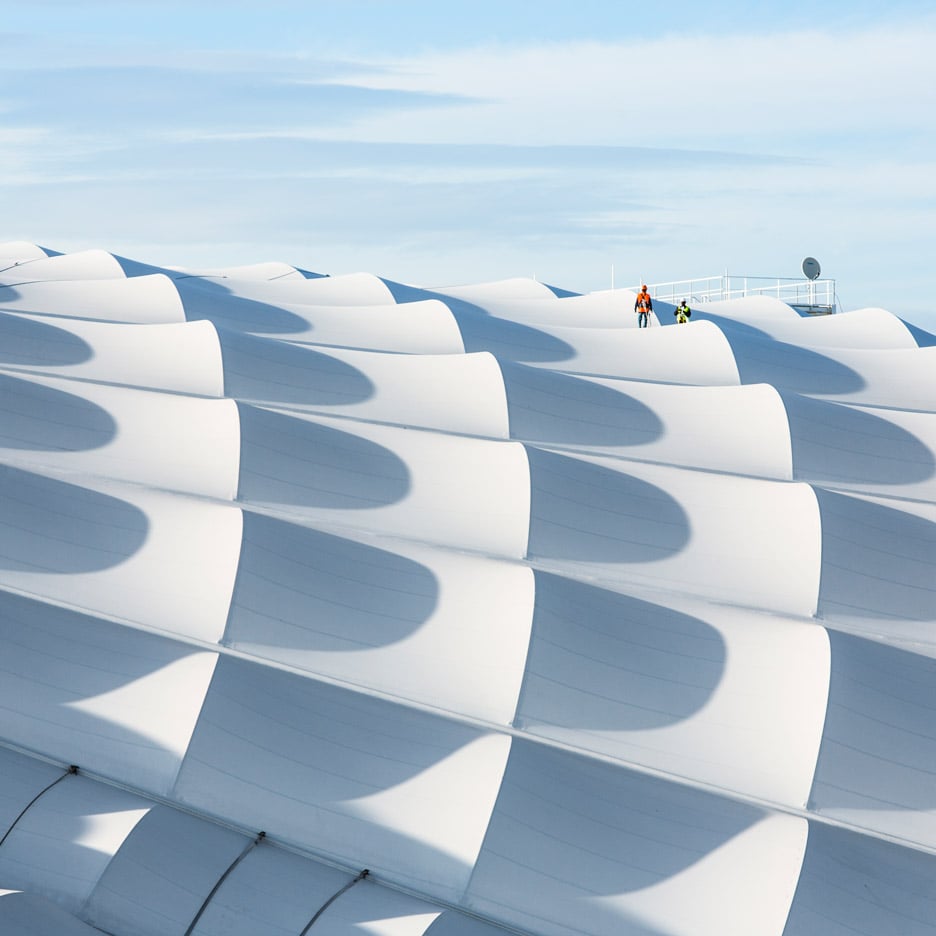
French firm SCAU designed the undulating fibreglass roof of Marseille‘s football stadium, which is set to host the UEFA Euro 2016 semi-final between France and Germany this Thursday (+ slideshow). (more…)
French firm SCAU designed the undulating fibreglass roof of Marseille‘s football stadium, which is set to host the UEFA Euro 2016 semi-final between France and Germany this Thursday (+ slideshow). (more…)

From the architect. The community centre El Roure and library La Ginesta are a cultural mix facility which includes a community centre with a multipurpose theatre and a municipal library as a result of a joint work among technicians, administration and citizens. Fully integrated into its surroundings, the centre is a social and cultural catalyst which enhances a natural space by the landscape recovering of Begues Stream and of a downy oak which names the centre.
Conceptual overall decisions and formal aspects
The design process has crystallised a chain of synergies among organisations, administrations, technicians, citizens and the place itself. It began with the definition of an agreed and adequate functional programme and it culminated in the name’s choice by the citizens of Begues and the cataloguing process of a downy oak for its cultural value.
Two main ideas underpin the conception of the new facility: to generate a confluence “inner square” and to tune into the environment revitalising the Stream.
The “inner square”:
The project outlines a single building which gathers the three services, creating a community space, a place where people meet, which will enhance citizen interaction, cultural synergy and sustainability in its construction and management. The architecture that hosts a facility of this kind should be diverse and pluricentric in order to support a wide variety of users and foreseen activities, but it must also have the ability to strengthen and harmonise the relationship between organisations and users. The architectural project begins with the definition of a foundation core, an agora able to attract and articulate around all areas defined in the functional programme, a place where all users can identify themselves as belonging to it.
To tune into the environment revitalising the Stream:
The triangular plot is located at the bottom of a hill covered with pine trees and bordered by two streets on its minor sides and by Fonda Stream (specifically on the flood limit drawn up by the Catalan Water Agency) on its major side.
The building accepts the limits of the plot as its own and occupies the entire place to achieve a horizontal construction integrated into the landscape of the stream and which can accommodate the lobby.
The design wants to recover the stream and the collective memory of a pool (popular place for summer recreation). For this reason, the main facade is oriented to the north, picking up the flow of neighbours coming from Ral path and reassessing this forgotten landscape, revitalising the ecosystem and promoting a new relationship with the users of the centre.
The building therefore aims to be a stream, a meander and a pool, flowing and reflecting the environment. The profile of organic geometry of the facade reflects the reverberation of the winding meander, generating a new access path and embracing the oak that names the Centre; its materiality is sometimes mirrored (to reflect and multiply the landscape in each piece of glass) and sometimes biospherical (to respect the naturalness of the environment).
Inside, each part of the programme finds its natural place, almost respecting the hydraulic logic by which erosion and sediment define the edge of the bank of the stream. Thus, the inside is organised in longitudinal layers tracing the line of the stream and resulting in more or less dilated spaces, which have a progressive materiality more dynamic, fluid, clear and watery near the facade of the stream and more solid, opaque, private or stony in front of the mountain. Mainly the library but also Espai Nou, Punt Jove and the bar are developed along this opening landscape facade which offers magnificent sightseeing options. The theatre, the rehearsal boxes and the various more closed type services are in the last layer or farthest place of the stream. All these spaces are articulated through an agora whose morphology, materiality and natural lighting procure a natural atmosphere which recalls the one enjoyed touring the stream.
Social impact
Three aspects explain the mission and the social impact of the centre. Firstly, the participative aim of the facility. The centre is born and developed by the citizens and the administration involvement, from its functional programme definition to the choice of the centre’s name according to a participative process which has strengthened the facility’s ownership by the citizens of Begues.
Secondly, we are dealing with a triple facility that brings together different areas focused to social and cultural organisations activities development aimed at very different sectors and swaths of population, becoming a true meeting point.
Finally, the strong bond between the building and the natural environment -which goes from the landscape recovery of the stream to the stream morphology in the inner spatiality, the commitment to an air conditioning with the biomass obtained from the splinters from nearby forests clearing -, strengthens the identity of Begues as a municipality of Garraf Natural Park.

Architecture is a broad field of practice, an industry where individual personalities are embraced as intrinsically part of the job. We’re all architects and we all live for design but we’re quite a varied bunch. Here we’ve cheekily compiled a list of the 21 different architects you’ll meet at some point in your career.
The Stealth Fighter
This architect manages to fly under the radar, seemingly just zooming in and out of Revit all day. You wonder how he keeps his job…until one day he sweeps in from underneath you and gets the promotion.
The Entrepreneur
Architects often have to wear many hats in the office and this one is particularly good at wearing the accountant hat and would probably find this article useful. Thanks for keeping the numbers out of the red!
The Project Manager
There has to be someone keeping all the silly little designers on their toes and that is the Project Manager. Awesome at management, but many of these types seemingly can’t manage to design.
The Silent Struggler
Most architects probably fit into this category: you try to keep your cool in the office as you work at your desk but inside you’re cursing the 300 pieces that still need to be glued onto the presentation model for tomorrow’s meeting.
The Groundhog
The difference between the Silent Struggler and the Groundhog is that the latter is happy to be doing the work, never seeing the light of day. This architect lives to work and is probably the first to arrive in the office and the last to leave…does this guy live here or something?
The Motivator
There’s something to be said about micro-managers in the office but you always get a good pep-talk from this one. *cue Eye of The Tiger soundtrack*
The Dictator
In some firms, you have the hotshot who just can’t seem to let others do the work. In her mind, she does the design and you simply “support” the creative process, which might actually mean grabbing the coffee. If you ever worked for one of these architects, you might become the next type on the list.
The Great Raconteur
This is the architect that got the coveted 8 week summer internship at some world-renowned firm, and lived to tell the tale… too many tales in fact. Making small talk with this architect probably means having to listen to how wonderfully they did things at firm so-and-so.
The Artist
This is the architect that comes up with the most fantastic work at the office. Does it matter that it’s two weeks late or that it would be a huge pain for the contractors? Not to this architect. For this one, it’s all about the “vision.”
The Pragmatist
The Pragmatist is the architect that was probably a contractor in a previous life. Will you get a simple decorated shed from this architect? Yes, but it was probably built on-time and within budget. Does not mingle well with The Artist.
The Pessimist
Otherwise known as the Debbie Downer or as Tom Kelley would describe them the Devil’s Advocate in the office, this architect constantly has something to complain about whether it’s his job, a project, or even architecture’s supposed irrelevance. The Pessimist probably enjoys indulging in Ruin Porn.
The Optimist
On the other hand, the optimist is still determined to change the world one project at a time. Le Corbusier is definitely this architect’s idol.
The Techie
We’re looking at the grown up version of the fresh-faced intern forced by her boss to learn how to code or use ArchiCAD in the 90s. Years later and with tons of knowledge in various software, this architect can model and render ten times faster than anyone at the firm. She readily assists with tech issues at the office, with only the occasional side-eye.
The Analog
Inversely, this architect is the species of proto-human that makes do with crude tools such as pencils and paper to perform the archaic ritual of manual drafting. This type of architect probably isn’t even reading this post. Apparently, if it’s not printed on paper, it’s not as important.
The Philosopher
Theory Theory Theory. The one who writes the next great manifesto for every project presentation.
The Mr./Ms. May-I-Borrow
This architect is the sole reason behind the firm’s choice to buy a plastic label maker—so that everyone’s pens and markers don’t pile up at this architect’s desk.
The Drinker
The one that carries around a flask of a little somethin’ somethin’ for “inspiration.”
The Zen Guy
While you’re stressing out over the next deadline, or over whether you sent those drawings to the right person at the planning office, The Zen Guy remains unfazed by whatever life throws his way. His mind is as uncluttered as his desk, and you could swear that as a result of his inhuman mental state he gets more work done and makes fewer mistakes.
The Count
4:57… 4:58… 4:59… The moment the clock strikes 5, this architect is already zooming out of the office, leaving the Silent Struggler to his misery and the Groundhog in her happy solace.
The Ol’ Stamper
With great power, comes great responsibility. Wielding a mighty red liner, these “real architects” work their last few years reviewing plans and handing out their seals of approval and ultimately signing off on everyone’s work—everyone but theirs.
The Intern
And finally we end with the new generation, probably the youngest one at the office, and as Bob Borson writes: the one that isn’t even assigned a desk. The trusty intern usually spends all day building models and drawing up legible details from illegible napkin sketches. But just you wait—soon enough the Intern will grow into her own as one of the other types.

Happy Independence Day from all of us at Interior! 🎆 We hope you have a happy and safe holiday. Photo of the 4th of July fireworks display over the National Mall in Washington, DC, by Tom Hamilton (http://ift.tt/18oFfjl). 🇺🇸
If only we could cajole Robert Altman back to life at this surreal moment in American politics. Even for fifteen minutes. Five minutes would be spent on the pitch: Listen, Bob, it’s 2016, and Donald Trump has somehow become the Republican presidential nominee. He wants to be the King of America. He has promised a ban on Muslim immigrants and was endorsed by Charles Manson and David Duke. There have been riots at his rallies, and he has encouraged people to beat up protesters. He alluded to his penis in one of the debates.
A minute or two for Altman to finish laughing and absorb the shock. Then the remaining minutes for him to level some devastating, trenchant commentary. Maybe he’d come up with a spontaneous idea for a twenty-first-century super-meta mockumentary that would put the whole bewildering phenomenon in perspective.
The reason to imagine such a scenario is part of the prehistory of our current “golden age of television.” Back in 1988 Altman released Tanner ’88, a brilliant, kinetic miniseries that originally aired on HBO, running right up to election time that year. Altman himself called this faux political documentary “the most creative work I ever did.” Even so, many Altman fans never got around to seeing it at the time. The series ran a fictional candidate for the Democratic presidential nomination named Jack Tanner and followed him on the campaign trail. Tanner is sincere and intent on cutting the crap. He’s a progressive democrat from Michigan, running on legalizing drugs, divesting in South Africa, and helping the inner cities. As played by Michael Murphy, he’s got an earnest manner and honest teeth — in some ways he resembles a younger Bernie Sanders, albeit with more polish and movie star looks.
There’s a crucial scene in the first episode of Tanner, when a cameraman catches Jack giving a spontaneous, impassioned speech to his campaign team. Jack doesn’t know he’s being filmed. The angle is surreptitious — it’s shot from the cameraman’s vantage point while he’s lying on the floor, upward through a glass coffee table. Tanner is rhapsodizing about “honest inquiry . . . We’ve got to keep asking the [pertinent] questions. That’s what the American experiment is about.” He’s grappling and searching, and Altman shows him to be genuinely invested, not for ego’s sake. And Tanner is a little reckless. After he gets arrested for trespassing at the South African embassy, his campaign manager (played by Pamela Reed) says with exasperation, “When is this candidate ever going to grow up?”
Tanner’s campaign slogan is “For Real” — two simple words that resonate with an almost eerie quality for a viewer looking back through decades of Survivors, Housewives, Jersey Shores, and — yes — Apprentices. Real was always relative, of course, and even back then, Altman was playing with the notion of real versus fake. Altman’s “documentary” is constantly sliding between real and contrived. Real people show up to interact with the show’s fictional characters: Pat Robertson, Bruce Babbitt, Bob Dole, and Kitty Dukakis make appearances, seamlessly worked into the action. One of the most audacious elements is the way Altman and his troupe infiltrate actual events. Often you can’t tell if the scenarios have been set up or intruded upon. The camera work is kamikaze. And this is years before mockumentaries became a Netflix genre and Sacha Baron Cohen (along with his less gonzo colleagues on venues like The Daily Show or The Colbert Report) made the fake interview a satirical trope.
Is it true that real was realer in 1988? More easily accessed, buried beneath fewer layers of simulacra? Even discounting the haze of nostalgia, it seems so: the Trump persona is too many funhouse mirrors removed from the actual person to keep track of any longer. He was the star of a reality show, after all, and this latest incarnation doesn’t seem to be much of a departure. Yet for all of the obvious fakery in his campaign, Trump’s supporters insist he’s the truly authentic one, unafraid to “tell it like it is.” Are we, the voters, just the larger audience to a political process that plays out like writer’s room dreck?
The funny thing is that Tanner ’88, back in its day, was itself a joyous screw-you to the establishment. It came at a time when Altman hadn’t yet had his Hollywood comeback with The Player, in 1992, and Short Cuts, in 1993. Political cartoonist Garry Trudeau was handpicked by HBO to write Tanner, and it was only after he insisted that Altman direct that he officially signed on. Altman was persona non grata in the film world anyway, so why not do it the way he wanted. He felt he was reinventing television, he later said, and looking at it now you see where he busted through the walls.
Altman’s work was always essentially American. Nashville was about American celebrity. McCabe & Mrs. Miller, American greed and progress. Short Cuts, American self-destruction. After I fell in love with his movies, I always knew that even in a more or less failed project (Prêt-à-Porter comes to mind) he would show me something important about myself and my fellow Americans. I would always feel somehow implicated, yet still not judged. I was no better and no worse than his greatest flawed characters. So now, I wish there were some way for Altman to help me find my place in this current spectacle. Am I — are we — as insane as I think? I’m looking, more than anything, for a moment of respite and clear thinking, and the sort of moment of grace his films allowed even his most hapless characters.
For a show that is sometimes ridiculously comical and now so obviously dated — look at the shoulder pads, the giant telephones, the terrible eyeglasses — Tanner has its share of grace. Even twenty-seven years after it was made, parts of it can still tear your heart out. In the eighth episode, Tanner is campaigning in Detroit, where he meets with a black community group devoted to addressing the senseless killing of kids in the inner city. Urban areas are being forsaken, crack is everywhere, and mothers who have lost children to gun violence are giving speeches. After the event, Tanner sits surrounded by people telling their stories and speaking their piece. It seems these could not possibly be actors — it sounds so unscripted and passionate — and the effect is to connect the story with the real losses being suffered in these communities, in a way that few political dramas manage.
Some truth is captured there, something meaningful transpires. When Altman said he was reinventing television, maybe that’s what he meant: In between the genres, he got reality. I won’t reveal if Jack Tanner wins the nomination in this alternate universe. But I will tell you it was sweet that Altman even let him try.
The Barnes & Noble Review http://ift.tt/29q3Ss8
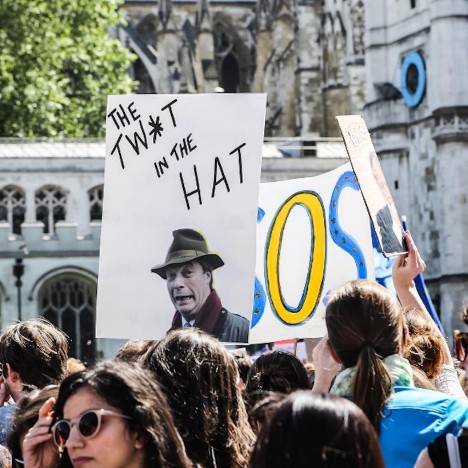
Brexit crisis: British architects and designers were among tens of thousands of people to protest against a UK exit from the European Union in London on Saturday. (more…)

From the architect. British architects Studio Andrew Todd have completed France’s first permanent Elizabethan theatre. Building started in September 2014 and concluded in May 2016.
The 388-seat auditorium is built in the grounds of the spectacular Chateau d’Hardelot near Calais, once the haunt of Charles Dickens and now home to the Centre Culturel de l’Entente Cordial, which hosts a major annual summer festival celebrating cultural ties with Britain.
Built (above ground) amost entirely of wood and bamboo, and naturally ventilated — a first in France for a complex cultural building— it is also revolutionary in its exceptionally low energy consumption, using less power than one average French person per year.
This building will not only be France’s first permanent Elizabethan-style theatre, but the only one in the country with a full thrust stage -a form which is widespread in Britain and North America. It will also convert into a small opera house with an orchestra pit and proscenium.
Studio Andrew Todd had not only to come up with a warm and magical space, but one that had to work with the chateau and the beautiful coastal parkland in which it is set. Their solution was a pure cylinder of wood surrounded by a shimmering cage of 12-metre bamboo poles.
A Globe for our times…
“It’s designed to vibrate with its natural surroundings rather than be a stand-alone, attention-seeking, alien object,” said Andrew Todd. “And we have carried this through to the interior: the circular wooden auditorium is naturally lit and ventilated, the building’s crown acting as a giant chimney to create a gentle current of air for the audience.”
“It is appropriate to consider the original metaphor of Shakeaspeare’s Globe -thought of as a society and a universe in miniature- in the light of our current global environmental crisis: what better than to make a building of healthy, sustainable materials, and needing minimal energy to function?”
“The presence of familiar, timeless materials -like the spruce structural panels and larch cladding- gives the building a universal character, relevant today or hundreds of years in the past or the future. The 12 metre-high bamboo stalks surrounding the building -imported specially from Bali- introduce for the first time in France this magical material in a major building. They also serve to remind us that ecology is a global question, and perhaps remind us that Shakespeare’s universality should not comfort us in our local identities: he explored far a eld geographically and opened up new depths to the human psyche. I hope this building is both familar and challenging.”
“From an objective standpoint, making this building of wood has served to capture 100 tonnes of carbon; this easily offsets the 200 kilogrammes needed to bring the bamboo across the world.”
Paris-based Todd — who was named Chevalier des Arts et Lettres by the French government in 2011 — said: “I’m a sort of one-man Entente Cordial, and this project feels like a homecoming, condensing so many areas of passionate interest to me: the productive tensions between France and Britain, radical ecology and the abundant possibility for theatrical creation. I hope this project will demonstrate that we can live fully, joyously and also lightly: theatre is a concentration of life and a worthy analogy for living more closely together, more economically, in mutual awareness and respect.”
Todd has a particular interest and expertise in circular spaces, having worked with the legendary director Peter Brook on the book The Open Circle: Peter Brook’s Theatre Environments (Faber, 2003).
“Circles have been largely banished from French theatre because of their association with bourgeois, hierarchical spaces where the poor were further away and couldn’t see the stage,” he said.
“I hope this project will show — like Peter Brook’s Bouffes du Nord theatre in Paris — the great social and dramatic potential of more convivial spaces. As France’s first permanent Elizabethan theatre it will certainly stimulate creative cross-pollination over the Channel,” said Todd.
Chateau d’Hardelot — on the Côte d’Opale between Le Touquet and Boulogne — dates from the 13th century and was transformed into a Tudor style manor in the mid- 19th century by Sir John Hare, a friend of Charles Dickens, who was a frequent visitor to the house.
In 2007 the chateau and its 880 hectare park became the home of the Centre Culturel de l’Entente Cordial, dedicated to strengthening cultural ties between France and Britain through exhibitions, conferences, theatre and music. The centre’s Midsummer Festival has taken place in a demountable Elizabethan-style theatre for several years. With growing success, and the ambition to provide year-round programming, the Département du Pas de Calais launched a restricted architectural competition in March to design a permanent, 400-seat building. Studio Andrew Todd won the competition against Alain-Charles Perrot and K-Architectures.
The Anglo-French design team includes Paris-based LM Ingénieur (structure and M+E), British theatre consultants Charcoalblue (behind the recent construction of the Royal Shakespeare Company’s new home), who are advising on lighting, stage engineering and acoustics and Cost Consultants Bureau Michel Forgue, based near Lyon.
In concert with the inauguration of the Hardelot theater, Andrew Todd also launched his book Common Sense.

The World Architecture Festival have announced the shortlist for their 2016 awards, featuring 343 projects from 58 countries across 32 categories. As the world’s largest architectural awards program, the shortlist contains completed projects from every corner of the globe.
All finalists will be invited to present their project live at the festival in November at the Arena Berlin in Germany to a “super jury” that will include Kai-Uwe Bergmann (BIG), Louisa Hutton (Sauerbruch Hutton), David Chipperfield, Ole Scheeren, and ArchDaily’s co-founder and Editor-in-Chief David Basulto. A winner for each of the awards’ 32 categories will be selected. From this, an overarching World Building or Future Project of the Year award will be selected. Tickets for the festival can be booked here.
You can explore all 343 projects on the shortlist, here.

It’s graduation time. As universities around the globe – or at least most in the Northern hemisphere, where over 80% of the world’s universities are located – come to the end of the academic year, many university architecture studios have recently closed out the construction of pavilions, installations and other small educational projects. Last year at ArchDaily, with the help of our readers, we were able to round up some of the best pavilions, installations and experimental structures created by students from all over the world. The resulting article was among our most popular of the year, demonstrating people’s huge appetite to see the work of the next generation of young architects.
That’s why we’re once again teaming up with all of ArchDaily en Español, ArchDaily Brasil, and ArchDaily China, asking our readers to submit their projects, so that we can present the best work from graduating students worldwide. Read on to find out how you can take part.
Please use the form below to submit a Google Drive Folder containing images and a brief description of your project. Submissions close on Monday, July 18th at 12:00pm ET.
Rules:
Tips:
Everyone of us has qualities that set us apart from the rest of the crowd. We like to emphasize them, and often mention them when we are hunting for a job. Certainly we have a lot of them, but we are usually going by one or two, that we consider our personality dominant traits.
However, the way we see ourselves is not always the way the rest of the world sees us.
Take just now this quiz to find out what is the first thin that people notice about your personality.
//cdn.playbuzz.com/widget/feed.js
The post What Is The First Thing People Notice About Your Personality? appeared first on Change your thoughts.

