Do you want to know how to plan a project that will get actually get things done?
Improvisation is great for comedy, but getting a project done on time and within budget is no laughing matter. If you want to accomplish something, you have to set a course of action that ends with the successful completion of that project.
There are 12 steps that you need to take to plan a project, and most take place before you even begin the work on your project. Project planning takes work! If you don’t do the due diligence and proper preparation to start your next project off right, then you’ve already put a huge obstacle on your path.
This sounds so obvious as to be silly to point out, but it’s usually the most overlooked step in project planning. You can’t accomplish a project if you don’t know what steps are required.
The scope of a project can change over time, but start by defining your goals and the general tasks that need to be done to accomplish those goals. This will keep you on target and not veering off on time-wasting tangents.
2. Who Are the Key Decision Makers?
You need to know where the buck stops, so to speak. Who are the important decision-makers, and the one who initiated the project? Do you know for sure what they want from the project?
You need to communicate with all relevant parties at the outset of your project to get their input so you can set your project up for success.
You know what you want to accomplish in the project, and now you have to figure out which people are able to help you complete all your tasks. Be sure you’ve defined key roles and identified people for every step of your project before you even start.
It’s important to define a timeline at the very beginning of any project otherwise you have literally infinite amounts of time to complete it. Rarely is that the case in reality. Most of us have deadlines, and even if we don’t, we can’t afford to pay people indefinitely for their services.
Define a clear deadline based on the tasks you outlined and the people you’ve assembled. Get them to estimate how long they think their part of the work will take. If you can’t finish the project in the time you have scheduled, then you’re going to need to go back and reevaluate your resources and other items to ensure your project will be done on time.
5. Create Milestones
You’ve got your goals, your task lists and your team’s estimates. Now which of those tasks, when completed, might mark a major milestone in the overall project? Are there different phases of your project, like construction starting or QA or launch parties, that could be considered major milestones?
Mark these dates on a calendar or in project management software so you can always keep the big picture into focus and track progress over time.
6. Break Down Major Tasks
Look at those milestones and your starting task list and see if any of those tasks can be broken down into smaller steps. The reason is you want to make sure you’ve defined all the relevant steps in order to control the production of your project, and you haven’t overlooked anything. These tasks can then be assigned to your team.
7. Create a Schedule
Congratulations, you’re finally at a point in the planning when you can actually draft a schedule!
This is the first time you’re going to try and coordinate all the various pieces of the planning puzzle you’ve been working on. This is when you take all your tasks and assign to people with clear due dates.
Remember, as plans move along, things will change. That’s okay. The goal of a schedule is to help you and your team stay focused on delivering each task.
You can’t make a plan and set it in concrete. The refinement process is never really over until the project is complete. But you can’t refine what you can’t see, so it’s crucial to monitor the progress of the plan. There are several ways to do this.
If you use project management software, you can track the plan in real time with your team. Or there are project templates you can download and use to plug in your plan. These help you compare where you are in the project against where you thought you’d be at this time in the project, according to your plan.
The only way to keep up with the constant change that always occurs in the process of production is by having clear and steady documentation of that process. This saves you from making mistakes based on miscommunication or misunderstandings, and it helps you document anything that might go wrong.
Keep track of emails and purchases, and ideally use one platform for project communications so you have only one source to reference, instead of emails and texts and spreadsheets all scattered around.
10. Communicate Progress & Successes
This is important for you, your team and your stakeholders. By keeping everyone on the same page, you insure that everyone is working together and not against one another, and you help remind people that you appreciate their input and help.
By taking the time to plan in detail, you do a great service to yourself, your team and your project. For one thing, you reduce the headaches you’ll have to deal with as project leader. You’ll also make it easier for your team to do their job. And stakeholders will feel more secure knowing that you’ve got a plan that you’re sharing so they can stay abreast of the project in real time. That’s a plan everyone can get behind.
(function(d) {
var params =
{
id: “cb4f919c-04fa-460c-b2ff-2c7f9ecf4472”,
d: “ZHVtYmxpdHRsZW1hbi5jb20=”,
wid: “165294”,
cb: (new Date()).getTime()
};
var qs=[];
for(var key in params) qs.push(key+’=’+encodeURIComponent(params[key]));
var s = d.createElement(‘script’);s.type=’text/javascript’;s.async=true;
var p = ‘https:’ == document.location.protocol ? ‘https’ : ‘http’;
s.src = p + “://api.content.ad/Scripts/widget2.aspx?” + qs.join(‘&’);
d.getElementById(“contentad165294”).appendChild(s);
})(document);
MALMÖ’S NEW SKYLINE World Trade Center Malmö is a new multifunctional housing project being constructed in the centre of Västra Hamnen, incorporating both dwellings and commercial facilities. Sjöjungfrun consists of187 dwellings comprising flats interspersed with public access shops at the lower levels. The housing project forms the boundary of the WTC area facing Stora Varvsgatan, the location of JFA’s award-winning Media Evolution City, and Kockumsparken directly opposite.
Sjöjungfrun is the visual marker placing the WTC area firmly on the map of Malmö. Dwellings are placed in two free-standing buildings, together forming a tenement block structure, but also an independent volume reaching its pinnacle in the WTC area’s north-eastern corner. The block structure forms an inner, semi-public atrium serving as an informal meeting point. The layout of the complex suggests through-going flats and secures an optimal daylight intake from the inner atrium. From the atrium, there is access to the flats via private access balconies. Access to the upper levels is provided by these balconies, creating a semi-public arrival situation. The uppermost flats in the complex have recessed roof gardens overlooking the city of Malmö. Sjöjungfrun responds well to the urban life of Malmö, linking Kockumsparken’s recreational environment with the inner semi-public atrium.
Plan
Section
SOCIAL MEETING POINT The atrium will be home to many functions and activities, creating a lush oasis comprising facilities for social gathering, individual gathering facilities for each stairwell, and private patios for ground-level flats. The through-going passage is accessible to everyone – an open invitation to the city. The elements of the atrium comprise a layered structure of terrain and planting in mutual harmony, combining to form a variety of spaces, structures, and uses. The central garden is easily accessible from all sides forming a social space where residents and visitors can come together. The paving in the atrium consists of concrete tiles with differentiated modular dimensions, which contributes to accentuating the level of public access in the atrium.
MODERN LIVING ENVIRONMENT At one and the same time, Sjöjungfrun relates to the urban life of Malmö, Kockumsparken with its recreational facilities, and the internal, semi-public atrium – a central urban oasis for the residents. In this way, Sjöjungfrun embodies a modern living environment in one of the large housing developments currently being constructed in Malmö. Sjöjungfrun has been awarded a Silver Certificate for being an environment-friendly and sustainable building complex.
In this interview, presented in collaboration with PLANE—SITE, Frédéric Bonnet of Obras Architecture and Grichka Martinetti of PNG, curators of the French contribution to the 2016 Venice Biennale, discuss their commitment to celebrating meaningful architecture in various contexts, and the ways in which this passion was translated into their exhibition. The duo explains the concepts driving the exhibition design, including their choice to exhibit small-scale work from throughout France rather than focusing on the large, high-profile architecture found in the major cities.
“We wanted to show that at every level, from the first step, let’s say everyday life in the transformation of our surroundings, there’s an opportunity to think about global challenges,” explains Frédéric Bonnet.
Grichka Martinetti adds, “One thing architecture should address is architecture itself within daily life. Because it’s very easy when you are an architect to talk about architecture with architects and we have kind of lost the track that architecture matters to everyone.”
From the architect. The Missouri State University (MSU) Bill R. Foster and Family Recreation Center is conceived as a crystalline, geologic form in the campus landscape. The chiseled stone mass is fractured by a new pedestrian campus passage that brings students to the entrance and center of the building, and on to other campus destinations beyond. The stone shell – referencing the historic stone buildings that define the MSU campus – is cut away to reveal a cool metal and glass interior, exposing the activities of recreation. The path’s subtle rise and fall allows pool and locker functions to slip below the walk on the lower level, while the jogging track loops above providing cover to students passing through the building. Inside, occupants are continually reconnected to campus through carefully measured cuts and apertures, creating a degree of transparency not readily apparent in the building’s exterior.
Bringing together previously scattered recreational offerings to create a centralized and cohesive recreation program, the MSU center is located on a pivotal campus site between student life functions, the academic core, and other sports and recreation venues. The center’s defining feature – the column-free passageway connecting two campus precincts – creates a unique spatial experience that helped solve both planning and phasing challenges. Its spatial qualities contribute to the fluid experience of passing through the building.
The building’s exterior is comprised of custom cast stone panels, scaled to a monumental size appropriate to the building’s size and colored to accompany the campus limestone architecture. In-grade linear LED lights line the pedestrian path that cuts through the building. The building’s interior is defined by a dynamic palette that complements the university’s colors, with coordinating accents applied in glazing, flooring and other materials.
The recreational program elements include a 3-court gymnasium, one with a multi-use play surface, 18,000 sf of weight fitness and cardio space; an indoor jogging track; a natatorium with both leisure water, lap lanes, and an outdoor deck; multi-purpose rooms for wellness activities; a climbing wall; and other support spaces, including locker rooms and administrative space. The building responds to increased student demand for enhanced recreational programming, and MSU student leaders and groups were integrated into the entire design process.
At any given moment when walking through Roberto Burle Marx: Brazilian Modernistat the Jewish Museum in New York, one may hear a soft rushing of waves, mixed with the murmur of an open-air crowd. A narration in Portuguese, both spoken and sung, will drift breezily in and out. This is the soundscape of Plages, a 2001 video by artist Dominique Gonzalez-Foerster. Shot from an aerial perspective above Copacabana Beach, the film shows the popular Rio de Janeiro waterfront not in its usual sunlit splendor but in the artificially lit nocturne of New Year’s Eve 2000. Celebrators teem in the space between city and ocean, in the moment between one year and the next, moving in dynamic patterns amid the immense designs laid out by Roberto Burle Marx.
For almost half a century, Copacabana Beach’s vast sweeps of mosaics have animated the Rio waterfront. Plages, however, reveals little of its iconic setting. Only glimpses of the seductive lines slinking up and down the boardwalk are captured on film. Yet its ambient soundtrack adds much to this latest appraisal of Copacabana’s designer. Gonzalez-Foerster’s video is among the handful of works on display that are not authored by Burle Marx; these more contemporary additions stand in as interpretations of what the show recognizably cannot make present—the gardens and landscapes themselves. In an exhibition populated with figural and abstract paintings, bright, polychromatic plans, and sculptural maquettes, it is easy to lose sense of the material that Burle Marx, through hundreds of commissioned works, so effectively mastered: outdoor—and often public—space. The white noise of Plages restores some of the spatial dimension that escapes the graphics and models that often represent Burle Marx’s oeuvre.
A number of these exquisitely colored plans, animated sketches, and scale models have been paraded out into the museum’s first-floor galleries. Joining them there are dozens of Burle Marx-designed objects with no direct relation to landscapes or gardens. The largest is a tapestry for the Santo André Civic Center, a woolly mural of multicolored, multitextured shapes and marks that spans the width of the main room. The smallest: two gleaming teardrops of tourmaline, set into gold earrings. This eclectic range of objects has made the exhibition a somewhat unprecedented tribute. Specifically, it is the first show in the United States to examine the full scope of Burle Marx’s cultural contributions, from the sketches and canvases he made while painting in his 20s to the blown-glass sculptures he produced as an accomplished designer, working into his 80s.
An untitled work in collage, made in 1967, illustrates Burle Marx’s diverse artistic pursuits. Image Courtesy of Sítio Roberto Burle Marx, Rio de Janeiro
Variety thus becomes one of the more obvious messages delivered through the objects gathered in the hall. In their effort to inspire a new wave of interest in Burle Marx, curators Jens Hoffmann and Claudia J. Nahson sought to portray their subject as much more than the peerless landscape architect revolutionizing Latin American design alongside clear-thinking innovators like Lúcio Costa and Oscar Niemeyer. As the title of the exhibition suggests, Burle Marx may be more fittingly considered a multifaceted “Modernist,” an individual whose readiness to apply himself to a variety of projects enabled him to imagine and truly embody the modern, whatever that may mean. A major claim of the show is that Burle Marx’s expanded artistic practice was essential rather than incidental to his innovations in landscape design.
As the introductory wall text acknowledges straightaway, Burle Marx remains a marginally familiar cultural figure outside of Brazil. Despite having left behind a portfolio bursting with projects—his most famed completed commission in the US being Miami’s vast, mosaic-embedded Biscayne Boulevard—and despite consistently appearing in the ever-expanding literature on Latin American Modernist architecture, Burle Marx has not yet attracted the kind of criticism and scrutiny of agenda (or ego) that usually accrues to midcentury figures of such influence. This latest exhibition therefore faces an interesting dilemma: Can an audience relatively unfamiliar with Burle Marx skip the circumscribed evaluation of his design practice and simply appreciate the plurality of his artistic pursuits?
The show contends that this is indeed possible and that a more expanded view of the man is a truer one. It guides visitors through the myriad disciplines and themes that were pulled into Burle Marx’s orbit: A preserved volume of a German gardening magazine signifies his early fascination with botany; hanging portraits of family members illustrate biographical details while also referring to a lifelong study of drawing and painting; tokens of his forays into designing theatrical sets, costumes, tapestries, and jewelry line the gallery walls and fill vitrines adjacent to vibrant drawings of parks and gardens. Together, these objects suggest an agile mind that moved freely between disciplines. They also prompt visitors to find similarities and differences within and across mediums, to observe changes in means of expression while developing a feel for some essential Burle Marxian quality intuited to connect this opulent cosmos.
Faced with such variety, it is tempting to fixate on superficial similarities among objects, to skate over details and search for a general trend. At first glance, Burle Marx’s career may appear to have climaxed in the middle decades of the century with the development of a bold, voluptuous abstraction that invoked contemporaneous directions in painting, anticipated the sinuous lines of Brazilian architecture à la Niemeyer, and culminated in some of his most celebrated garden designs, as it were. Along these lines, Burle Marx’s landscaping for the 1938 Ministry of Education and Health (MEH) building in Rio de Janeiro lends itself to representing a breakthrough for modern design. The gardens of the highly publicized project—an important early commission for the young painter-turned-landscape architect—neatly encapsulate the rejection of symmetry and the reconceptualizing of figure and ground, which have come to connote Modernism. The building’s rooftop garden, for instance, tells of how Burle Marx transformed the traditional promenade into a dynamic compositional element, a vaguely organic entity that both separates and connects amorphous islands of vegetation.
The gouache drawing of this rooftop garden is telling in many ways. With its interlocking, polychromatic globs, pristinely painted without the addition of text or other systems of notation, it is one of the most eye-catching pieces in the exhibition. (Visitors are greeted at the entrance with this showstopper, and it adorns a brochure directed at children.) Yet a nearby photograph of the project—one of the few photographs in the show—reveals that the vibrant hues of the two-dimensional design do not correspond with the coloration of the actual garden. While Burle Marx was widely recognized for his tendency to group flora into immense daubs of monochrome, presenting plants like the pigment of an oversize painting, the photograph depicts only varied shades of green in the garden’s medley of grasses and foliage, sharply contrasted against swaths of light-gray rubble.
Considering his initial training as a painter, along with the formative couple of years he spent sponging up the influence of Weimar-era visual artists in Berlin, one could reason that Burle Marx applied modern, painterly abstraction to external disciplines like garden design and, in so doing, heralded the arrival of Modernist landscape architecture. Yet the gouache drawing of the MEH rooftop, which is described in its object label as “both a garden plan and an abstract painting,” suggests a more nuanced narrative. In leaving obvious discrepancies between the garden and its graphic representation, Burle Marx seemed to acknowledge that the interplay of hues and forms that animates a painting is precisely not the same elemental interplay that animates a landscape—or a work of any other medium. The challenge of modern landscape architects is twofold at the very least: They must grasp not only the geographical specificities of each site but also the material specificities of each art form used to imagine and represent these sites.
This may be the deeper subtext of the exhibition and its emphasis on the heterogeneity of Burle Marx’s pursuits: Rather than reflect a compulsion to use other arts to reinforce developments in Western painting, Burle Marx’s oeuvre seems to support a broad investigation of materiality, a lifelong search for the terms unique to each medium with which he engaged. He scaled his compositional approach with remarkable dexterity. His aesthetic sensibility applied to magazine covers as well as rooftop gardens, precious items of jewelry as well as bold public sculptures. The viewer, however, must take care to study the materials and contexts that distinguish them.
A cover design for a 1953 issue of Rio magazine. Burle Marx experimented with new forms in different formats, including works of sculpture, which he often integrated into his landscape designs. Image Courtesy of Sítio Roberto Burle Marx, Rio de Janeiro
This sensitivity to material is what propelled Burle Marx’s career as a landscape architect. It can be recognized in his use of native flora in his garden designs: Burle Marx labored to identify and cultivate Brazil’s understudied tropical undergrowth (he discovered nearly 50 species), framing indigenous plants in arrangements that gave them new significance. His regard for an expanded view of nature—and not just its most historically prized specimens—fed into his pioneering advocacy for ecological preservation. At the same time, Burle Marx freely used nonorganic and manmade elements, transforming sites with concrete sculptures, ceramic tiles, and immense beds of colored minerals, as in the rooftop garden of the Banco Safra headquarters in São Paulo. In these gestures, he made clear that the materials of garden-making had changed: Modern man built miniature Edens atop skyscrapers, paved roadways next to sublime coastlines, slashed and burned forests in the name of progress. A modern garden, in turn, could not ignore these aspects of its zeitgeist. It absorbed them—“cannibalized” them, to use the term of the Brazilian poet and incidental theorist of Brazilian Modernism Oswald de Andrade—and consequently produced something provocative and new.
Similarly, the exhibition acknowledges the conditions of its site, so to speak. The curators concede the difficulties of communicating the experience of space, that ephemeral medium composed of so many facts and conditions that inherently exist elsewhere. Given their sprawling scale and organic instability, landscapes and gardens are particularly resistant to established means of representation. Rather than present an excessive supply of photographs to aid in the imagination of Burle Marx’s landscapes, the show enlists seven contemporary artists to interpret the man’s legacy. These contributions, which include ceramic pieces inspired by Burle Marx’s work with tiles, paintings of books published about the landscape architect, and a few large-scale photographic prints of his gardens, mostly fall flat amid the dazzling array of Burle Marx–designed objects. Plages may be the standout piece that adds to the ecology of the exhibition. The collective chatter of a people and their place, held together in a liminal moment, inspires a wonder and excitement that might come close to what Burle Marx felt in his own time.
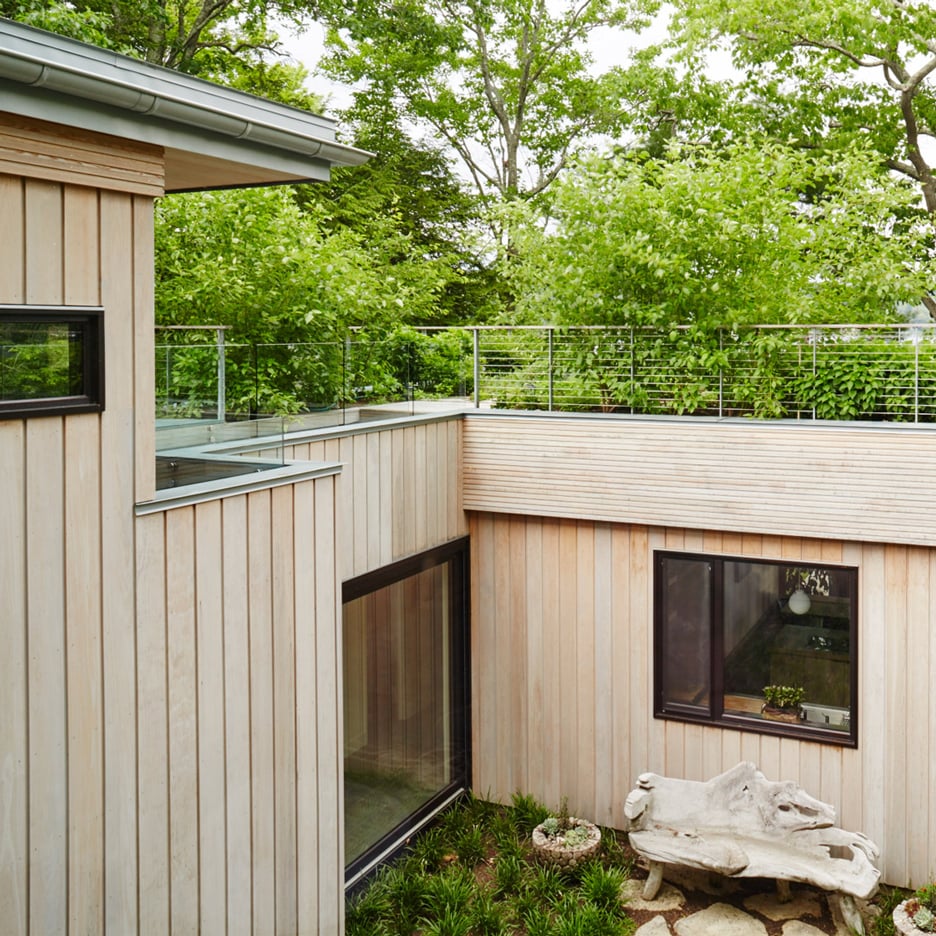
Lush greenery tops one half of this three-bedroom residence on the shore of Connecticut‘s Lake Wononscopomuc, which local studio Allee Architecture and Design created as two separate parts (+ slideshow). (more…)
Are you struggling in the summer heat? Let’s flashback to December and take a mental stroll through the ice caves at Apostle Islands National Lakeshore in Wisconsin. Accessible by foot when Lake Superior freezes over – which doesn’t happen every year – the caves are like a palace decorated with hanging blue ice formations. It’s a very cool experience. Photo by Wan Shi (http://ift.tt/18oFfjl).






 Sig Nordal