Month: April 2017

3 Surprising Tips That Will Transform Your Job Search Approach
Unemployment is tough, especially when you’re stuck in it for several months. Every day, you wake up early, get dressed, make a plan for the day, and hit the job boards only to find yourself falling short of the competition most of the time.
It’s particularly hard to stay positive during this period. Job searches are incredibly stressful. Between worrying about your lack of income, waiting to hear back from several prospects, and submitting your ninth application for the week, you have a lot going on.
A February 2015 study published in the Journal of Applied Psychology found that levels of agreeableness, openness, and conscientiousness decreased over time in unemployed participants. These things can negatively affect the way you feel about your situation.
It’s crucial to maintain a positive outlook and to take care of yourself. You need to manage your stress, stay healthy, and maintain a high level of productivity as these are the things that can help you land a job faster.
Hack Your Mind
The term “mind hacking” is increasingly popular nowadays and for good reasons. Mind hacks are essentially tricks and tips you can use to impact your cognition.
Essentially, they can help you manage your attitude. For example, if you’re frustrated in finding a work in sports, you can choose to let that negativity and hopeless feeling take over or you can reframe your perspective.
See Also: The Secret Mind Hacks That Can Change Your Life Today
Here are a few simple ways to hack your mind as well as the best job search tips worth giving a try.
Start a gratitude journal
Every morning, after you wake up, write down three specific aspects of your life you’re grateful for. They can be as simple as the bagel you’re eating or as meaningful as your loving relationship with your spouse. Happiness is a byproduct of appreciation.
Counting all the awesome things in your life helps you focus on the positives and cultivate a sense of contentment. This is crucial to staying healthy and focused during a job search.
Perform acts of kindness
You don’t have to go build houses with Habitat for Humanity (although you absolutely can) in order to spread joy in the world. Any small act of kindness will do, like buying someone’s coffee or giving a compliment to a stranger.
Write daily affirmations
Choose a negative thought you have about yourself, like “I’m not smart enough to work in sports.” Then, write out the positive opposite of that belief. It could be, “I am capable and ready to work in sports.”
Keep a few of these affirmations on hand, like in a note on your phone. Refer to them and remember them when you find yourself drowning in negative self-talks.
Create a “done list”
This is the anti-to-do list. Writing your accomplishments by the end of your day can help you celebrate all your wins, no matter how small. Plus, you can reflect on it the following morning to start your day off right. They can remind you of your daily successes.
Create a Dream Job
Can’t find what you’re looking for? Create your own opportunity.
Let’s say you want to work in sports, but you’re not finding the right career that suits your unique skills and various passions. Start by defining your career wants.
For example, you want a flexible schedule, creative freedom, and you prefer to work from home. Research your industry, then find out where you can create this opportunity.
You want to combine your photography skills, writing ability, and passion for working with people? Then start a freelance gig where you can create digital albums for athletes.
Share your work on a blog or personal website. This way, potential employers or clients will notice your passion and strengths.
See Also: How to Market Yourself During A Career Search
Seek Out Recreation
No matter how desperate your job search feels like, you still need some “me time.” Focus on two gifts you can give yourself: socialization and physical activity.
These things will help you stay happy and healthy during the stressful periods in your life.
A June 2016 report published in Medicine & Science in Sports & Exercise found that 20 minutes of moderate exercise can enhance motivation for cognitive tasks and increase feelings of energy. It can reduce feelings of confusion, fatigue, and depression, too.
Combine staying active with being social. Join running clubs and try to meet new people while engaging in exercise. These breaks away from job hunting are crucial. They can help you clear your head and feel refreshed when you return to the job boards.
See Also: Top 5 Uncommon Jobs In The US And How To Get Them
If you’re looking for work in sports, planning a major career change, or just passively looking at open jobs, make sure you add some variety to your efforts. This is one of the best job search tips that can bring a positive perspective to the process.
How are you breaking up your tedious job search?
The post 3 Surprising Tips That Will Transform Your Job Search Approach appeared first on Dumb Little Man.
A Guide to Fear Mastery
By Leo Babauta
We normally think of fear as something that’s holding us back, or something to be avoided … but what if we could see it as a powerful tool?
What if we could master that tool? We’d become masters at life, able to push through fears of rejection, failure, ridicule, and more.
Fear is normally like a barrier for us, keeping us from doing awesome things in life. Or if we push up against that barrier, we see the fear as making the experience miserable, and cringe because of it.
But in truth, fear is a useful thing. Once upon a time, fear was a signal to run from a lion or some other danger, and that was pretty useful. These days, we don’t usually have much physical danger (the lions have more to fear from us), but the same fear signals still happen, even when it’s trying to pursue our dreams or becoming vulnerable to other people.
These days, the fears aren’t physical — they’re more about not being good enough. Here are the top fears in a survey I did earlier this year:
- Fear of failure
- Fear of being inadequate
- Fear of rejection
- Fear of not being prepared
- Fear of being a fraud
- Fear of ridicule
You might notice that they are all really the same fear. The fear of not being good enough — if we’re not good enough (inadequate), we might fail, we might get rejected, we might be ridiculed, we might be found a fraud, we might need preparation because without it we won’t be adequate. Our deepest and most common fear is that we’re not good enough. That’s not physical danger, it’s all internal.
So fear, then, is no longer a signal that we should run.
Instead, fear is a useful signal that we should go toward something.
Let’s find out how.
Freedom & the Wall of Fear
Whenever we feel fear, it means we’re up against some kind of wall … on the other side of the wall is some kind of freedom.
This is a freedom we desire, and that’s a healthy thing to want that kind of freedom. But we push up against the fear, and it can hold us back because our normal response is to avoid that wall of fear. By avoiding it, we remain on the side of the wall where we stay comfortable, where we know what we’re doing, where things are easy. We’re trapped by that wall of fear, as long as we keep avoiding it.
What would happen if we pushed through that wall? We’d have freedom: the freedom to connect with others in a vulnerable way, to put ourselves out there and pursue the life of meaning we really want, to publish books and websites and podcasts and poems, to explore the world or create a non-profit organization, to make friends and love with an open heart.
Freedom is on the other side of the wall of fear. So when we feel fear, it’s actually a signal that we should go toward the fear.
Yes, it’s difficult. But avoiding it doesn’t work. It just causes more difficulty. Instead, we can go inward, and see the turmoil that’s in there that the fear is signaling, go into our cave of darkness and process whatever’s in there. That means looking at how we think we’re not good enough, trying to learn to love ourselves, learning to trust ourselves to be OK even if we get rejected or if we fail.
And we can also courageously take action, in the presence of fear.
Acting in the Face of Fear
Just because fear is present, doesn’t mean we have to run. In fact, we can practice acting mindfully even with fear in our bodies.
The practice is to notice that there’s fear, and notice our habitual reaction. Stay with the fear, and notice how it feels as a physical sensation. Notice that it’s not so bad, that we can actually be OK in the middle of that physical sensation. It’s just hormones in our bodies, just an energy of excitement.
Being in the moment, we can take action: write a book, have a conversation, go to a social event, get on stage. We can immerse ourselves fully in the moment, feeling the fear in our bodies but still doing the action.
Fear is a worry about the future, which doesn’t exist. Noticing that, we can turn back to the present moment: what’s here in front of us. We can be grateful for what’s in front of us. We can smile at it, and take action.
This takes practice. Try it now. Practice it every day: go toward whatever scares you, repeatedly. Lean into the fear. Be courageous, pushing through the wall of fear into the freedom of openness
Listen to Me on the Rich Roll Podcast
I had the honor of sitting down with the awesome Rich Roll on his popular podcast … check it out:
It was an absolute joy, and Rich is such an incredible person. I hope you enjoy the podcast.
Afghanistan: Making It Worse
Afghanistan desperately needs an overarching political strategy, which should include dialogue and diplomacy to deal with the problems that President Ashraf Ghani faces, as well as a regional strategy to counter external support for the Taliban. So far Trump’s team has only come up with excessive use of force. The capacity of the military to create lasting change remains limited. How many more lives will have to be lost before the Trump team figures that out?
1:1 Arquitetura Design Creates a Contemporary Home with Strong Character in Brasilia, Brazil

Built on downhill terrain, this beautiful and elegant house is kept well-illuminated thanks to its glass walls. Designed by 1:1 Arquitetura Design in 2016, this small home sits at 123 meters squared and is located in Brasilia, Federal District, Brazil. Its perforated brick walls give fresh air to the house, allowing it to flow freely throughout the home. Meanwhile, the design allows natural light to enter throughout the day, resulting..
America’s national parks include some of the most cherished…

America’s national parks include some of the most cherished natural landscapes and cultural sites in the world. Today is World Heritage Day and we’re recognizing a unique park with a global profile. Hawai’i Volcanoes National Park is one of the few places on Earth where visitors can safely get an upclose look at an active volcano. Witness powerful natural forces at work as Kīlauea and Mauna Loa (two of the world’s most active volcanoes) continue to add land to the island of Hawaiʻi. Photo by Janice Wei, National Park Service.
A Guide To Guilt-Free Daydreaming
You probably feel guilty, irresponsible, and unproductive when you catch yourself daydreaming during an important task. In the words of Harvard psychologist Matthew Killingsworth and his colleagues: “A wandering mind is an unhappy mind.”
On the surface, the source of this guilt and despair seems obvious. Daydreaming implies you are procrastinating — and nobody likes to waste time or be off-task. Yet, if you look more deeply at the reasons for this guilt, the scene becomes much more complex.
For example, when our minds wander, we feel freer. As philosopher Søren Kierkegaard pointed out, freedom may seem appealing, but it also causes anxiety. This anxiety makes us feel dizzy as if we are without “gravity” when our minds are adrift.
Psychology researcher Jerome Singer confirmed that this type of guilty daydreaming is no good for us. Yet, as he also pointed out, daydreaming can be spectacularly great — but only if we do it the right way.
Daydreaming The Right Way
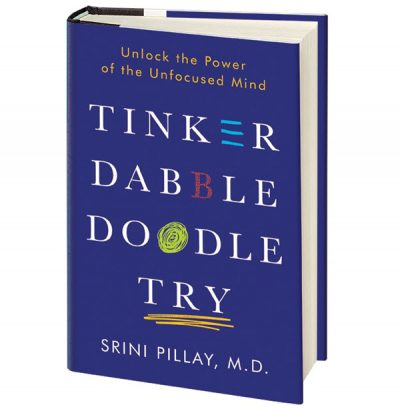
In my book, “Tinker, Dabble, Doodle, Try,” I explained in detail how daydreaming can lead to glorious outcomes with a few tweaks.
What you want to aim for is called positive constructive daydreaming (PCD) — also known as “daydreaming that rocks!” These sessions of unfocusing can be spontaneous or planned, and they will ultimately make you feel more self-aware, more creative, and far less bored.
When you engage in PCD, you give your focused attention a break and allow yourself to plan and rehearse what’s to come. In other words, if you allow yourself to constructively daydream, you are likely to realize things about the future that you would miss otherwise.
Let your mind wander on a leash; it will lead you to the jewels of self-awareness and illuminate missing information hidden in your brain. When you find these clues, you can connect the dots of your past and present to construct a more accurate prediction of the future.
How to Engage in PCD
PCD is drastically different from the guilty daydreams you suddenly slip into, like the ones about last night’s shenanigans instead of tomorrow’s big meeting. Here are four steps to help you master daydreaming psychology.
Start by planning
Planning a daydream may sound counterintuitive. Just think of it as taking the time to plan a skydive rather than spontaneously jumping out of an airplane.
When you consciously set aside time to daydream, you avoid the shock and dismay of unexpected mind-wandering.
Turn your attention inward
You spend most of the day engaging the world with your senses, which means the majority of what you learn comes from the outside.
Daydreaming is all about closing the door on perception and turning your attention inward. Closing your eyes may help you get disconnected faster.
At first, it may feel like your mind is simply going on a wild goose chase. But, studies show that this is simply your brain’s planning mechanisms just under the radar. If you find it difficult to turn inward at will, try marking the switch with a relaxing chair tilt or a much-needed walk to the window.
Do something low-key
You may think of daydreaming as total downtime, but a recent study claimed otherwise. Daydreaming actually has the potential to improve your creative ability.
Doing nothing at all or something that takes up too much attention will be less effective, so try knitting, gardening, coloring, or light-hearted doodling while you daydream to get your creative brain charged.
See Also: Top Tips On Training Your Brain To Be Creative
Overcome the vomit response
Social psychologist Jennifer Mueller and her colleagues found that although we laud the attributes of a creative mind, we are actually predisposed to hate our own creativity. This goes particularly true during times of uncertainty.
Our brains, without overt warning, associate the word “creativity” with “vomit” and “agony.” Someone else being creative may feel like music to your ears, but once you start to become creative yourself, the music metaphorically becomes haunting and disturbing.
It’s crucial to acknowledge the fact that creativity will cause your stomach to churn. When you find yourself feeling queasy, recognize why you feel this way and keep on truckin’.
The Lowdown
So, what’s the earth-shattering lowdown here?
• Daydreaming can improve your focus, creativity, and self-awareness. It can also help you envision and prepare for the future.
• Set aside a time in your day to veg out.
• Turn your attention inward by switching off your perceptions. Close your eyes to get a quick start.
• Do something low-key or don’t do anything.
• Beware of your brain’s tendency to resist, and use self-talk to tell it to chill. Sit back, relax, and daydream yourself to success.
See Also: 5 Top Weird Brain Facts
The post A Guide To Guilt-Free Daydreaming appeared first on Dumb Little Man.
Imagine Wanting Only This
Type the word “nothing” into a Google search, and up pops “Nothing Gold Can Stay,” with more than six and a half million results for Robert Frost’s treasured eight-line poem, first published in 1923. Kristen Radtke’s haunting graphic memoir, a melancholic meditation on impermanence, essentially drops the qualifier “gold” from Frost’s assertion.
In Imagine Wanting Only This, Radtke reminds us repeatedly that loss is the only constant the world has to offer. Her mantra is, “We forget that everything will become no longer ours.” It’s a point of view catalyzed by the loss of Radtke’s beloved youngest uncle, who died of a rare congenital heart disorder while she was away at college — a disease she has also inherited.
After her uncle’s death, Radtke, a native of Wisconsin, became obsessed with blighted cities, abandoned mines, and war ruins that reflect the transitory nature of even tarnished things, whether natural or manmade. She’s fascinated by what’s missing and what’s left behind. To her chagrin, she discovers that even memorials don’t last — including the makeshift one she inadvertently transgresses when, as an undergraduate visiting a derelict abandoned cathedral in Gary, Indiana, with her boyfriend, she takes home a pile of ash-strewn photographs — which she later learns were part of a tribute to a young photographer who died at twenty-three when hit by a freight train he was photographing.
In combining a bildungsroman with a record of her ardent pursuit of ruins around the world, Radtke’s debut exemplifies a growing trend in memoir — Lauren Elkin’s Flâneuse is one recent example — in which an author’s personal story is interwoven with research and reporting on a subject that has captivated her attention and shaped her life.
Imagine Wanting Only This is also part of another significant trend among memoirists — one that puts the graphic back in autobiographical narrative. Standouts include Alison Bechdel’s Fun Home, David Small’s Stitches, Marjane Satrapi’s Persepolis, and Roz Chast’s Can’t We Talk About Something More Pleasant? Although there’s a movement to call these books by the plainspoken term “comics,” I prefer “graphic literature,” since comic strips, with their connection to cartoons and the funnies, imply a form driven by humor — which these memoirs decidedly are not.
Whatever you choose to call it, Imagine Wanting Only This effectively meshes a distilled, starkly confessional, probing text with an equally eloquent visual element. It’s hard to imagine this book without Radtke’s darkly expressive black-and-white ink-washed drawings, through which she often zooms in on telling details — a high-heeled pump when the author is in professional mode, delivering a talk in Iceland on filmmaker Chris Marker; a forlorn bundle of mail awaiting her in Iowa City on her return from a research trip; a fragment of an iPhone screen, old newspaper clipping, or medical report conveying disturbing news.
Radtke’s artwork evokes movie stills more than comic strips, panning cinematographically from full-page landscapes to tightly framed close-ups and intense conversations (often on cellphones). She frequently holds an uncomfortable focus on herself through multiple frames as she struggles with difficult emotions, conveying, for example, her ambivalent feelings after she becomes engaged to her college boyfriend. There are many lovely, pensive self-portraits lit by the glow of a computer or phone screen, while bird’s-eye views of her anxiety-wracked insomniac nights suggest a restless, caged animal.
The overall mood is of brooding loneliness. This is often captured in panoramas of solitary walks in which the author is depicted as a small human presence against a vast backdrop. The strikingly effective cover drawing shows her dark, silhouetted, luggage-toting figure from behind, gazing out the large picture windows in a Detroit airport terminal over dark, abandoned high-rise buildings in the distance, one of several “calcifying rust-belt cities” she tries to fathom.
Radtke acknowledges that “ruinophilia” and “ruin porn” have become hip even as her obsession with deserted, forgotten sites fuels her travels through Europe, Southeast Asia, and the American West. The travelogue portions of her book, while less compelling than her moving evocation of her relationship with her uncle, capture the insatiability of her search. “It felt like I had to see everything, as if it was the only way my life would count or matter,” she writes.
This restless ambition to find answers “or at least information” about the transitory nature of existence defines Radtke’s profoundly contemplative book. “Am I supposed to want children who will mourn me or husbands I will watch lowered into the ground or houses I will endure in their emptiness?” she asks, blatantly demonstrating the kind of failure to stay in the moment that would make a Buddhist cringe. She is a disaster scenarist who, after moving to New York City, pictures its streets and subways flooded. Why? Could it be defensive, to steel herself against further loss? Or a nod to Blaise Pascal, whose Pensées so eloquently reminded us of our minute place in a vast universe?
Radtke doesn’t shy from these big, potentially overwhelming questions. Yet her takeaway offers some measure of comfort: By accepting that “someday there will be nothing left that you have touched,” you may have an easier time accepting that none of us, and none of the losses, are important. After all, in the end, all is ephemeral: Nothing gold can stay. Imagine wanting only what’s here, now. Besides, she adds, “Who knows what will be significant when we have all moved on to whatever is waiting or not waiting?”
The Barnes & Noble Review http://ift.tt/2oIznSn
A Rural Home in Morciano di Leuca, Italy

This building, surrounded by olive trees and framed by wonderful stone walls, was designed by Luca Zanaroli architetto in Morciano di Leuca, Italy, in 2011. The intention of the designer was to achieve the right landscaping and maintain the integrity of the place without altering the space. The interior attempts to maintain the dialogue with its surroundings through large openings and glass walls with views of the countryside, through which..
The post A Rural Home in Morciano di Leuca, Italy appeared first on HomeDSGN.
Jacksonville Zoo – Florida – USA (by David Ellis)

Jacksonville Zoo – Florida – USA (by David Ellis)
 Sig Nordal