Month: April 2017

Here’s something you don’t see everyday. Three Canada geese…

Here’s something you don’t see everyday. Three Canada geese flying through a rainbow at Morris Wetland Management District in Minnesota. Made up of 245 small parcels of wetlands and grasslands scattered throughout an eight-county area, the Morris District restores and protects enough wetland and grassland habitat to meet the needs of prairie wildlife and breeding waterfowl, as well as providing places for public recreation. Photo by Alex Galt, U.S. Fish and Wildlife Service.
A Beginner’s Guide To Personal Development

What is personal development? How can it change your life?
Personal development can be difficult to explain to someone who hasn’t started his journey yet. Conversations around this topic can often create more confusion than clarity.
To help you figure out exactly what it means, here are the basic concepts of personal development you need to know about.
Sharpening the saw
In Steven Covey’s 7 Habits of Highly Effective People, he describes a concept that is an excellent first stop for all personal development practices. It’s called sharpening the saw.
The premise is based on this analogy:
If you’re sawing through a log and never stop to sharpen your blade, it’ll likely be an arduous task that will ultimately lead to failure. But, if you take the time to sharpen your blade, you’ll get through the process quicker and with less effort. Although it may take you away from your goal momentarily, it’s more likely to give you a successful result.
In today’s fast-paced lifestyle, it’s easy to feel like you don’t have enough time to sharpen your saw. Personal development highlights the importance of tuning yourself up mentally, and how that can help you achieve your goals faster.
Paradigm Shift
A paradigm shift occurs when you view a piece of information from a totally new perspective that flips your entire view of it.
Here is my personal experience:
I never invested in self-education, which is essentially ‘sharpening my saw’ from point one. I never really learned how the mind works, and how I could utilize it to become successful.
A few life events occurred that made me question everything. I was adamant that a current mechanic and high school drop out would not become successful. I knew it was possible to learn skills but believed it wouldn’t work for me because I was unlucky. It’s like the more I planned, the more horribly it all went awry.
From that point, I realized that I needed a big paradigm shift to open my mind to possibilities. I needed to change the way I look at life and how I can make things work in my favor.
A year after this shift, I was a self-made millionaire.
That is personal development. It’s what can change your mind and point of view about reality. It is what can convince you that if you just believe, you can achieve absolutely anything you desire.
See Also: 5 Women Entrepreneurs Who Failed Before Becoming Millionaires
Psycho-Cybernetics
I learned about the concept of Psycho-Cybernetics from Maxwell Maltz, an internationally renowned Plastic Surgeon who performs disfigurement surgery and documents his follow-ups. He found out that majority of post-surgery patients walk around as if they still have their disfigurements and all the internal baggage they come with.
Like those patients, we generally build our self-images through negative life experiences and act as if they are the truth.
So, if your self-image involves being blue-collar worker earning $36K a year, that’s pretty much what you’ll aspire for. That idea can greatly limit your potential.
On Starting With Your Personal Development
What is personal development?
In essence, it highlights the power of self-affirmation and mental visualization and how these things can connect your mind and body. Acknowledging the importance of your inner thoughts about yourself is an essential step in every personal development journey.
To change your life, you must change how you think of yourself. Once you become successful with that, your life will change to match your perception.
These principles are an excellent start to understanding what personal development is. Once you start seeing life through these concepts, you’ll be able to peel off the negative layers of your inner self-image.
By instinct, you’ll start changing your perspectives and seek out people with a similar mindset. You’ll start to realize that you have the willpower you thought you didn’t have before. You’ll have emotional resilience and confidence in making decisions.
Personal development starts with the premise that you are perfect. It’s understanding that, with your mind and body, you have the power to achieve anything you desire.
We are all born to prosper. Once you find the courage to start, that’s exactly your cue to start your journey.
See Also: 3 Fundamental Personal Development Steps You Need to Take
The post A Beginner’s Guide To Personal Development appeared first on Dumb Little Man.
Comfortable and Cozy Apartment in Tokyo, Japan

Done in a subtle and simplistic style that envelops visitors upon entrance, this small apartment can be found in Tokyo, Japan, and was recently renovated by the architectural firm Design Studio Minorpoet. Perhaps the most striking feature of its design are the light, matte wood doors behind which is hidden a small and very simple kitchen, which provides a wealth of storage space. Its floors, made of very light wood,..
The post Comfortable and Cozy Apartment in Tokyo, Japan appeared first on HomeDSGN.
Grand Canyon National Park – Arizona – USA (by Elizabeth…

Grand Canyon National Park – Arizona – USA (by Elizabeth Haslam)
Al Beadle Remodels a 1989 Desert Home in Scottsdale, Arizona

We are received by this beautiful house with an exquisite design in its desert-like outdoor gardens. Designed by Architect Al Beadle, the home is located in Scottsdale, Arizona, USA. The house, with an area of 2,686 square feet, dates back to 1989 and was only just recently restored. The house, which retains a retro style, has outdoor areas where we can enjoy a swimming pool with terraces on different levels…
The post Al Beadle Remodels a 1989 Desert Home in Scottsdale, Arizona appeared first on HomeDSGN.
9 Stats About Small Business Digital Marketing in 2017
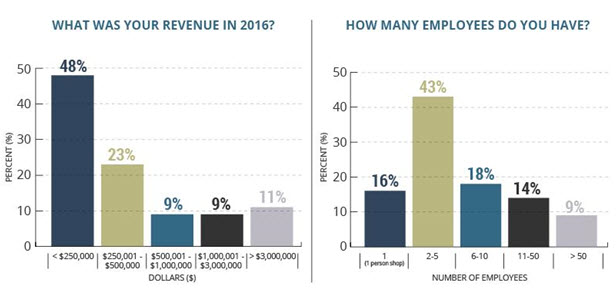
In order to help small business digital marketing agencies and SEO professionals effectively forecast this year’s online marketing trends, white label SEO company HubShout conducted a survey which collected data on the digital marketing investments of small- to mid-size agencies.
This report details the online marketing data for 2017 and compares it to the data taken from HubShout’s 2016, 2015, and 2014 surveys. Before exploring the findings, however, it is important to note the range in size and revenue of the agencies represented in the survey:
Size
Of the respondents, 43% had between two and five employees while 16% were entirely run by one person. Only 9% of the agencies that participated in the survey employed more than 50 people.
Revenue
These small- to mid-size agencies tend to have limited budgets, which becomes clear when reviewing their 2016 revenue. Nearly half (48%) reported a revenue of $250,000 or less last year and 23% of the surveyed businesses earned between $250,001 and $500,000.
Digital Marketing Expenditure
The survey posed the question, “What did your typical client spend per month on online marketing?”
Comparing the responses to this question over the past three years, a pattern is clear: small- to mid-size businesses are boosting their digital marketing expenditures.
Back in 2014, more than one-third of these businesses invested $500 or less each month. However, that cohort dropped to 20% in 2015. Last year, only 14% invested such minimal funding.
When asked to predict how their clients’ budgets will change in 2017, 63% of respondents replied that they expected online marketing expenditure to increase.
Digital Marketing Budget Allocation
Search engine optimization (SEO), website development, pay-per-click (PPC) advertising, social media, and email marketing are the five areas essential to an online marketing campaign. While small- to mid-size businesses tended to invest most extensively in web development in the past, 2016 turned out to be a big year for SEO.
See Also: The 5 Internet Marketing Trends That Will Dominate in 2017
For the first time ever, survey respondents reported that 30.3% of their online marketing budget went to SEO while 28.4% went to web development.
What’s in store for 2017?
Of the agencies surveyed, 35.7% predicted that SEO will be the most sought after service once again, beating out web development and PPC for the second consecutive year.
Revenue Generation
HubShout asked survey participants which services generated the most revenue for them.
SEO and web development tied for the top spot, with 31.6%. The rest were reported as follows:
PPC — 12.3%
Content Marketing — 10.5%
Other — 8.8%
Social Media — 3.5%
Email Marketing — 1.8%
Outsourcing
SEO is one of the most common services that’s likely to be outsourced to a third party firm. In 2016, 68% of agencies outsourced SEO and this was 1% higher than the numbers from 2015.
Website development, on the other hand, is being outsourced by fewer and fewer marketing agencies. While over 50% outsourced web development in 2015, only 24% of agencies did that last year.
Yet, digital marketing budget allocation trends show that businesses are still investing in web development. With fewer agencies outsourcing this service, it’s easy to conclude that more are choosing to set up in-house web development and design departments.
After all, compared to the dynamic nature of SEO, creating and selling a website is a much simpler task.
Mobile-Friendly Websites
Optimizing a website for mobile use is more important now than ever before, especially since Google has begun experimenting with mobile-first indexing. In order to gauge respondents’ levels of understanding and implementation, HubShout asked the following question:
“What percentage of your clients have mobile-friendly websites with a phone number, location and business hours prominently displayed for mobile users?”
A full 50% of survey participants replied that 100% of their clients met the outlined criteria.
Almost all (98%) of the respondents said that they value the importance of having a mobile-friendly website. The 2%, on the other hand, which do not inform their clients of the said pieces of information do not provide SEO services at all.
The 2017 Outlook
HubShout’s findings paint a fairly positive picture for digital marketing professionals selling their services in 2017. SEO firms, in particular, will still be in demand as Google continues to alter and update its algorithm.
Marketing agencies that cater to small- and mid-size businesses may also see their revenues increase as more of these companies begin to allocate funds to online marketing initiatives.
The post 9 Stats About Small Business Digital Marketing in 2017 appeared first on Dumb Little Man.
April 24th
I had already found that it was not good to be alone, and so made companionship with what there was around me, sometimes with the universe and sometimes with my own insignificant self; but my books were always my friends, let fail all else.
Unconscious Bias: 3 ways your brain is unknowingly holding you back (and what to do about it)

You’re reading Unconscious Bias: 3 ways your brain is unknowingly holding you back (and what to do about it), originally posted on Pick the Brain | Motivation and Self Improvement. If you’re enjoying this, please visit our site for more inspirational articles.
“A life lived of choice is a life of conscious action. A life lived of chance is a life of unconscious creation.” – Neale Donald Walsch
We usually think of our brain as our greatest asset.
It’s what makes us human and allows us to grow and learn. However, the more we begin to understand the complex link between our psychology and our physiology, the more we start to see that a lot of the time, our brains are actually holding us back.
This is because we live in a world vastly different from the one our brains evolved in. As a result, we can have a number of issues with things such as confidence, anxiety and even just rational decision making.
Fortunately, by taking a clear look at ways in which our brains might be holding us back, we can start to develop and utilize the more rational parts of our mind, and free ourselves from these barriers.
Here are three common ways your brain might be holding you back (and what to do about them).
- Self-judgement Fatigue
Self-judgement fatigue occurs when we spend a disproportionate amount of time critically looking at ourselves and questioning out abilities. All the energy that could be invested towards completing a task is wasted on our own rumination.
Key Takeaway:
When you notice a self-judgement, label it as such, simply recognise that it’s trying to help you (this is a key aspect of Acceptance and Commitment Therapy), but that it’s a thought that is taking away your energy and is not necessary. From there try to make decisions with less hesitation, and direct your focus outwards towards a task as opposed to inwards towards yourself.
- The Someday Fallacy
This is when we put too much reliance on our future self. The underlying belief here is that our future self will be more inspired to act than our current self. Unfortunately that’s never really the case and most people live a life where their dreams get relegated to the ‘someday pile.’
Key Takeaway:
Learn to take action now and not expect that your future self will take care of things for you. Assume that in the future there’s a high probability that you’ll be less likely to do something than you are now. One effective way to overcome the someday fallacy is to be meticulous with goal setting; tracking dates and milestones to measure your progress objectively and see where you’ve been putting things off.
- Mood-congruent Memory Bias
This happens with all of us, almost all of the time, to varying degrees.
There’s an old saying “when it rains it pours” which basically means when things are good they’re really good, but when things are bad they’re really bad. However, this is actually a cognitive bias, rather than a statistical truth.
The reason behind this is because when things are going well we’re better able to retrieve memories related to other times when things were going well, however when things are going poorly, we tend to remember other times when things were going poorly.
This is particularly dangerous for anyone who suffers from depression or bipolar disorders as they can get stuck in negative or manic cycles of thought as their mood colors their memories and therefore their experience.
Key Takeaway:
Keep a journal and track your moods and actions. Make it a habit to complete important tasks independently of how you feel. Whether you’re motivated and inspired, or sick and tired, try to be as consistent as possible and not get swept up relying on your feelings for momentum.
Attention Pick the Brain Readers!
Would you like to learn more about how your mind is holding you back?
Then take our FREE psycho-metric style personality quiz and receive feedback based on your psychological profile:
How Well Do You Know Your Unconscious Mental Barriers?
Ben Fishel is a freelance writer, and the creator of Project Monkey Mind – a blog that delves deep into psychology, spirituality, and the mind, and offers practical wisdom for the digital age.
Don’t forget to follow Project Monkey Mind on Facebook!
You’ve read Unconscious Bias: 3 ways your brain is unknowingly holding you back (and what to do about it), originally posted on Pick the Brain | Motivation and Self Improvement. If you’ve enjoyed this, please visit our site for more inspirational articles.
 Sig Nordal