To commemorate the forty-eight men they lost in the battle of 1901—or perhaps to avenge them—American troops brought the three bells of Balangiga home from the Philippines with them. When President Donald Trump travels to Asia this November, he will meet with the president of the Philippines, Rodrigo Duterte, who recently called for the return of the bells. At the heart of the dispute is the question of how we ought to remember a little-known, inglorious war in which American and Filipino troops alike committed acts of valor and war crimes.
Author: signordal
The Meeting
Don had longed to go to a big meeting for a long time. He had prepared in front of the mirror talking to and admiring himself. After two months he felt strong and proceeded to the meeting. Then someone called him an idiot, Don started crying and ran home to his friend, the mirror
Just a memory…

via Bits Of Wisdom http://ift.tt/2zD8xAi
You were born to make mistakes…

via Bits Of Wisdom http://ift.tt/2iNMuiq
18-Year-Old Photographer Captures the Sublime Beauty of Majestic Mountainscapes

“Treasure island in the land of golden larches.” Isola, Graubunden, Switzerland
Eighteen-year-old Swiss photographer Fabio Zingg first became interested in photography during a family vacation two years ago, when he admittedly picked up the camera out of boredom. Since then, he has become a member of The Alpinists: a group of nine young photographers from Switzerland who explore the Alps together. From Monday to Friday he works in an office as a commercial banking apprentice, but on the weekend he explores the epic summit heights of the world’s most beautiful mountain ranges, camera in tow.
“It is always a new adventure, and I am always impressed with how beautiful nature is,” says Zingg. His adventures have taken him to Italy, where he explored the Dolomites; Canada, and it’s dense, misty woodlands; Norway, with it’s impressive fjords; as well as the stunning mountains of his native Switzerland.
Zingg’s photos capture an astute appreciation of the world around him, showing consistency of tone and color that one would expect from a more mature photographer. We see rich, golden woodlands, stunning azure waters and in some shots, a person in a vibrant red jacket, emphasizing the scale and beautifully contrasting against darker, moodier hues. Zingg explains, “The larger a mountain appears and the smaller the person is, the more it becomes clear how small we truly are.”
Zingg isn’t one to keep this amazing editing to himself, though. Thanks to a recently released collection of Adobe Lightroom filter presets, anyone can now achieve his deep tone aesthetic. Keep up to date with Zingg’s epic adventures on Instagram.
18-year-old Photographer Fabio Zingg beautifully captures the incredible Swiss mountain landscapes.
“Consider a tree for a moment.” Bellwald, Switzerland.
“Moments of silence, freedom and innert peace.” Triftsee Lake, Switzerland.
“Mighty Piz Languard as the first sun light hits the peak.” Piz Languard, Switzerland.
“Pre winter vibes at Lake Derborence.” Derborence, Switzerland.
“Calm golden mornings in the Swiss Alps.” Derborence, Switzerland.
“The man in the fog.” Switzerland
He’s also travelled to the fjords of Norway.
“The famous Preikestolen right before the sun rose.” Preikestolen, Norway
“Moments at the rough Fjords.” Odda, Norway.
The misty Italian Dolomites…
“Mighty misty Dolomites.” Tre Cime di Lavaredo, Italy.
“Tre Cime in all it’s glory.” Tre Cime di Lavaredo, Italy.
…as well as Canadian woodlands…
“Canadian vibes.” Banff, Alberta.
…and the ramped cliffs of the Faroe Islands.
“Sunrise at the green Faroese Coastline.” Faroe Islands.
Fabio Zingg: Instagram
My Modern Met granted permission to use photos by Fabio Zingg.
Related Articles:
More Incredible Entries From the 2017 National Geographic Nature Photographer of the Year Contest
Photographer Travels by Boat to Capture Ghostly Photos of Greenland’s Arctic Landscape
Cinematic Photos Captured in Naturally Dramatic and Diverse Landscapes of Iceland
Incredible Photos of Japan’s Natural Landscape That Look Like Watercolors
The post 18-Year-Old Photographer Captures the Sublime Beauty of Majestic Mountainscapes appeared first on My Modern Met.
Quick Guide to the Rule of Thirds for Artists and Photographers
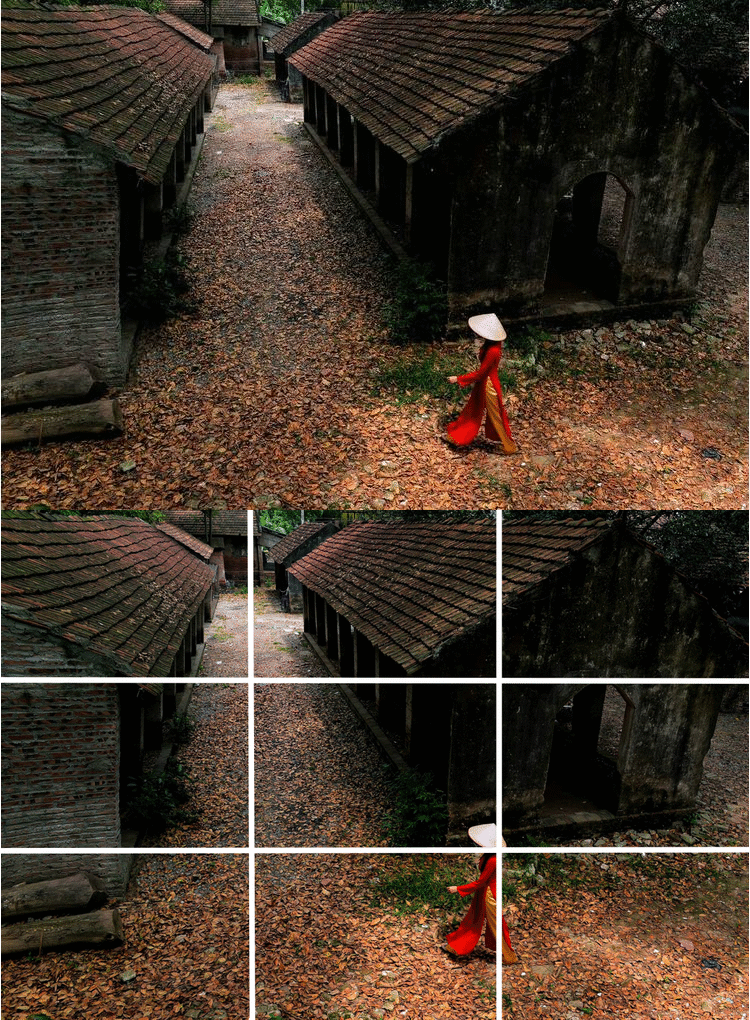
Most creatives, from painters to photographers, will have come across the Rule of Thirds at some point. Anyone who deals in producing visually appealing work will have had this golden guideline pushed on them in order to achieve a balanced composition. But what is the Rule of Thirds? And where does it come from?
What is the Rule of Thirds?
The Rule of Thirds is a general guideline for how to create an interesting composition which states that any image—painting, photograph, graphic design—should be broken into a grid with two vertical and two horizontal lines, creating nine equally proportioned boxes. Important compositional elements should then be placed either on the lines or at their intersections. This results in dynamic, interesting compositions that draw the viewer’s eye across the scene.
This technique is often employed in landscape painting and photography, but really can apply to any genre. As one of the beginning rules of composition taught to visual artists, it’s a quick and easy way for anyone—from beginner to expert—to improve the visual impact of their work. And while today the Rule of Thirds is most often associated with photography, it should come as no surprise that it originates from painting.
One of many compositional tricks that artists use, the Rule of Thirds was first written down in 1797, when an author quotes English painter Sir Joshua Reynolds. In discussing the balance of light and dark in an artwork, Reynolds refers to the Rule of Thirds, discussing it as a more general principle of balance. It would later be transformed into the grid system we know today.
An easy way to see if artwork—whether your own or by others—follows the Rule of Thirds is to lay a grid over the final image. If you don’t feel like making the simple calculations, you can download a grid.
Rule of Thirds in Painting
Photographers aren’t the only ones who use the Rule of Thirds. Long before the world’s first photographs, famous artists frequently employed the technique in order to achieve harmony and balance in their compositions. Let’s look at three different artists across different genres to see how they all applied the Rule of Thirds to great effect.
Johannes Vermeer
‘A Maid Asleep’ by Johannes Vermeer (ca. 1656–57)
This early painting by Vermeer shows a use of the compositional trick by the manner in which the sleeping maid’s head lines up with the upper horizontal line. Interestingly, the top of the jug on the table matches with the lower horizontal line, creating a pleasing distance between foreground and background subject. Even the door cracked open has a compositional purpose. The door itself fall exactly on the right vertical line running through the painting. These choices, combined with Vermeer’s use of light and shadow, lend dramatic tension to this seemingly everyday scene.
J.M.W. Turner
‘The Fighting Temeraire’ by J.M.W. Turner (1838)
This famous landscape painting by acclaimed English Romantic painter J.M.W. Turner makes great use of the Rule of Thirds. Not only does the horizon fall on the lower horizontal line, the ships intersect along the first vertical line. Placing the ships slight off center gives the piece a sense of dynamic movement that helps make it one of Turner’s most acclaimed paintings.
Pierre-Auguste Renoir
‘On the Grass’ by Pierre-Auguste Renoir (1873)
Impressionists may be known as rule breakers, but that doesn’t mean they didn’t practice the fundamentals of good composition. Renoir’s 1873 oil painting, now part of the Barnes Foundation in Philadelphia, shows the careful placement of his subjects, letting them hit along multiple lines in the grid. Renoir’s masterpiece is a good reminder of how the Rule of Thirds can be used to create natural groupings of people within a composition.
The post Quick Guide to the Rule of Thirds for Artists and Photographers appeared first on My Modern Met.
Artist Creates Tattoos That Combine a Love of Vintage Illustrations and World Travel

Multi-talented French artist Franck Pellegrino is known for his illustrations, graffiti art, and tattooing. Originally from Lyon, and now living in Paris, he’s part of Bleu Noir tattoo studio, where he inks clients with permanent pieces of his monochrome, travel-inspired artwork.
Pellegrino began his creative career as a graffiti artist at age 15, and first starting tattooing around six years ago. Using black ink, his graphic style is reminiscent of traditional illustrations from the 19th century. He often mixes iconic typography with motifs such as aeroplanes, vintage stamps, emblems, bank notes, and historical architecture. He incorporates memories from client’s adventures—to places like New York, Mexico, Paris, Portugal, and Tokyo—using his characteristic fine lines and subtle dot work.
Keep up to date with Pellegrino’s work on Instagram.
Tattoo artist Franck Pellegrino creates travel-inspired tattoos in black fine lines and dot work.
He mixes iconic typography with vintage motifs, such as old stamps and cultural emblems.
Franck Pellegrino: Website | Instagram | Vimeo
h/t: [Fubiz]
All images via Franck Pellegrino.
Related Articles:
Half-Sleeve Tattoos Cover Arms in Mythical Landscape Illustrations
Illustrated Poster Reveals the Meanings Behind Traditional Sailor Tattoos
Artist’s Illustrative UV Tattoos Come to Life and Glow Under Blacklight
Classic Paintings Reimagined as Tattoos Infused with Korean Art Techniques
The post Artist Creates Tattoos That Combine a Love of Vintage Illustrations and World Travel appeared first on My Modern Met.
On Veterans Day, we say thank you to all the men and women who…

On Veterans Day, we say thank you to all the men and women who have served in our nation’s armed forces. Memorials across the country honor our brave veterans and make sure that we never forget their dedication and sacrifice. Photo of the Korean War Veterans Memorial on the National Mall and Memorial Parks in Washington, D.C. courtesy of Nathan Jones.
Hugh Edwards: Curator, Mentor, Friend
By the spring of 1962, when I met him, Hugh Edwards had been responsible for more than twenty exhibitions at the Art Institute of Chicago, including a selection by Edward Weston and a survey of Alexander Gardner’s Civil War pictures. On a visit to the museum after we had met, he said to me, “Go downstairs and see that show.” It was Robert Frank’s first solo exhibit.
Talking…

via Bits Of Wisdom http://ift.tt/2zB48ho
 Sig Nordal