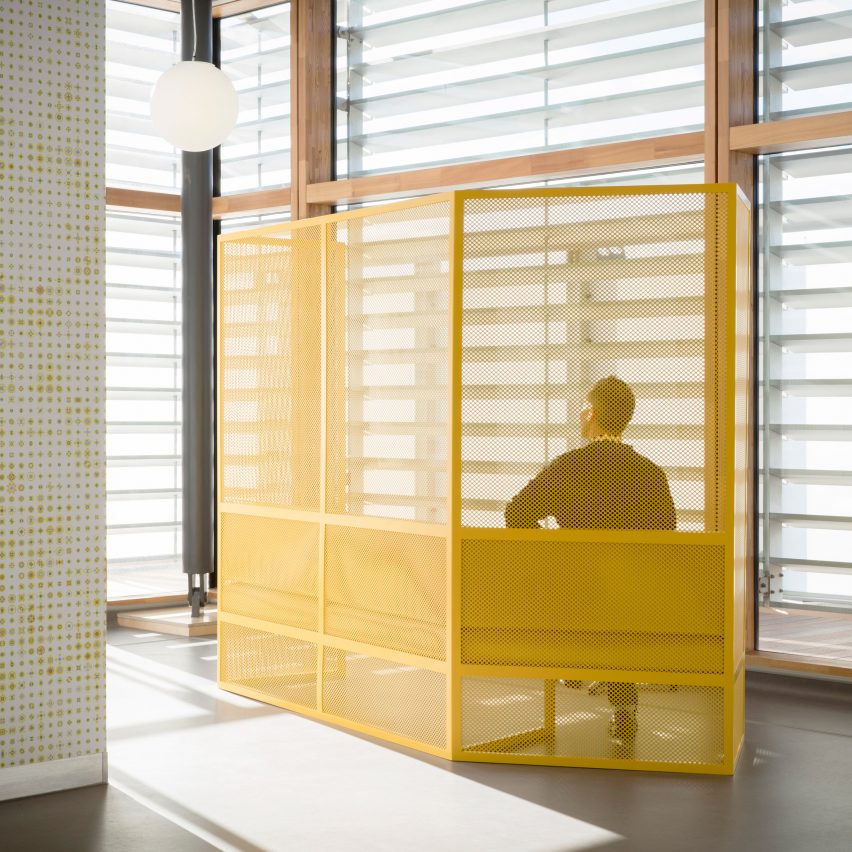
German designer Gitta Gschwendtner has created the furniture for a dedicated cancer treatment centre at Guy’s Hospital in London, completed by Rogers Stirk Harbour + Partners earlier this year. Read more
German designer Gitta Gschwendtner has created the furniture for a dedicated cancer treatment centre at Guy’s Hospital in London, completed by Rogers Stirk Harbour + Partners earlier this year. Read more
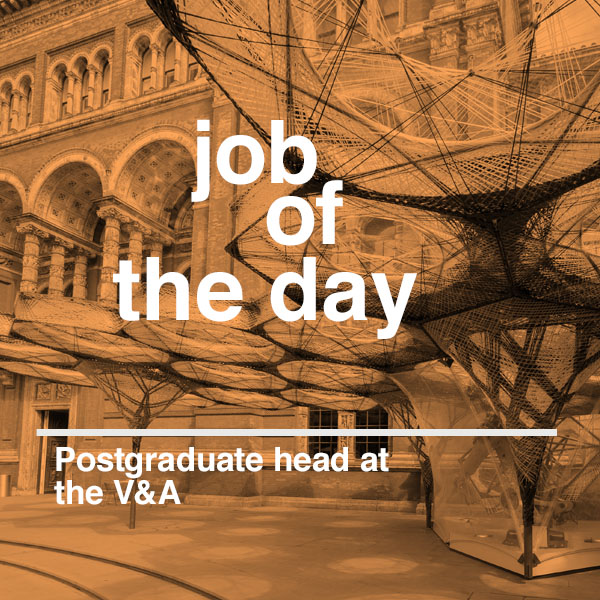
Our job of the day from Dezeen Jobs is for a head of postgraduate programme at London’s V&A museum, which recently hosted a robot-fabricated pavilion inspired by the wings of beetles (pictured). Read more stories about the V&A or browse more architecture and design opportunities on Dezeen Jobs.

Adjaye Associates, alongside development manager Alchemi Group, have submitted a planning application for 5 Strand, a mixed-use scheme adjacent to London‘s iconic Trafalgar Square. Inspired and informed by the surrounding historic buildings, the new 5 Strand will include 62,000 square feet (5,760 square meters) of office space, 26 apartments, and two ground-level retail units.
The design’s most striking element is the repeated arches which make up the facade. This feature “draws from the architectural rhythms and forms of the context,” states David Adjaye in a press release, “to produce something both modern and contextual, elegant and distinctive.” The arches can be seen on all facades of the building, and on the undercroft which provides a separate entrance to the apartments from Craven Street. However on the front facade, which responds to the more “ceremonial” buildings on the Strand and Trafalgar Square, the arches are joined by columns to give the facade increased depth and complexity.
Given the project’s sensitive location within the Trafalgar Square Conservation Area, the design development extended over 12 months, with Adjaye Associates consulting with Westminster City Council, Greater London, WCC Highways Department, St James’s Ward, Historic England, Westminster Society, The Grand Buildings, and Northbank BID.
“The opportunity to work on the Strand, adjacent to the iconic Traflagar Square, is an immense honour and one that I do not take lightly,” said David Adjaye. “My team and I have undergone rigorous investigation into the history and development of this crucial piece of London’s urban fabric.”
News via Adjaye Associates.
I recently read two things that gave me the idea for this post. The first one is a summary of Disrupt Yourself by Whitney L. Johnson. The second one is the autobiography of Ray Kroc, the man who built McDonald’s. Both of them taught me an important lesson:
To move to the next level in life, you may need to disrupt yourself.
The concept of disruption was popularized in the business world by a book titled The Innovator’s Dilemma by Clayton Christensen. It tells the stories of how big companies failed because of disruptions in their businesses. They couldn’t see a new wave coming. Or they saw it, but they hesitated to change because that would mean sacrificing their cash cow. As a result, many of them went out of business.
Disrupt Yourself applied this concept to an individual’s career. In essence, it says that you need to disrupt yourself every now and then to adapt to new situations. You can’t just stay the same. You can’t just stay in your comfort zone. You need to change in order to thrive.
The story of Ray Kroc shows this principle in action. He was a person who was willing to disrupt himself. He knew that things would change and therefore he would have to change as well. Consequently, he was always alert to new waves.
There were multiple disruptions throughout his career, but the most famous one is his decision to build McDonald’s. At that time, he already had a comfortable job selling milk-shake mixing machines. But he saw that the demand for the machines would drop in a few years, so he opened his eyes for a new opportunity before it’s too late.
The opportunity came when he heard good reports about a restaurant operated by McDonald brothers. The reports made him curious, so he flew out to check it out himself. Impressed by what he saw, he then negotiated with the brothers to expand their restaurant to new places.
It was a disruption in his life. In his own words, he had to “slave away” to build McDonald’s. He had to leave his comfort zone behind and faced a lot of resistance. But he did it. The result is McDonald’s that we know today.
It’s easier said than done, but we need to learn to disrupt ourselves. We need to learn to change the way we do things. That’s how you can enter a new season in your life and move up to the next level. You can’t expect something new if you just do what you have always been doing.
#####
P.S. I have a special offer coming on Black Friday (Nov 25). Stay tuned!

Partly within the Los Angeles city limits, Santa Monica Mountains National Recreation Area in California is home to a small population of mountain lions. National Park Service researchers have monitored more than 50 mountain lions in the park since 2002. Roaming freely, these big cats face unique challenges living so closely to urban areas. Photo by National Park Service.

Wonderful shot in Tetrahedron Provincial Park, British-Columbia captured by 📸: @dolfvermeulen thanks !
Share with us your best shots ! Use #travelcanada or tag @travelcanada_ to get featured
.
.
.
.
#canada #explorecanada #tetrahedron #tetraherdonprovincialpark #beautiful #britishcolumbia #explorebc #explorebritishcolumbia #canadiandestinations #landscape #mountains #hike #hiking #nature #winter #snow #viewsaddict #camerasnipers #photographer #photography #throwback (à Tetrahedron Provincial Park)

From the architect. The house is located close to Brasília´s city centre. The previous owner of the house had planned to build a bigger one with 350sqm and two stories high. Instead, due to funding problems, he decided to build all the foundations of the house and only use it partially in a 150sqm, one story construction. He built the extra floor plan and covered it with a ceramic tile roof. Moreover, he sold the house without never going ahead with the expansion plan.
The value of the land often surpasses the price of the existing constructions, making it very common for people to buy old houses only to demolish them in order to make space for building new ones. The intention here was to build a bigger house in the same lot with a budget that was 35% lower than what was expected for a brand new construction. The idea to lower the final cost of the construction was to take advantage of the existing structure and re-use part of the existing walls.
The area occupied by the previous construction was not enough to fit the new program. Therefore, a new concrete grid created to expand its structure, create extra space and defined the outside casing. Due to the lack of regularity in the existing foundations, columns and beams, the new grid follows an “imaginary” pattern of growth inspired by the irregularity of the existing structure. It sits on both existing and new foundations and uses columns with two different sections: 40x40cm and 40x15cm.
The new grid works as a graft, connecting old walls and new ones and supporting the additional program of the extension. Porous brick walls intentionally arranged in the grid respond to different necessities of solar protection and privacy. Two steel structure pavilions added additional services to the house such as a garage, an outdoor kitchen and a sauna.

Amazing sky in Banff National Park, Alberta ✨🌌🇨🇦😍📸: @maximblr
Good night 😉
Use #travelcanada or tag @travelcanada_ on your pics to get featured !! .
.
.
.
#canada #explorecanada #alberta #explorealberta #banff #banffnationalpark #beautiful #sky #night #nightsky #mountains #photography #stars #night #latenightpost #nature #landscape #adventure #wanderlust #viewsaddict #canadiandestinations #camerasnipers #instadaily #instagood #galaxy (à Banff National Park)

“I would maintain that thanks are the highest form of thought; and that gratitude is happiness doubled by wonder.”
G.K. Chesterton
“Enjoy the little things, for one day you may look back and realize they were the big things.”
Robert Brault
“Cultivate the habit of being grateful for every good thing that comes to you, and to give thanks continuously. And because all things have contributed to your advancement, you should include all things in your gratitude.”
Ralph Waldo Emerson
This week many of my readers will celebrate Thanksgiving.
So I thought it would be a good time to share a handful of my favorite tips for making thankfulness a daily part of life.
Because being thankful for what you have is one of the simplest and easiest ways to lift your mood. To give your motivation a jolt. And to live a happier life.
No matter who you are or where you live in the world.
1. Pause and look around yourself.
A simple first step to being more thankful is to pause during your day and ask yourself these two questions:
If you don’t come up with 3 people and 3 things each day then that is OK. One thing or person is great too.
But if you can, try to not repeat yourself too often. Instead, think of more people and things to be grateful for to, day by day, expand your thankful view of your world.
2. Express your thankfulness.
Don’t stop at just coming up with people for whom you are grateful to have in your life.
Take a few seconds to tell them about it. This will make their lives happier. And as their faces light up with a smile you’ll feel happier too.
Now, that gratitude could just be a small sentence. But it can have a big impact on someone’s day, week or even life.
So be sure to make the small effort to express it.
3. Look towards yourself too.
It is not only things that are important. Or other people.
You are important and valuable too.
So appreciate that.
Ask yourself:
What are 3 things I can be thankful for about myself?
It could be that you were a good sister during a crisis last week. It could be that you finally got done with that boring or difficult task you had been procrastinating on.
Your self-gratitude does not have to be all about achievements. You can simply be thankful for your good sense of humor. Or the help you give your friends and family by being a good listener from time to time.
And the thankfulness doesn’t have to be about big things either. It could simply be about the fact that you floss for a couple of minutes in the morning.
4. Be thankful for the things you may take for granted.
The things we get very used to having can become things we take for granted. But they are not things everyone in the world has access to.
A few such things that I like to reflect upon and feel very thankful for having are:
I have found that being grateful for things like these are especially helpful to zoom out and to put my situation in perspective when I am going through a tough time in life.
5. Start or end your day with thankfulness.
To make thankfulness into a habit that sticks find a regular time for it in your day.
For example, you can start your day in a good way by finding 3 things to be grateful for about yourself over breakfast.
Or you can take a few minutes in the evening, just before going to bed, to use a journal to write down 3 things you are grateful for about your day.
Try a tiny time commitment like one of these and see what impact it has on your life.
Image by Mr. Theklan (license).

The use of steel in both the past and present is mainly associated with the success of grand industrial and civic structures. But due to the commercialization and standardization of steel profiles, its use in residential projects (thanks to its mechanical properties and fast installation) has resulted in complex and interesting solutions on a domestic scale.
Dive into these 15 construction details from residential projects that have made use of steel structures and cladding.

