Team : Thiago Bernardes, Camila Tariki, Francisco Abreu, Daniel Vannucchi, Fabiana Porto, Victor Campos, Gabriela Di Toma, Antonia Bernardes, Caroline Premoli, Fernanda Lopes, Luiza Landim
From the architect. The Aníbal Building is located in one of the densest and most upscale neighbourhoods of Rio de Janeiro, Ipanema. It houses the headquarters of three different companies distributed throughout three open floor plans. Both ground floor and penthouse spaces are shared by all the users.
The façade is composed of a package of different layers that filter light and sound. The outermost skin is a lattice of perforated aluminum that covers the upper working floors, which is followed by a green buffer and special soundproof windows.
Work spaces occupy open plans that are made possible by concrete waffle slabs that are supported by peripheral columns and load-bearing walls. Building installations, vertical circulations and columns are all located around the perimeter of the building. The full occupation of the site by the building brought the challenge of guaranteeing adequate daylight to its interiors, which is solved by using the library, which spans through all floors and is used as a large-scale skylight. The glass partitions of the library render it as a light prism, distributing daylight while filtering undesired radiation.
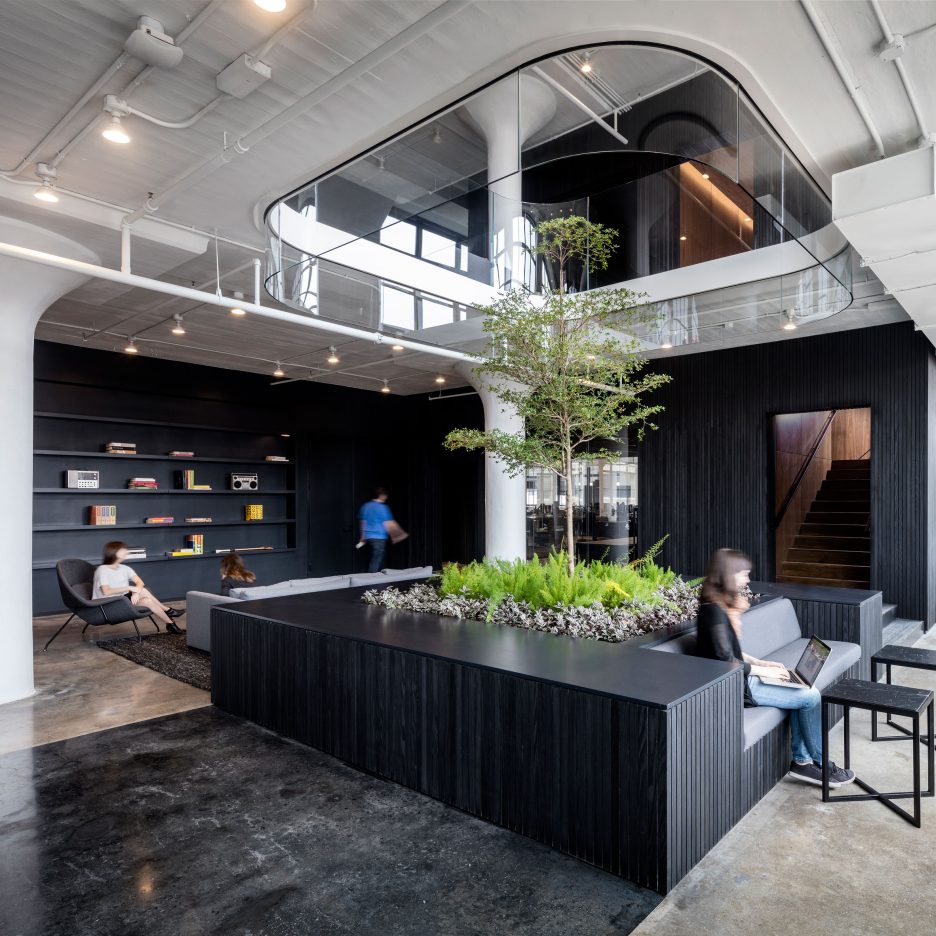
Black and white surfaces, indoor trees and a rooftop workspace all feature at the new head office for website building service Squarespace in New York (+ slideshow). (more…)
Alaska has been called “The Last Frontier,” and at Lake Clark National Park and Preserve that holds true. This backcountry park – accessible by boat or aircraft – has no roads or campgrounds and only one hiking trail. For the intrepid few who reach this remote gem, solitude reigns in a land of immense glaciers, active volcanoes and boreal forests. Photo of crimson tundra on Tanalian Mountain looking towards Port Alsworth and Lake Clark by National Park Service.
Paulo Mendes da Rocha is one of Brazil‘s most celebrated architects. And, in spite of the fact that very little of his work can be found outside São Paulo, his “Paulista Brutalism” is revered worldwide, earning him the Pritzker Prize in 2006 and, just last week, the Royal Institute of British Architects’ Gold Medal. In light of the RIBA Gold Medal news, as part of his “City of Ideas” column, Vladimir Belogolovsky here shares an interview conducted with Mendes da Rocha in 2014. The interview was conducted in Mendes da Rocha’s office in São Paulo with the help of Brazilian architect Wilson Barbosa Neto acting as translator, and was originally published in Belogolovsky’s book, “Conversations with Architects in the Age of Celebrity.”
Vladimir Belogolovsky: In your short text “The Americas, Architecture and Nature,” you say that “for Brazilians and Americans in general, the historical experience begins with the modern world. There is a difference between rebuilding old cities in Europe and building new cities in the Americas.” Could you elaborate this thought?
Paulo Mendes da Rocha: Of course, there is a difference in attitude when one builds in such a new place as Brazil or the American continent in general as opposed to Europe. The landscapes are different, cities are different, cultures are different. How can you compare St. Petersburg in Russia and Vitória, my hometown, in Brazil?
Paulistano Athletic Club, 1957. Image Courtesy of Paulo Mendes da Rocha
VB:True, these cities are very different, but interestingly, architecture which is being built now no longer offers much of a difference whether it is built in one place or another. It is now common to talk about national and regional characteristics as a reaction to global architecture. Do you see yourself as a Brazilian architect? I am asking this because you once said: “Architecture that is done here can only be interesting when it possesses a universal dimension. There is no such thing as Brazilian architect.” Why do you think so?
PMdR: Being an architect is not just about where you are. Architecture is universal. Just because I am here doesn’t mean I produce Brazilian architecture. I look around, I take advantage of the resources available, the materials; I acknowledge the climate and so on. Being an architect is a matter of knowledge – you explore the place and interpret how to respond to a particular site and situation. Water is water, gravity is gravity, and sunlight is sunlight. It is the same everywhere.
Paulistano Athletic Club, 1957. Image Courtesy of Paulo Mendes da Rocha
VB:Still, historically, the results were quite different. In the past architecture was much more responsive to specific place and culture. If you traveled in the 18th or 19th century, you would see a very apparent difference between, for example, French, Italian, and German architecture. Contemporary architecture, for the most part, has become indistinguishable.
PMdR: There was the time when classical architecture was also global and indistinguishable. But now in Brazil we have a good chance to produce architecture that is different from European and other places. Here we need millions of new housing units, which are in much greater demand than in Europe. This is a good moment for us to build in a new way and explore possibilities for what Brazilian architecture can become.
VB:Are you working on any housing projects at the moment?
PMdR: No.
VB:Why not?
PMdR: This is not architecture; what they are building is just boxes. There is no room for architecture in these projects; they simply provide the necessities.
VB:You don’t think architecture is possible on a tight budget?
PMdR: These are just boxes with utilities. They are not built to last. They are just like the latest version of a mobile phone. It is just utility, a tool, nothing more.
VB:What do you think about social housing projects by Alejandro Aravena in Chile? He told me that you participated in the work of the jury in the competition that he organized. I find his work very sophisticated and inventive and from what I can judge, his idea of half a house is very clever and, in my opinion, the solution is quite elegant and not just utilitarian.
PMdR: I think the question of whether this is architecture or not should be answered by people who live there. In any case, this would not work here in Brazil because the other half of the house still has to be built by the families and they will look like shit. We already have favelas here; people build as they want. What they have in Chile is just another model for favelas… It is a political trick; they want to use free labor to build cheap housing… I did not have an active role in that jury and I did express my opinion about these types of projects very clearly.
Paulistano Athletic Club, 1957. Image Courtesy of Paulo Mendes da Rocha
VB:What do you think about Oscar Niemeyer’s work? Was he Brazilian or universal architect in your opinion?
PMdR: What do you think?
VB:I think if he practiced elsewhere, his architecture would have been very different. So for me he is associated with Brazil. But what do you think? Was he a big influence on your work?
PMdR: What is architecture? I think it comes from the knowledge and skills of an architect. Some architects are true artists. He was a very close friend and I admire what he did. He was like Picasso, a great artist. You can’t put him into any category. Oscar was absolutely unique. Have you heard about Oscar’s curves being inspired by the surrounding mountains and women?
VB:Sure.
PMdR: This is all bullshit. But he would not argue against this because he liked the way it sounded.
Paulistano Athletic Club, 1957. Image Courtesy of Paulo Mendes da Rocha
VB:Wasn’t he the one who promoted these inspirations? Where do you think his curves came from?
PMdR: Common sense… Let me give you two examples. Take his Cathedral of Brasília. It was Brunelleschi who did his famous dome at the Basilica di Santa Maria del Fiore in Florence. You need perfect circular structure to resist stresses uniformly. The structure of a circle is always perfect. You can’t reinvent it. This is how structures work [Mendes da Rocha draws the shape of the dome, inverts it and adds a mirrored profile to illustrate an inverted dome]. And here you have the same dome but inverted. Isn’t it the Cathedral of Brasília? It is the same structure, and now we have different materials, we can do great spans and forms. This is not inspired by a woman’s curve; it is just the way structures work in principle.
Paulistano Athletic Club, 1957. Image Courtesy of Paulo Mendes da Rocha
VB:In principle, it all looks easy and rational, never mind the fact that Brunelleschi’s dome was not a circle and took years to resolve. Principles aside, some of Niemeyer’s sculptural roofs stand against the mountains as a backdrop, and I find it hard to believe that there is no direct link between the two… His buildings seem to fit perfectly into their settings, but you need to be Oscar Niemeyer to introduce such eccentric shapes that seem consequential and even inevitable when we try to rationalize them. I don’t think beauty is inevitable…
PMdR: Really? You don’t need to be a genius, just intelligent. You just need to do what Brunelleschi did and interpret it in modern ways. Let’s talk about the other example – Oscar’s Edificio Copan here in São Paulo [the building can be seen through Mendes da Rocha’s office window]. Oscar was an intelligent man, he said to the developer that we can make it into a popular place, well integrated into the city’s infrastructure, such as the metro and parking, and provide a commercial base with stores, cafes, galleries, and so on…
Look, an architect is not an exceptional person. We have schools with thousands of students who explore such projects. It is impossible to teach architecture, but you can educate people to be architects. All you need is intelligence. That site is not big enough for many buildings to be built there. You need one large building connecting all the various services along its base and you need to provide as many apartments as possible to make it successful for the developer, so you wouldn’t place a building on a straight line there.
More so structurally, it makes perfect sense to curve a very long building, so it is more stable in its resistance to the wind loads [he bends a sheet of paper into a double curve and demonstrates how this way it can stand on its own, as opposed to a flat sheet, which has no rigidity]. The fact that this building is curved has nothing to do with women, it is based on principles. It is a great building. I lived there myself. It is brilliant, but not because of its shape. It is wonderfully planned. The building is not just beautiful, it works. It has the capacity to transform a place in the city.
VB:Why do you think it is not possible to teach architecture?
PMdR: Every project is an emergency. You have to go there and see what needs to be done. You can only teach architects to think by empowering them with knowledge and skills.
VB:Do you teach?
PMdR: I am too old now. There is a law in Brazil – you can only teach up to the age of 70.
VB:It is a pity, the wisest can’t teach.
PMdR: I used to teach the final year of the design studio. I would not try to influence the students too much because they were almost professional architects themselves. Of course, they think they know everything, but the reality is that noone knows anything. But a good teacher has to act like he knows. Confidence is very important, not only knowledge. Every problem requires thinking, not readymade solutions. You know that you don’t know, but there is an urgency to do something. You have to discover the knowledge – that’s the whole point.
VB:Wouldn’t you say that it is not just about knowledge, but feeling?
PMdR: Some people are born into architecture. It is part of them. They have a need for building beyond the utilitarian. You can only be taught about traditions, construction methods, and so on. The rest is up to your talent.
VB:What words would you chose to describe your architecture?
PMdR: If I spent time thinking of words I would not have time left to do any architecture. [Laughs.] Architecture is a discourse. You could spend your entire life talking about it. Look at the Pyramid of Cheops at Giza. Why do people still talk about it?
VB:It is the Great Pyramid; it is magnificent, but also mysterious…
PMdR: There is no mystery there. That is the only shape the Egyptians could have built then. That was the only way to carry the stone to the top. Today we can build very different forms, but four and a half thousand years ago, that was the rational form to build. The Egyptians used the advantage of basic mechanics to push the stone blocs up the inclined plane. There are shafts there through which you can see the stars. I think the desire was to build this pyramid of crystal. This was realized when IM Pei built his pyramid of glass in the Louvre in Paris, but just like Niemeyer he did not talk about it. Architecture is not about inspirations, it is about history and principles. Inspiration does not exist. Architecture is about hard intellectual work. You have to think through problems and analyze history and reality rationally.
Paulistano Athletic Club, 1957. Image Courtesy of Paulo Mendes da Rocha
VB:You said that contemporary architecture is essentially the design of the city. Here is a short quote: “We need to untie the knot in the schizophrenic separation of architecture from urbanism, art from technique, and art from science.“ So you think that architecture is all of these things, right?
PMdR: It is not about what I think. This is how it is. Architecture always was and has been about technique, art, and science. If you don’t know how to read or write you can’t come up with a poem. You have to know these basic tools. It is all about extracting knowledge from such disciplines as anthropology, geology, structural mechanics, building construction, design, and so on to come up with a spatial interpretation, which is called architecture. It is a peculiar way of knowledge, not a form for form sake. It is about methodology.
VB:In a number of your projects, you rely on basic geometric forms. You stress that you focus more on the program rather than on form, on accentuating simplicity of the form rather than its complexity. Do you ever try to invent new forms in your work?
PMdR: Every project is different, but there is no need to invent a new form every time. For example, I designed a master plan for the University of Vigo in Spain where the topography is very complex, so I provided a series of straight elevated axes for students like promenades, so that all new buildings would be elevated off the terrain and connected to the main links. It is very simple. I don’t search for new shapes; I search for results that work. Some projects require different solutions. When I was designing Capela São Pedro in Campos do Jordão using clear and stained glass windows, I was searching for a form that would work best with the ideas of intensifying the views and creating multiple reflections and other optical illusions. It was important to come up with a particular solution, with a form that explored these ideas.
VB:Let’s talk about your Brazilian Museum of Sculpture in São Paulo. You conceived it as a garden with the sculpture gallery underground. Could you talk about the relationship of this project to the ground?
PMdR: I wanted the Sculpture Museum to be an outdoor garden. Fortunately, I could take advantage of the sloped site and turn it into terraces with the interior gallery hidden underneath, leaving the whole site open and free. Another solution could be to build a building with the sculpture garden on the roof, but it is always challenging to get roof access and in this project, the whole site serves as one big garden.
VB:The Museum, which is shaped as a portal, is somewhat reminiscent of Lina Bo Bardi’s Museum of Art here in São Paulo. This may not be a conscious reference; nevertheless, there is a visual connection between the two…
PMdR: Many people make such an assumption, but it is not so. You see, if the whole museum is placed underground it is confusing for visitors – where is the museum? I needed a symbolic gesture and to frame the view, to have a symbolic entry into the building underground. It is a huge mistake people make… Look at the scale difference, the purpose is also different. Her museum is up, mine is down. There is nothing in common. My suspended beam is not accessible. It is a symbolic portal; the top frames the important space. It brings attention to the entry. Its only function is to hold the lighting to light sculptures below.
The straight line is there to keep the balance between architecture and sculptures; it is a particular way to frame the collection. It is like walking around a sculpture and touching it… No one knows how to read architecture. [Laughs.] It is like literature – the author writes for everyone, but it is for people to interpret the meanings. Architecture could be anything and its interpretations are limitless. Architecture does not desire to be functional; it wants to be opportune.
Paulistano Athletic Club, 1957. Image Courtesy of Paulo Mendes da Rocha
VB:Would you say that your Paulistano Athletic Club of 1957, finished just several years after graduating from university, was your manifesto?
PMdR: I didn’t think about that then, but I would like to think so because in this building I tried to express many of my ideas. It was my first major project. It was not only about providing space to play basketball or other sports. It was about creating a beautiful space for people to interact within which expresses its structure on the outside. The building was conceived as a space of opportunity and when, for example, Merce Cunningham, an American dancer and choreographer came to São Paulo and was looking for space to perform, he was shown the Club and he chose it for his performances. Still, I don’t like manifestoes. Every project is unique.
VB:You said the city’s purpose is man’s supreme work of art. São Paulo is work in progress. How do you see this city in the future?
PMdR: If I took on one more project I would choose the whole city of São Paulo to correct many planning mistakes – how the energy is generated and distributed, its relation to the water, and so on. I would like to involve many people in re-planning the city in a better way for all the people. Every city is all about its people – how they go about their everyday lives. The people are the conscience of cities. I hope the people of São Paulo will be able to transform the entire city the same way my project transformed the Pinacoteca building here. The decayed urban chaos would turn into a beautiful city.
Belogolovsky’s column, City of Ideas, introduces ArchDaily’s readers to his latest and ongoing conversations with the most innovative architects from around the world. These intimate discussions are a part of the curator’s upcoming exhibition with the same title which premiered at the University of Sydney in June 2016. The City of Ideas exhibition will travel to venues around the world to explore ever-evolving content and design.
When was the last time you procrastinated on an important task? When was the last time you ate too much? Bought something you didn’t really need? Made a bad decision at work?
Admit it. Most of the decisions we make aren’t all good; some of them make us feel regretful after. In some cases, they can make us feel embarrassed and even mad at ourselves.
Learning how to make better decisions can’t give you results overnight, but here are 4 strategies to help you out.
Why Do We Make Bad Decisions?
You can blame your brain for that. Ideally, we are rational beings. It’s what sets us apart from animals.
However, despite being capable of using logic, our emotions often get the best of us. The emotional part of our brain is vulnerable to making errors and cognitive biases.
It causes us to fall into akrasia or the state of acting against one’s better judgment. Take, for example, eating a whole carton of ice cream in one sitting. You know that feeling when you know you shouldn’t do it, but you do it anyway because you just can’t stop yourself? That’s what akrasia feels like.
So, how can we prevent ourselves from experiencing it?
There is a special field that focuses on addressing cognitive biases. One of its experts is Dr. Hal Arkes who revealed how he adapted the concept of debiasing in his own life to protect himself in this video.
Here’s how to make better decisions:
Key Strategy 1: Outside Perspective
Take an outside perspective of yourself. Imagine a friend who’s going through the same situation as you.
What would you advise your friend to do? What mistakes would your friend be likely to make? How can your friend avoid these mistakes?
Thinking of these things and asking yourself such questions can help you avoid making decisions that you’ll regret later.
Key Strategy 2: Consider Alternatives
Before settling on a decision, it’s a good idea if you can take the time to consider other possibilities.
Is there a different solution? Were you influenced in your decision? Do any people you know support alternative conclusions and why do they support them?
Considering alternative solutions and strategies is a great approach to avoid cognitive biases.
Key Strategy 3: Establish Decision Criteria in Advance
Have you ever walked into a bakery, smelled the delicious smell of bread and ended up getting much more food than you actually wanted? When was the last time you walked into a department store and bought stuff you later realized you didn’t need?
Establishing decision criteria in advance can help prevent any undesirable effects your decision can have. These are the criteria you can use to weigh your options and their results before you actually take action.
Thinking about your decision a hundred times as well as its implications can help you figure out if you are being rational or not.
Key Strategy 4: Account for Overconfidence
A lot of people are overconfident. Most of us think that we are more disciplined and accomplished than we actually are. We think we have more resources than we really do.
Just think about today’s drivers. At least 80 percent of them think that they are above average. In reality, however, a large number of drivers still make mistakes that end up in costly repairs and even injuries.
So before you take actions on your decisions, go back and rethink. Make sure that you are not acting out of overconfidence and that you’re making a decision based on your capacity and capability.
These strategies aren’t really that hard to implement. They do, however, take some time to get used to. Once you become accustomed to these techniques, you’ll find it easier to make decisions that actually matter- without biases and regrets.
The new Currency Museum is located on the waterfront of Luanda, just in the heart of the city downtown, nearby the charismatic headquarters of the National Bank of Angola.
The purpose was pretext for two major interventions. On one hand, it disposes the museum spaces below ground, becoming more reserved and quiet. On the other, its roof establishes a new urban square that both denotes the museum and enables the celebration of public space, in some way expanding the new public spaces of Luanda’s waterfront.
The new museum, with about 4.800 sqm, reveals itself in the stereotomy generated by excavation, with its entry announced by the stairs void and the metallic parasols that generate shadow and urban scale. It includes two exhibition areas (permanent and temporary), complemented by public areas and an auditorium to support learning activities.
On the surface, the stone paved urban square generates a subtle topography justified by the bay views and the nearby context, allowing rest, pathways, diverse public equipment and redesigning its central ambition as a public space open to the city and the community life.
Brexit: London and other UK cities need to take “radical action” and introduce their own work permits so design firms can thrive after Brexit, according to former government policy adviser Rohan Silva. (more…)
Are you always Mr./Ms./Mrs Nice? Or are you exactly the opposite? Maybe, most of the time, you are somewhere in between. There is one way to find out…
Play nice and answer sincerely to the questions in this test. If you don’t agree with the answer, maybe you should try again at some other time, or ask somebody how accurate was the answer.
Take just now this quick quiz and find out how attractive is your personality!
The MIT School of Architecture’sSelf-Assembly Lab has teamed up with Google to create Transformable Meeting Spaces, a project that utilizes woven structure research in wood and fiberglass pods that descend from the ceiling, transforming a large space into a smaller one. Designed as a small-scale intervention for reconfiguring open office plans—which “have been shown to decrease productivity due to noise and privacy challenges”—the pods require no electromechanical systems to function, but rather employ a flexible skeleton and counterweight to change shape.
This skeleton is composed of 36 fiberglass rods, which are woven together into a sort of textile or cylindrical braid. Thus, the structure behaves “like a Chinese finger trap: The circumference of the pod shrinks when it’s pulled, and expends when relaxed.”
Courtesy of MIT Self-Assembly Lab
Courtesy of MIT Self-Assembly Lab
Expanded fully, the pods measure about ten feet in diameter and eight feet tall, providing space for up to eight people to either sit or stand inside.
Furthermore, the inside of the spaces are lined with felt, so as to dampen outside noise.
Courtesy of MIT Self-Assembly Lab
We’ve had four people sitting in there at tables, or standing in there for a meeting, said MIT Self-Assembly Lab’s co-director, Skylar Tibbits. We also thought it could be a sort of nap pod. It’s more about the transformation of space rather than trying to present what happens in that space. We’re just trying to create different capabilities.
Research on the project is ongoing, and in the future, will be concentrated on applying these transformable materials to larger-scale architectural practice, for instance in retractable stadium roofs. With such technology, the Lab hopes that stadium roofs or even stadiums themselves, among other systems, could be collapsed after use without major disturbances to the urban landscape.