“The four most beautiful words in our common language: I told you so.” – Gore Vidal

gore-vidal-novelist-quote-the-four-most-beautiful-words-in-our-common

The B&N Podcast: Tayari Jones

Every author has a story beyond the one that they put down on paper. The Barnes & Noble Podcast goes between the lines with today’s most interesting writers, exploring what inspires them, what confounds them, and what they were thinking when they wrote the books we’re talking about.

An American Marriage is Tayari Jones’s extraordinary fourth novel, a page-turning love story with a powerful political undercurrent. It’s as much a novel about family and race, expectation and desire, loneliness and loyalty as it is a story about how readily the American Dream can be derailed on the basis of skin color.  The writer of one of the season’s most keenly anticipated new books joins Miwa Messer in the studio to talk about writing a story that’s page-turning and thought-provoking in equal measure.

//html5-player.libsyn.com/embed/episode/id/6226919/height/90/theme/custom/autoplay/no/autonext/no/thumbnail/yes/preload/no/no_addthis/no/direction/backward/render-playlist/no/custom-color/87A93A/


The author of Silver Sparrow returns with a stunning novel about race, loyalty, and love that endures.

Newlyweds Celestial and Roy are the embodiment of both the American Dream and the New South. He is a young executive, and she is an artist on the brink of an exciting career. But as they settle into the routine of their life together, they are ripped apart by circumstances neither could have imagined. Roy is arrested and sentenced to twelve years for a crime Celestial knows he didn’t commit. Though fiercely independent, Celestial finds herself bereft and unmoored, taking comfort in Andre, her childhood friend, and best man at their wedding. As Roy’s time in prison passes, she is unable to hold on to the love that has been her center. After five years, Roy’s conviction is suddenly overturned, and he returns to Atlanta ready to resume their life together.

This stirring love story is a profoundly insightful look into the hearts and minds of three people who are at once bound and separated by forces beyond their control. An American Marriage is a masterpiece of storytelling, an intimate look deep into the souls of people who must reckon with the past while moving forward–with hope and pain–into the future.

See more books by Tayari Jones.

Like this podcast? Subscribe on iTunes or Stitcher to discover intriguing new conversations every week.

Author photo of Tayari Jones (c) Nina Subin

The post The B&N Podcast: Tayari Jones appeared first on The Barnes & Noble Review.

The Barnes & Noble Review http://ift.tt/2nLhwtS

4 Important Things To Consider When Changing Jobs

Have you ever been so burnt out at work and sick of all the corporate politics that you are thinking of quitting your job?

Or maybe you are only working hard enough to get a paycheck and make it to the weekend?

Week after week.

Month after month.

Year after year.

You meant well when you first accepted the career position. Now, you’re no longer sure if you’re feeling the same way.

And you’re not alone.

Some statistics say up to 85% of people hate their jobs. So, if you find yourself wondering if you should change careers, here are 4 important things to consider when changing careers.

#1: What is your ideal work situation?

Analyze your work environment. Has it changed dramatically since you accepted the position?

If this is the case, then you have to put yourself back in your life’s driver’s seat.

Make a list of the top 10 words or phrases that describe your career. You can include all the pros and cons of your job. For example, you can write how many hours you spend commuting per day, all the benefits you get, and the things that make your work extra hard.

Now, how do you feel about that list?

#2: Do your actual job duties match your personality?

There are 4 traits that make you the person you are today.

Those traits relate to your ability to interact with people, solve problems, manage day-to-day tasks, and respond to events and situations.

Here’s what you could do:

Take your list from question one and start to ask yourself which of those things match who you are.

If you don’t know where to start, I suggest taking the DISC personality profile test or a Myers-Briggs personality profile test. Once you have the results, ask yourself if your dominant personality types fit your current career.

See Also: How To Get Out Of A Career Rut

#3: What are your values, passions, and dreams?

“Always remember, you have within you, the strength, the patience, and the passion to reach for the stars to change the world.” Harriet Tubman

Do you dream of a work-from-home position?

Well, does your current company offer that? If not, then you won’t fulfill this dream until you change careers.

Do you have a passion for achieving results but your team simply goes through the motions?

Start looking for another team to be a part of today.

Do you value work-life balance?

Take the necessary steps to see how you can create more balance in your current career. If that’s not possible, it’s probably time to change careers.

#4: Is there a paying market for your ideal career?

Honestly, I love to eat Mexican food. Unfortunately, it’s impossible for me to find or create a job where I can get paid well for only eating Mexican food.

Career changes are similar. Don’t just move from one thing to the next if there’s not a great paying market for you. Living on beans and rice to get by is fine for a while, but your family will need more than that.

My word of advice for those I coach is to stay at their current jobs while they look for a new one or start something that will fit them better.

So, is it time for you to change careers?

I don’t know for sure but I do believe that if you take the time to evaluate where you’ve been and where you’re headed, you’ll come to a conclusion of what’s best for you.

Don’t wait any longer trying to make your career fit you. Take action and begin finding or creating the work that you love.

See Also: How To Change Careers Without Losing Your Mind

The post 4 Important Things To Consider When Changing Jobs appeared first on Dumb Little Man.

http://ift.tt/2sbh2CI

The United States was founded by the brightest people in the country — and we haven’t seen them since. – Gore Vidal

vital1

8 Safety Tips For Traveling With Your Engagement Ring

Getting down on one knee and popping the big question is hard. If you’re doing a destination proposal, it’s going to be way harder. There’s always the risk of ruining the surprise and worse, losing the ring while you’re traveling. For someone who’s prepared so hard during the last couple of months, that’s probably the last things you want to happen.

So, what to do?

Here are a couple of tips you can use to make sure nothing goes awry while you’re traveling with jewelry.

Safety Tip #1: Make a plan

Before you head out to your destination, make sure you already have a plan in place. Buy your ring several days or weeks before your trip so you won’t have to scramble and panic hours before you leave. Make sure that it’s the right size and design you want.

Consider where you’ll pack your ring, too. As much as possible, keep it in a box with maximum cushioning. You can place the box inside one of your socks if you’re worried that it might get jostled around inside your luggage as you travel.

Now, instead of keeping the ring in a checked bag, store it in a carry-on. Choose a smaller bag so it won’t have to be checked.

Why?

Your ring is likely to trigger the metal detector. That won’t only make your partner suspicious but the airport security as well. Read up on your airport security’s rules about jewelry so that you can take appropriate measures.

Safety Tip #2: Insure the ring

This is probably the most important thing when it comes to traveling with jewelry. Since you’ll never know what things can happen while you’re traveling, particularly with all the excitement, securing insurance for the ring should be a top priority.

Get one before you even make the proposal. This way, your ring will be protected in case it gets lost or stolen during your trip.

Take note, however, that not all travel insurance policies can cover big jewelry claims in the event that you lost yours. This makes it important that you do your homework and find out all about insurance for engagement rings or talk to your agent and clarify what type of policy you’ll need. Never skimp when it comes to investing in the right insurance policy.

Tip: Make a list of all the pieces of jewelry you’ll be taking with you on your trip, including the engagement ring. You can take photographs as well as part of your documentation for your insurance.

Safety Tip #3: Use a safe
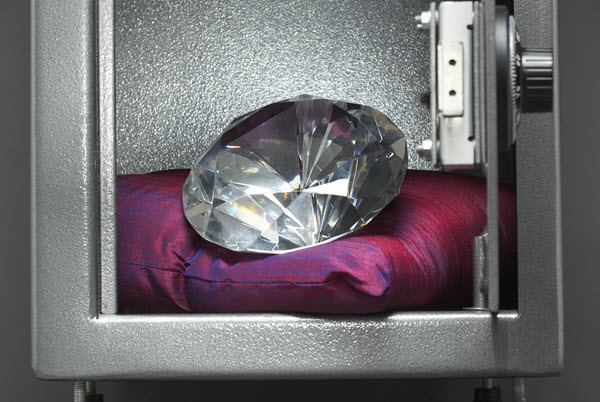
Pieces of jewelry, like engagement rings, can easily attract thieves when you’re in a foreign place. Instead of carrying it with you wherever you go, find a safe place where you can hide it. You wouldn’t want to lose it while you’re hiking, diving, or driving around town.

If you are staying in a hotel, ask if you can use one of their safes. Just make sure that you secretly ask for it and that your partner won’t be using the same safe. Otherwise, it might ruin the surprise.

Tip: Choose the hotel’s front desk safe as it’s more secure than an in-room safe. It’s less likely to get broken into as well.

Safety Tip #4: Keep calm

The more you think about the ring and your surprise, the more nervous you’ll get. This can easily make anyone suspicious. Try to remain as calm as possible throughout your trip until the big day. Enjoy the activities you planned but be sure to check the ring once in a while. Make sure that it’s still there when you need to retrieve it.

Safety Tip #5: Propose early

The longer you keep the ring in the safe, the longer you’ll worry about it. This can take out much of the fun from your trip or vacation.

Instead of waiting for the last day, propose at the beginning of the trip. You won’t have to hide and worry about the ring for days and you’ll be able to enjoy your vacation more.

Safety Tip #6: Pick your proposal location properly

It might be tempting to propose on the beach but it’s not really the best idea as you can easily lose the ring in the sand. You should also avoid proposing in amusement park rides or while you’re parachuting as you’ll have an unstable footing there.

Avoid proposing in overcrowded areas or locations where the ring can easily get snatched from your hand by passersby. Don’t put it in foods and drinks as the ring can get lost or chocked on.

Safety Tip #7: Don’t overshare it

Being engaged is a blissful experience and you’ll probably feel too excited about it. However, despite how excited you are, refrain from sharing too much about it on social media. Geotagged photos can catch people’s attention, particularly burglars within your area.

To be safe, limit posting or you can just save the photos and upload them once you’re home. Don’t talk too much about it as well, especially when you’re in a crowded place. It might seem paranoid but there can be thieves and burglars around who might overhear your conversation.

Safety Tip #8: Wear it the other way around

Diamonds are attention-getters. They can easily get people to look at them, particularly if they’re big.

If you and your fiance are planning to go around town to explore, ask her to wear her engagement ring the other way around. Keeping the stone facing her palm lessens the risk of people catching sight of the diamond

Conclusion

Planning a proposal isn’t easy, particularly if you’re doing it in another city or country. You have to consider so many things, like how you can go on traveling with jewelry and how you can keep your ring safe. Worrying about such things can easily spoil the fun of your vacation and even your proposal.

This set of safety tips can help make sure that you get the most out of the experience. Just follow them to a tee and always be aware of your environment. Take precautions as there are potential thieves almost everywhere.

The post 8 Safety Tips For Traveling With Your Engagement Ring appeared first on Dumb Little Man.

http://ift.tt/2saY8f5

Delaware Water Gap National Recreation Area on the…

Delaware Water Gap National Recreation Area on the Pennsylvania-New Jersey border features almost 70,000 acres of forested mountains, picturesque valleys and fertile floodplains that have known 10 millennia of human contact. The sloping, rocky landscape is home to several waterfalls. A popular destination in every season, Raymondskill Falls is especially gorgeous in winter. Photo by National Park Service.

Who Killed More: Hitler, Stalin, or Mao?

These months mark the sixtieth anniversary of the launch of Mao’s most infamous experiment in social engineering, the Great Leap Forward. It was this campaign that caused the deaths of tens of millions and catapulted Mao Zedong into the big league of twentieth-century murders. But Mao’s mistakes are more than a chance to reflect on the past. They are also now part of a central debate in Xi Jinping’s China, where the Communist Party is renewing a long-standing battle to protect its legitimacy by limiting discussions of Mao.


http://ift.tt/2nCljKG

The Afterlives

Hall of Small Mammals, Thomas Pierce’s 2014 debut story collection, was roundly acclaimed as heralding the arrival of that not-quite unicorn, the “extraordinary new talent.” His first novel now makes Pierce an actual rarity: the author who fulfills an improbably frequent forecast with room to spare. The Afterlives is a nearly perfect embodiment of the ways paradox constitutes the most compelling art. The novel sparks with matchstrikes of humor and stares down sober questions. It is a romance and a speculative fiction and a philosophical inquiry. It’s also a delight to inhabit, a literary structure so cleverly wrought you search in vain for signs of the epic labor that had to have gone into its sills and stairs.

Once having entered, one is loath to leave its fascinating space. The book’s longueurs are few and, well, short. The immediacy of first-person narration draws the reader into the initially normal life of one Jim Byrd, a commercial loan officer who at the biblically meaningful age of thirty-three suffers cardiac arrest. That he saw nothing during his visit to death, not even the apocryphal long hallway ending in dazzling white light, causes him to variously ponder if he’s missing a soul or if there is in fact no afterlife. (He ends up wrong on one count, if not both.) The novel is constructed as a postulation, winding its way along a double helix of narratives stretching from past lives to future society. Each step brings the reader to a turn affording double views. We look both forward and back on the lives of Jim and his wife, Annie, who — appropriate to Pierce’s intricate rubric of uncanniness — was his girlfriend in an earlier period. Jim could never have foreseen meeting her again, much less marrying. There’s a lot in these pages that can’t be foreseen. And as much that can.

Which is the point of The Afterlives. Life is very much like the experience of reading this novel. Or is it the other way around? Jim muses, “I was here and then I wasn’t” in the type of line that is easily passed over — the author’s easy style propels us ever on to the next event — but that on second read often bears heavy freight: a wide stare into the vertiginous abyss. On one level Jim is referring to his medical mishap. On another he is describing the doleful mystery of life itself. He will come to find himself wandering in that half-dark land Shakespeare wrote into being with Hamlet.

“Fear and wonder just about sums it up for me these days,” he remarks to Annie, echoing Horatio upon seeing the king’s ghost. Things always do get strange after one glimpses the other side. He goes on:

Everything feels inverted, turned around. At this very moment, a thousand satellites are circling the earth, and the government can use them to zoom all the way down to our arm hairs if they’re in the mood, and yet an entire airplane drops from the sky, and we can’t ever locate it again. People pay hundreds of dollars for a blanket that tells you the temperatures under the covers and above. Viral eye-dyes. Condoms that glow green when they detect STDs. Pills that cure baldness but make you limp. Pills that make you stiff but make you lose your hair. So why not ghosts? is my question. Why not the voice of a dead woman on a CD that sounds like a broken vacuum cleaner?

And this is just the beginning of the fearful wonders encountered by our hero. Try subatomic “daisy” particles that continually move between the realms of being and not-being. (These previously appeared in a story in Hall of Small Mammals, so as a returning literary device they manifest their own essential nature.) The plot itself is built expressly for the purpose of carrying a doubled load: the story is also about the nature of stories; the book is about reading this book. A doctor tells Jim, “I wouldn’t read too much into it,” an otherwise throwaway comment that here suggests the only logical approach to the half-constructed stories of our lives. It also comprises the sole instruction for what to do with the object we hold in our hand at that moment.

Jim and Annie’s tales — along with those of physicist Sally Zinker, in Jim Byrd’s terse appraisal “a conspiracy website given skin and bones,” and parishioners at the creepy Church of Search — are intercut with a more haunting history. Pierce’s book is meticulously structured as the proof of its own supposition: the past runs concurrently with the present, and in the pauses between frames we might see some of the unnumbered movies playing beneath this one.

Pierce’s novel maintains an exquisite gyroscopic balance between sentiment and idea, postmodern self-referentiality and science fiction’s nostalgia, gee-whiz plot points and elemental human cares. Its overarching subject is that classic of the contemporary age, towering anxiety. Worries large and small are the threads that comprise its complex tapestry. Who is real and who is not? Is “fake” just as good as “real”? (Truth has become a mutable concept — who knew?) In the future, will death itself disappear? Are we truly as replaceable as humans have seemed increasingly to be? Am I replaceable in the affections of my beloved? In this story holograms loom large, of course.

Jim Byrd may wonder, “If I’m only a character in a story, then will I still exist after the story ends?” but Thomas Pierce offers at least one certainty. If you’re a character in a book called The Afterlives, the answer is yes. Very much yes.

The post The Afterlives appeared first on The Barnes & Noble Review.

The Barnes & Noble Review http://ift.tt/2E3MhoS

Edited: 3 Reasons Not To Overlap Business And Personal Emails

Have you wondered how many employees use their personal email accounts for work purposes? Who uses their work email for personal reasons? An anonymous survey has helped answer these questions and more about business and personal email usage, but one question remained: Is using your work and personal emails interchangeably a bad thing?

The short answer is yes, business email accounts and personal email accounts should remain separate in most cases. Currently, 38.8% of people living in the U.S. allow their email usage to overlap at least some of the time. Here are three great reasons why keeping your emails separate is the smart choice.

It’s Unprofessional

Unprofessionalism with business and personal email accounts is twofold. First, communicating personal life through a work email usually means you are doing so on company time. This is a poor use of your time, and disrespectful to your employer. Instead of using work downtime to put yourself at risk by being unprofessional, get up, take a short walk, and get a breath of fresh air. If you are asked by your boss why you aren’t at your desk, ask if there is anything they need to be done. Offering to help with the extra workload is a great way to shine at work.

Secondly, if you are the employer, or a freelancer, using your personal email for business can be disorganized, allowing more room for miscommunication and missed emails altogether. Junk mail alone accounts for too much of our personal inboxes, clouding the space for efficient communication. Not to mention potential customers noticing your email is JohnSmithGOSTEELERS@gmail.com is likely not going to look great unless you do work for that football team.

Tip: Best email addresses for work include the business name, such as JohnSmith@windowinstal.com. Not only do your customers know exactly who they are dealing with, but they also see your company name anytime they contact you. It’s advertising in a simple form.

It’s a Security Risk

Adults under 35 and over 65 are more likely to use their personal email for work-related communication. For business security, this is risky. The more files get transferred to and from these emails, the more likely they are to become susceptible to viruses and other malicious activity. Not to mention your company cannot insist on the security of your personal email. Therefore, they have no way of ensuring protection against possible threats. Using personal email for work is an unassumed risk your boss may not be too happy about. Consider business security especially before forwarding any sensitive information and exercise extra caution if you’ve signed any document preventing you from sharing information. The last thing you want is to be the employee responsible for leaked or lost information.

See Also: 8 Easy Steps To Your Browser Security And Privacy

It Reduces Your Privacy

Communicating personally through your work email is risky business for you. Chances are good that the IT department has the ability to see and report on everything that happens via work computers, including your email. That spicy photo you just sent to your girlfriend may have been spotted. Even worse, if you’re job hunting and communicating with possible future employers and you get caught – goodbye current paying gig!

Let’s say that no one says anything to you about the unprofessional emails you’ve been sending or receiving from your desk. This doesn’t mean they have gone unnoticed. When the time comes for a promotion or raise, those mistakes may come back to haunt you. This is a case where the best policy is to keep work at work and home at home.

Fact: Men are more likely to use personal email for work communication, use their work email for a personal login, and to forward work emails to their personal accounts.

If these reasons aren’t enough to scare you out of using your personal and business emails interchangeably, consider your work-life balance. If you use your personal email for work business, you are never far away from work or coworkers and trust us, they don’t care if you’re on vacation. Vice versa, your great aunt Margaret can’t pester you about attending the family reunion while you’re at work if she doesn’t have your work email. Keeping your work life separate is the key to sanity, we promise.

Source

The post Edited: 3 Reasons Not To Overlap Business And Personal Emails appeared first on Dumb Little Man.

http://ift.tt/2BW4PBy

“As societies grow decadent, the language grows decadent, too. Words are used to disguise, not to illuminate, action: you liberate a city by destroying…

“As societies grow decadent, the language grows decadent, too. Words are used to disguise, not to illuminate, action: you liberate a city by destroying it. Words are to confuse, so that at election time people will solemnly vote against their own interests.”

-Gore Vidal

vital