The Story Behind the Sistine Chapel’s Stunning Ceiling by Michalangelo

Michelangelo Sistine Chapel Ceiling Sistine Chapel Painting Sistine Chapel Vatican

Michelangelo is known as one of the most prolific painters and sculptors in history. As a key figure of the High Renaissance, he is specifically celebrated for his ambitious approach to scale and his expertise on anatomy. While all of his masterworks convey his undeniable talent, his world-famous fresco on the ceiling of the Sistine Chapel stands above the rest.

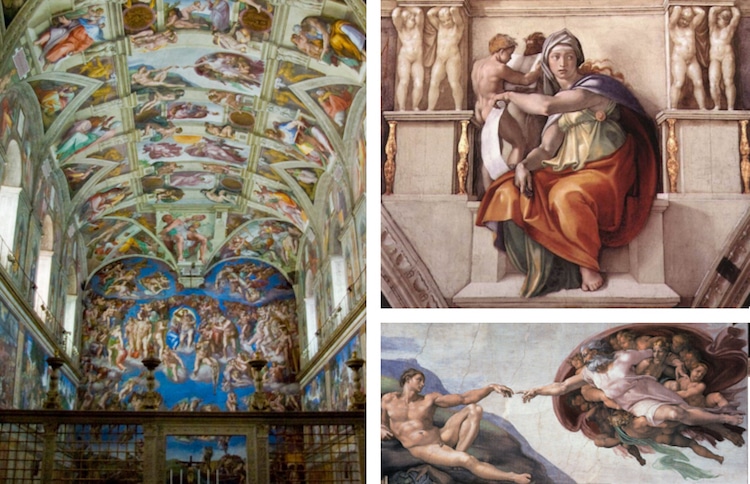
Painted for the pope, the busy yet beautifully balanced composition depicts a range of religious iconography rendered in Michelangelo’s distinctive style, making it one of the most cherished masterpieces in the world.

What is the Sistine Chapel?

The Sistine Chapel is a large chapel located in the Vatican’s Apostolic Palace. It is named after Pope Sixtus IV, who oversaw its restoration in the late 15th century. Historically, the chapel has had various important functions. Today, it retains its religious role, as it serves as the site where cardinals meet to elect the next pope.

Michelangelo Sistine Chapel Ceiling Sistine Chapel Painting Sistine Chapel Vatican

Photo: juni_cz via Pixabay

What the Sistine Chapel is most well-known for, however, is its ceiling. Painted by Florentine fine artist Michelangelo di Lodovico Buonarroti Simoni between 1508 and 1512, the complex and colorful fresco is celebrated for its realistic figures, vast size, and innovative process.

Background

By the early 16th century, Michelangelo was an esteemed artist known throughout Italy. He was particularly praised for his ability to render—both in painting and sculpture—figures with lifelike anatomical features, as evident in his famous David statue from 1504. Given the artist’s reputation, it is no surprise that Pope Julius commissioned him to decorate the ceiling of Sistine Chapel, whose walls were already adorned with frescoes by Botticelli, Ghirlandaio, Perugino, and other famed artists.

While the pope’s plans for the ceiling revolved around a depiction of the 12 apostles, Michelangelo had bigger plans: he would paint several scenes from scripture featuring over 300 figures.

Method

In order to reach the chapel’s ceiling, Michelangelo created special scaffolding. Rather than build the structure from the floor up, he installed a wooden platform held up by brackets inserted into holes in the wall. As he completed the painting in stages, the scaffolding was designed to move across the chapel.

Once the scaffold was installed, Michelangelo was able to begin the painting process. Like many other Italian Renaissance painters, he used a fresco technique, meaning he applied washes of paint to wet plaster. In order to create an illusion of depth, Michelangelo would scrape off some of the wet medium prior to panting. This method culminated in visible “outlines” around his figures—a detail considered characteristic of the artist.

Michelangelo Sistine Chapel Ceiling Sistine Chapel Painting Sistine Chapel Vatican

Photo: via Wikimedia Commons

As plaster dries quickly, Michelangelo worked in sections, applying planes of fresh plaster each day. These sections are known as giornata, and remain perceptible today.

The post The Story Behind the Sistine Chapel’s Stunning Ceiling by Michalangelo appeared first on My Modern Met.

http://ift.tt/2AGqwJ8

Lies

Dear Norma,

I am writing from San Juan, from the one and only hotel here. I visited Mother this afternoon—a half-hour drive along a tortuous road. Her condition is as bad as I had feared, and worse. She cannot walk without her stick, and even then she is very slow. She has not been able to climb the stairs since returning from the hospital. She sleeps on the sofa in the living room. She tried to have her bed shifted downstairs, but the men said it had been built in situ, could not be moved without being taken to pieces first. (Didn’t Penelope have a bed like that—Homer’s Penelope?)

Her books and papers are all upstairs—no space for them downstairs. She frets, says she wants to get back to her desk, but can’t.

http://ift.tt/2zXzulH

Located just an hour’s drive from Fairbanks, Alaska, the…

Located just an hour’s drive from Fairbanks, Alaska, the one-million-acre White Mountains National Recreation Area offers stunning scenery, peaceful solitude, and outstanding opportunities for year-round recreation. Summer visitors to the White Mountains pan for gold, fish, hike and camp under Alaska’s midnight sun. In winter, visitors travel by ski, snowshoe, dog team and snowmobile to enjoy the 12 public-use cabins, 250 miles of groomed trails and the spectacular sight of the Northern Lights dancing overhead. Photo by Bob Wick, Bureau of Land Management, @mypubliclands

The Poet’s Pencil

I knew a poet who could only write his poems with a stub of a pencil. Nothing else worked for him as well. What he loved about writing with a stub is that it made his scribble mostly illegible. That way, he never felt embarrassed by what he had written. He’d look at it, and look at it, afterward, while trying to guess what in the name of God he had said.

http://ift.tt/2iaDDHD

The rugged beauty of Badlands National Park in South Dakota is…

The rugged beauty of Badlands National Park in South Dakota is undeniable. From hiking past unique rock formations and fossil beds to watching bison run across the grasslands and the surprise of a swift storm moving in, outdoor adventures abound. Photo by Christina Laws (http://ift.tt/18oFfjl).

Britain’s Game of Thrones

In an era of unbridled populism, however, personalities matter more than arguments. The current heir to the throne was jealous of his first wife, resenting the attention she got during public engagements; now he will have to accommodate a glamorous daughter-in-law trailing photographers and camera crews wherever she goes. Charles hasn’t spent years planning his coronation only to discover that the only question on anyone’s lips is “What will Meghan wear?”

http://ift.tt/2AoOsy1

6 Effective Tips For Yoga Newbies — To Attain A Life Balance.

You’re reading 6 Effective Tips For Yoga Newbies — To Attain A Life Balance., originally posted on Pick the Brain | Motivation and Self Improvement. If you’re enjoying this, please visit our site for more inspirational articles.


Yoga is a form of exercise used to increase strength, flexibility, and VO2 consumption. It helps in shaping the mind and body to attain a life balance. Meanwhile there are some key points yoga newbies needs to take note of.

Daily yoga practice can help you stay more productive, happy and more reasonable. This exercise reduces high blood pressure, increases flexibility, muscle strength and tone.

It also improves respiration energy and fertility, also helps in weight reduction.

This and more benefits of this exercise has encouraged several people especially, entrepreneurs to consider yoga as a key practice for productivity and maintaining life balance.

As a matter of fact, the National Health Interview Survey (NHIS) reveals that yoga is the sixth most commonly use complementary health practice for American adults. This survey also discovered that more than 1.5 million children practice yoga annually.

As a yoga newbie, it’s normal to lack confidence and motivation in the beginning. Most times you feel intimidated by the die-hard yogis who warm up with headstands. But seriously, you shouldn’t be bothered with that; they also started as a beginner before getting to that stage.

The most important thing is to prepare your body and make up your mind to get through the beginners stage, and with time, you’ll naturally find motivation to practice yoga at will.

Below therefore are 5 effective tips for yoga newbies to achieve a life balance.

1. Prepare for it:

Do you know that by spending time out preparing for this exercise, you can actually optimize your yoga experience?

Effective preparation before the exercise brings about optimum results and helps loosen up the body before venturing into the real yoga exercise.

To start with, set up a soft warm-up routine for 5- 15 minutes before starting the real yoga exercise.

Here are few warm-up exercises you can implement:

  • Rotate your neck both clockwise and anticlockwise to know if there’s any stiffness.
  • Pump your shoulder and shake your hands to shrug off the lethargy
  • Message your head, browse, nose and chick

2. Start simple:

Being a yoga experts is not an instantaneous activity. The process starts from being a yoga newbie to becoming an expert. So, start simple!

As humans, we love to get to the peak of our activity even right from the scratch, but most times it requires great commitment of yoga newbies to attain and maintain a balanced life.

“You don’t have to be great to get started, but you have to get started to be great”- Les Brown.

As a newbie, it’s advisable to learn simple yoga posts first before proceeding to the tough ones. So as not to loose motivation at the beginning of your experience.

3. Get a yoga kit equipment:

As a newbie, there’s high desire to get new steps in yoga practice. It’s more important to acquire yoga kits, in other to get the most effective result out of your practice.  

In addition, getting yoga kits gives you a sense of professionalism at the exercise, and as well, protects you from unnecessary injury. While there are some auto transport service that helps customers ship their cars, there are also some shipping services that can help in conveying your yoga kits to you, so worry less about the market. 

Here are 5 bit of yoga kit and equipment for beginners.

  • Yoga mat: This will provide cushioning on a hard floor and a non sleep surface for standing. Also, it grants friction, padding and increases safety when doing yoga positioning.
  • The Yoga block: Yoga block is also known as foam block. It’ll help stabilize standing positions when you can’t reach the floor easily. 
  • Bolster: Yoga bolster is used to support the leg, spine or abdomen in certain positions.
  • Yoga belt: This type of  belt is made of cotton or nylon, it helps to support your back and extend your grasp.
  • The Blanket: The yoga blanket keeps you warm and comfortable at the end of each yoga postures.

4. Get and Communicate with a seasoned yoga teacher:

As a newbie it’s important to learn under a good instructor or teacher — that would observe and assist you during practice.

Communicate with a professional yoga instructor if you have any medical  condition. It’ll help the teacher to customize a special training that’ll not affect you physically but help your health condition. 

One more important thing is to have the ability to say no. If a pose feels wrong or too painful for your health status, communicate with your teacher and say it out, your teacher may know a simple way to help.

5. Be consistent:

As a newbie it’s important to make sure you practice frequently. Little and often is more effective than occasional long session of yoga.

Practicing for just 20 minutes daily, with a few well chosen poses, can have a positive effect on your physical and emotional well being.

Be dedicated with constant practice to strengthen your inner desire. And as time passes, your body will begin to feel comfortable and familiar with the process and the exercise becomes a part of you.

6. Wear a comfortable clothing:

You’ll have to put on a comfortable clothe and put away body gadget like belt or jewelry as it could get in the way of your yoga practice. You’ll need to stretch your body to different directions, so you must not put on anything that’ll restrict your movement.

It is advisable to wear all natural materials, for example 100 percent cotton and hemp (which will allow circulation of air into the entire body) is good for yoga practice. 

You can also check various materials to find out the one that best fit you for your yoga activities.

You’ve read 6 Effective Tips For Yoga Newbies — To Attain A Life Balance., originally posted on Pick the Brain | Motivation and Self Improvement. If you’ve enjoyed this, please visit our site for more inspirational articles.

>

Interview: Designer Dedicates Her Career to Discovering the Hidden Impact of Consumer Goods on the Environment

Did you know that most average Americans live as though they have 4.8 planets? This is what Dutch industrial designer Babette Porcelijn discovered when she largely left behind a thriving business working with commercial clients to focus on the hidden impacts of design.

After 11 years working with agencies, she began her own design studio in 2011. And since 2015, she’s dedicated her career to studying how we can make an “eco-positive world” through our choices as designers and consumers. Her book, De Verborgen Impact (Hidden Impact), maps the environmental impact of the consumer, giving a large scale view in order for individual understanding of how each choice made contributes to the larger problem.

In her research, Porcelijn looks at everything from the global impact of importing and exporting to the environmental toll of producing single consumer items, such as a laptop computer. Her “Impact Top 10” breaks down, with surprising results, the average items used by consumers that cause the largest amount of environmental impact. Who knew that meat would come in second, beat out only by consumer products, but well above cars? (If you speak Dutch and want to understand your individual impact, answer a few questions to see how you compare to others.)

We had a chance to speak with Porcelijn about her work and how she hopes her book can help create change both for consumers and designers. Read on for our exclusive interview.

Babette Porcelijn hidden impact

How did the idea for your book come about and when did you start the research for it?

At the beginning of 2014, my husband Rick and I were at home sitting on the couch. The kids were out and we talked. He told me that the sixteen largest container ships emit as much sulfur as all the cars in the world together. I was surprised. When he told me that every day 27 million trees disappear, while trees remove CO2 from the air, I was shocked.

Rick had delved into it, and as he went on telling me more, my image of our world tilted. I thought we were doing a pretty good job here in the West, but at that moment I saw we just moved our impact out of vision, to the other side of the world.

The rich consumer buys a lot of products, but he does not see the impact the production of these goods has on the environment. How can you make sustainable choices if you don’t know what’s going on? The decision was made in a split second: I’m going to do something about this!

What surprised you the most about your findings?

When I started to investigate, I was shocked to find out that often I couldn’t find answers to my questions. Even worse, sometimes there were no words to describe the things I wanted to talk about. The worst finding, perhaps, was the fact that there was no impact top 10 of the average consumer, including hidden impacts. This is the first thing we need to know if we’re going to effectively change our daily routines, right?

Babette Porcelijn industrial designer

You found that importing and exporting goods is part of what causes the issue with products and their impact on the environment. Can you explain why this is and what solutions you see to solve the issue?

As Western consumers, we have more impact on the environment than we think. Not just at home or at the pump, but also on the other side of the world, by producing and transporting the things we buy every day. If you include this hidden impact you can change your everyday life more effectively. I investigated the hidden impact of our daily lives and my book provides the knowledge and tools to live an eco-positive life.

If we assess the impact of the consumer, we usually only consider environmental impacts caused by the use of a product. Furthermore, we mainly look at climate effects, but if we solve the climate problem, and we don’t solve problems like water scarcity, pollution or plastic soup, then we still have a problem.

Over the last few decades, rich consumer countries have moved much of their industry and agriculture to low-wage countries. Production comes with lots of impact on climate, nature, and environment. Rich countries import these products and this food and their consumers buy these. But we often leave the “hidden impact” out of the equation.

Babette Porcelijn Verborgen Impact

Why do you think it’s important, as a designer, to be aware of the environmental impact of consumer goods?

Designers can make a big difference in many ways. First, we are beginning to understand what we should NOT do anymore—and Hidden Impact reveals that thoroughly—but the next question is, what to replace the fulfillment of our needs in a sustainable way? What SHOULD we do? And that is a design challenge! I think we need to work together with scientists to come up with the best solutions.

Second, we are trained systems thinkers, and the world needs those—product designers can design circular products, and circular business models, while product designers and architects can design for long endurance products, with renewable materials and design for disassembly and reuse.

We could take responsibility for the products we put in the world; do we want to add more stuff people don’t really need into the world, while it damages the environment and brings our joint future in jeopardy, while the ones who benefit have commercial motives instead of humane motives? Also, design for communication: tell the world what’s at stake and what we can do about it, inspire them with awesome alternatives which are more attractive than our current ways

In short, we need nothing short of a paradigm shift and we need designers to make it a good one. Eco-positive and fair.

How has your research been received thus far?

When I started out, I thought nobody would be interested in a book about the environment. But I really wanted to make this book because I thought it was important, so I made the book I wanted to make. Along the way, I received a lot of positive feedback and since publication in Holland, things have gone crazy!

We’ve already sold over 5,000 copies in Holland, and today I’ve sent the fourth edition to the publisher. My inbox overflows with requests for an English version and I’m working on the U.S. edition—still looking for a publisher in the U.S. though.

I was in Brazil last week, and there it was received with enthusiasm: I was on Globo (biggest national network), headlines on BBC Brazil and Casa Vogue, etc. In Holland, I’m fully booked for lectures and interviews. All these things are great, and at the same time, I’m a bit worried, because when am I going to find the time to write my next book?

Babette Porcelijn environmental impact of consumer goods

How do you hope your findings are used by the public?

The best thing that can happen—and it does, people tell me—is that people actually change their lifestyles. I will never tell people what they should or shouldn’t do. I merely help those who want to make effective changes to improve their environmental impact. And I hope to inspire people as a side-effect of my research.

Babette Porcelijn environmentalism

Some of the biggest issues you mention, like microplastics, come from items like car tires. With this being such a common item, do you know of any companies working on alternative solutions?

It is a common item, but it isn’t common knowledge yet. Nevertheless, I’ve heard about research for better tire materials, but that’s difficult to tackle since biodegradable plastics in nature aren’t as biodegradable as in the lab. We could catch run-off from the roads and clean it, and we could choose a different means of transportation (bike, walk, and public transit).

Babette Porcelijn environmental research

Aside from a U.S. edition, do you plan on having your book released in other languages as well, to reach an even wider audience?

Oh yes, for sure! If we want to save the world, we need as many people on board as possible. Especially in rich consumer countries, which have—on average—the biggest impact. In the twelve biggest economies in the world lives 13% of the world population, but we cause 55% of the impact! That means that with 13% of the people, we can reduce over half the impact, and that’s a hopeful thought to me.

What would be your message to consumers about the impact their choices have on the environment?

We, consumers, are key. Ultimately, we decide everything that’s going on in the world, even though we often don’t realize it. We buy products and with our money, companies thrive. They can either damage or save the environment, and we get to choose which ones survive by buying their stuff. We decide who our politicians are and what they will fight for. The more money you have, the more difference you can make, either by your lifestyle and daily habits or by devoting yourself as a professional to for an eco-positive society*.

[Eco positive: when you (or a company, or a city/country etc) have a more positive impact on the environment than negative, harmful impact. Protecting and restoring nature, working on family planning and reducing population growth, designing sustainable or eco-positive solutions, cleaning up pollution etc.]

Any upcoming projects or further research you’d like to share?

Yes, I’m hoping to start working on my next book soon, because I’m curious what the best possible (feasible) future would look like. I want to put an attractive dot on the horizon!

Babette Porcelijn: Website | Twitter

My Modern Met granted permission to use photos by Babette Porcelijn.

Related Articles:

Eye-Opening Landscape Photos Explore the Environmental Cost of Human Impact

Mermaid Swims in a Sea of 10,000 Bottles to Spotlight Plastic Pollution

Eco-Friendly Logo Redesigns Promises to Save Millions a Year in Printing Costs

Interview: Photographer Travels to Alaska and Discovers Polar Bears Living With No Snow

The post Interview: Designer Dedicates Her Career to Discovering the Hidden Impact of Consumer Goods on the Environment appeared first on My Modern Met.

http://ift.tt/2i89sko
More Light!

The current retrospective of over sixty years of David Hockney’s work—reaching back to a teenager drawing what he saw in the mirror in 1954—brings together portraiture, landscape, and still life in every kind of combination. It reveals a wonderfully resourceful artist, but one whose working moods have seemed to veer between studious and strident.

http://ift.tt/2iaJD3n

Rachel Whiteread’s Solid Air

There’s something cool yet passionate about Rachel Whiteread’s work. It is calmly paradoxical, domestic but monumental, tactile but detached, nostalgic but austere: objects and dwellings from everyday lives are lifted to a different sphere, a dance in space. In a new exhibition celebrating twenty-five years of her career as an artist, Tate Britain has removed the partitions that usually divide separate rooms, creating a huge open space with white walls and glowing, pale wood floor. She asks us to see things we know—tables and chairs, the inside of a room—from the opposite of our normal perspective, looking at the space instead of the walls, the gaps instead of the frames, making the air itself solid.

http://ift.tt/2j7SVOt