Photographer Analyzes His Subjects’ Brains to Reveal How They Really Want to Look

Portrait Photography of Ideal Self-Image by Scott Chasserot

It’s no secret that we’d all like to change at least one thing about our appearance. No matter how much we might accept ourselves, flaws and all, there is probably something that we wish we could “correct.” Photographer Scott Chasserot is making this wish come to life in his project called Original Ideal. Combining portrait photography with neuroscience, the endeavor “isolates the subjects’ ideal self-image” by analyzing their brain waves.

Chasserot begins his sessions with a volunteer subject by photographing them in a completely natural appearance. Each individual stares at the camera with a neutral face that’s unadorned with makeup or jewelry. With that shot complete, Chasserot creates many altered versions of their face based on “scientifically established canons of beauty.” This includes making faces symmetrical, eyes closer together, and forehead adjustments. The results look similar to his subjects but have striking differences that ultimately transform them into a totally new person.

After Chasserot’s editing is complete, he presents the portraits to the subjects while they are wearing EEG headsets that measure their brains. The photo that they have the most “positive neural reactions” towards is then considered their ideal self-image. In taking this extra step for his project, Chasserot is trying to determine “what we find instinctively beautiful in the human face and how [that] translates to self-image.” While different for everyone, the societal standards of an eye-pleasing appearance remain generally the same for all of his participants, down to the smaller noses and brighter eyes.

What is your ideal self-image? Photographer Scott Chasserot determines it in his series Original Ideal.

Photographs of Ideal Self-Image by Scott Chasserot

After snapping a picture of his subjects au naturel, he then creates many altered versions of their face based on “scientifically established canons of beauty.”

Portrait Photography of Ideal Self-Image by Scott Chasserot

Then, he shows them the photo and measures their brain waves using EEG headsets.

Portrait Photography of Ideal Self-Image by Scott Chasserot

The photo they have the most “positive neural reactions” towards is considered their ideal self.

Photographs of Ideal Self-Image by Scott Chasserot
Photographs of Ideal Self by Scott Chasserot
Portrait Photography of Ideal Self-Image by Scott Chasserot
Photographs of Ideal Self-Image by Scott Chasserot
Photographs of Ideal Self by Scott Chasserot
Portrait Photography of Ideal Self-Image by Scott Chasserot

Learn more about the Original Ideal project in this video:

Original Ideal: Website
Scott Chasserot: Website

My Modern Met granted permission to use photos by Scott Chasserot.

Related Articles:

Powerful Portraits Show the Homeless Dressed Up for Their Dream Careers

Designers from 18 Different Countries Photoshop One Woman’s Body to Meet Their Nation’s Ideals

Woman Had Her Face Photoshopped in 25 Countries to Compare Beauty Standards Across the Globe

Blurring the Lines Between What’s Real and Ideal

The post Photographer Analyzes His Subjects’ Brains to Reveal How They Really Want to Look appeared first on My Modern Met.

http://ift.tt/2EN4McS

The Cutting-Edge Art of Matta-Clark

Within a very few years, he single-handedly established a new genre of environmental art, in which he used abandoned buildings as raw material and radically transformed them into stunning found sculptures. A prime example was Splitting: Four Corners (1974), in which he took an unoccupied wood-frame house in Englewood, New Jersey, and made a two-story-high vertical incision from the roof to its raised masonry foundation, which caused the rear half to lean back slightly, although the whole did not collapse. 

http://ift.tt/2B7B7ch

Australia’s 17-hour TV Show Reveals The Incredible Beauty of The Ghan Train Journey in Real Time

Claimed to be Australia’s first attempt at the“Slow TV” movement, the SBS television network recently televised The Ghan: Australia’s Greatest Train Journey. The uninterrupted, 17-hour livestream show revealed the “stunning topographical vistas and dramatic palette changes” of The Ghan train journey in real time. Known to be one of the world’s most scenic train trips, the Ghan train runs 3,000 kilometers (over 1,800 miles) north to south through the “Red Centre” of Australia from Darwin to Adelaide.

Last week the channel released a 3-hour, condensed version of the journey. It was so popular it became SBS’s highest rated show of the past 12 months, and even temporarily crashed their website due to high traffic. Two days later SBS announced the 17-hour full version, with their latest trailer inviting viewers to “take it slow, and go on a journey like no other.” For people wanting to escape the hustle and bustle of modern-day life, they’re able to immerse themselves in a virtual Australian outback. While some described it as “watching paint dry,” others were mesmerized by the broadcast, claiming it was “addictive and hypnotic.”

With “no commercials, no stress. Just you and tracks ahead,” the lengthy, real-time documentary shows Australia’s stunning landscape from the train driver’s perspective—a view that many people would never get the chance to experience in real life. Text appears throughout the video, explaining the local history of each new area, with a focus on indigenous history and early European, Chinese, and Afghan immigrants, which The Ghan is named after.

If you too would like to catch this slow TV train, you can watch both the 3-hour and 17-hour versions via SBS On Demand, if you have an account. If you’d rather experience the real thing, the rail service—operated by Great Southern Rail—is scheduled weekly. Including a four-hour stopover in Alice Springs, the journey takes a total of 54 hours.

Dubbed “Slow TV,” SBS Australia recently had a 17-hour-long livestream of The Ghan train journey.

The Ghan Slow TV by SBS Australia

The Ghan Train via Wikimedia Commons

Known to be one of the world’s most scenic train trips, the Ghan train runs 3,000 kilometers (~1,800 miles) north to south through the “Red Centre” of Australia from Darwin to Adelaide.

The Ghan Slow TV by SBS Australia

The Ghan’s Route (Image: Bidgee via Wikimedia Commons (CC BY 3.0)

SBS Australia: Website | Facebook | Instagram | Twitter | YouTube
h/t: [Jalopnik]

Related Articles:

Photographer Leaves Behind City Life to Capture Gorgeous Images of Australian Outback

12 of the World’s Most Scenic Train Trips

See the Most Beautiful Scenic Views on a Train Ride Across Canada for Only $397

Stunning Photos of Trains Roaring Through Picturesque Landscapes

The post Australia’s 17-hour TV Show Reveals The Incredible Beauty of The Ghan Train Journey in Real Time appeared first on My Modern Met.

http://ift.tt/2B7ottQ

Safety Tips for Natural Disasters: A Quick Guide On How To Secure Your Property

Accidents and natural disasters can happen anytime. If you aren’t prepared, they can end up ruining your property and taking your loved ones’ lives. To ensure protection, take a look at these 8 severe weather conditions and safety tips for natural disasters.

Earthquakes

If you live in an earthquake-prone area, hire an engineer to conduct a seismic evaluation. This way, you can be sure that your property can resist damage. This may cost a little more than you like, but keep in mind that earthquake damage is a whole lot more expensive.

Additionally, furniture, walls, fixtures, and vents should all be properly anchored or braced. If an earthquake hits your building, evacuating all residents and shutting off electricity and gas switches should be a priority.

Wildfires

wildfires

Wildfires are unpredictable and often destructive. If your building is situated in an area where wildfires are a reality, there are several things you can do to prevent devastating damages.

Using fire resistant materials in the construction or modification of your property is a great way to prevent damage. Another area to assess is landscaping. Make sure that there aren’t any bushes that could lead the fire right to the structure.

Keep on top of all fire prevention systems. Sprinkler systems, fire alarms, and fire extinguishers can not only save lives but belongings and buildings, too. If you have any questions, contact your local fire department.

Floods

Flooding or flash flooding can happen almost anywhere. In fact, each of the 50 states has had one of the two occur.

To protect your property, consider raising wall sockets, switches, and other electrical elements to above-predicted flood levels. Take a look at the grading outside as well. Chances are you may need to have the grading re-sloped to provide you with the most flood defense.

Consider relocating your HVAC system to a higher floor as well as anchoring fuel tanks. Assuring your building has a sewer back-flow valve will protect against sewage backflow as well. Keeping gutters and drains free from debris allows water to flow properly and reduces the risk of severe flooding.

Severe Heat

Preparing your property for heat comes down to installing and maintaining a good HVAC system. Consider systems that clean and reuse air for green solutions that save 20 to 30% more energy.

Maintaining all systems during hot months is as important as replacing air filters. Consider having a backup generator on the property to ensure cool air in the event of a power outage.

Blizzards/Extreme Cold

blizzards extreme cold

Structures built to withstand cold weather are well-insulated.

To ensure your building will stand the test of blizzards and chilly winter air, check out the insulation situation first. Next, take good care of your heating source by keeping it well-maintained and by changing filters in your HVAC.

Insulate plumbing pipes and be sure to drain any outdoor exposed pipes before the cool weather comes. Burst pipes are a property owner’s nightmare.

Make sure you have carbon monoxide detectors installed. It also doesn’t hurt to have a backup generator for the worst case scenario — power loss.

Drought

For drought, consider all the little things you can do to help reduce water consumption. One simple task to stay on top of is the plumbing. By making timely repairs and routinely checking your property’s plumbing, water conservation has already started. Replacing regular fixtures with low-flow versions and adding smart water meters are two additional ways to save on water.

Tornadoes and Hurricanes

hurricane

Although these two weather conditions are slightly different, they are both capable of causing severe damage quickly. With tornadoes, you have almost no warning.

If your property is in a tornado-prone area, investing in roof clips, cable ties, and reinforced external doors should be considered in building modifications. As well, designate a safe place to get to and stay throughout the storm. Looking at FEMA regulations is a great place to start.

The best ways to prepare for hurricanes include boarding up windows and removing and safely storing outdoor furniture and other unsecured outdoor items. Clear drainage areas and gutters and collect sandbags in case of flash flooding.

Although prevention does not mean assured protection, with these modifications and procedures in place, you will have the best chance of minimizing damage to your property. Always follow your local building codes and contact the right people before starting any work on your property.

Severe Weather Preparedness Tips for Your Apartment Community

The post Safety Tips for Natural Disasters: A Quick Guide On How To Secure Your Property appeared first on Dumb Little Man.

http://ift.tt/2mKzRaN

The Doomsday Machine: Confessions of a Nuclear War Planner

Daniel Ellsberg and his colleague Harry Rowen slipped away from work at the Pentagon one afternoon in 1964 to see Stanley Kubrick’s madcap Cold War satire Dr. Strangelove, which begins with an American general ordering an unauthorized nuclear attack against Russia and ends in Armageddon. They emerged from the theater in a daze, agreeing, in Ellsberg’s words, that what they had just seen “was, essentially, a documentary.”

Ellsberg worked for the RAND Corporation, a think tank that advises the U.S. Air Force, and for the Defense Department, in positions with high-level clearances that afforded him access to classified military intelligence unknown to almost anyone else in the world. He went on, in 1971, to leak the top-secret Pentagon Papers, which detailed decades of American involvement in Vietnam, in an attempt to hasten the end of the Vietnam War. (That story is told in Steven Spielberg’s recent film The Post.) In his new book, The Doomsday Machine: Confessions of a Nuclear War Planner, the famous whistleblower reveals information that is even more unnerving, in this case about the jaw-dropping recklessness and deception inherent in our government’s nuclear program.

Ellsberg is now eighty-six, and his firsthand experience with government nuclear policy dates back nearly to the dawn of the nuclear era; he believes, however, based on available evidence, that little has changed in the ensuing decades. What shocked him most then, and what continues to vex him today, concerns the hidden purpose of our nuclear program and the widespread delegation of authority to initiate a nuclear strike.

It’s commonly believed that the purpose of our nuclear weapons program is to deter a nuclear first strike on the United States. Ellsberg argues that this is a fiction that our nuclear forces exist “to limit the damage to the United States from Soviet or Russian retaliation to a U.S. first strike against the USSR or Russia.” He explains, “This capability is, in particular, intended to strengthen the credibility of U.S. threats to initiate limited nuclear attacks, or escalate them — U.S. threats of ‘first use’ — to prevail in regional, initially non-nuclear conflicts involving Soviet or Russian forces or their allies.” Ellsberg lists twenty-five instances in which presidents from Harry Truman to Bill Clinton, usually in secret, threatened the use of tactical nuclear weapons in the midst of a non-nuclear conflict, including Nixon’s threats against the North Vietnamese and George H. W. Bush’s against Iraq. Barack Obama is the only president to have considered a “no first-use policy” regarding nuclear weapons, but he ultimately declined to adopt one. “Few Americans are aware of the extent to which the United States and NATO first-use doctrine has long isolated the United States and its close allies morally and politically from world opinion,” Ellsberg writes.

As for who has the power to launch a strike: during presidential elections, Americans are routinely asked to consider which candidate they would prefer have his or her finger on “the button.” Working for RAND during the Eisenhower administration, Ellsberg was astonished to learn that a number of lower commanders had been given the power to launch nuclear missiles; the common belief that only the president has access to a unique set of authorization codes is, Ellsberg claims, political theater. It would have to be, he reasons — if only the highest-ranking government official could launch nuclear weapons, then an adversary would need only pull off a “decapitating attack” on Washington in order to escape retaliation. It’s nerve-racking to think of blustery Donald Trump, not known for impulse control, having the ability to precipitate a nuclear conflict. (He has, Ellsberg drily notes, applied Nixon’s “madman theory” with “more plausibility than some of his predecessors.”) It’s equally unsettling to consider the unauthorized actions that could result from this widespread delegation, which, Ellsberg says, is precisely why it’s been hidden from the public.

The Doomsday Machine, as its subtitle suggests, has a confessional tone, as Ellsberg chronicles his involvement, as a onetime committed Cold Warrior, in drafting nuclear war plans during the administration of John F. Kennedy. (The book also includes a condensed but enlightening history of modern warfare, tracing the shattering of the longstanding international norm of not targeting civilians.) In 1961 the Joint Chiefs of Staff drafted a top-secret memo for Kennedy, estimating that a general nuclear war would result in 600 million deaths. Ellsberg, one of the few people to see the memo, was struck that there was “no shame, apology, or evasion” in the answer, no acknowledgement that the discussion was deranged. “That expected outcome exposed a dizzying irrationality, madness, insanity, at the heart and soul of our nuclear planning and apparatus,” he writes. It was then that his commitment began to waver.

What we have since learned about nuclear winter, the climatic effects that scientists expect would follow a nuclear war, makes clear that the numbers were extreme underestimates, that in fact a general nuclear war would likely bring about the destruction of human civilization. The United States and Russia both have the capability to bring about this destruction, with systems that are “still on hair-trigger alert” and are “susceptible to being triggered on a false alarm, a terrorist action, unauthorized launch, or a desperate decision to escalate,” Ellsberg writes. He asks a question whose answer ought to be simple: “Does the existence of such a capability serve any national or international interest whatsoever to a degree that would justify its obvious danger to human life?” How much risk are we willing to tolerate, and for what purpose?

At the end of this alarming, galvanizing, and brilliantly written book, Ellsberg calls on “patriotic and courageous whistleblowers” to go public about nuclear dangers and urges readers to become more informed and engaged in order to pressure the government for change. He knows that the genie can’t be put back in the bottle, but he makes a strong argument that the purpose of nuclear weapons should be deterrence alone, a goal that the U.S. could meet with a “radically lowered” number of weapons. “This shift would not totally eliminate the dangers of nuclear war, but it would abolish the threat of nuclear winter,” he writes.

I lost track of how many times Ellsberg used the word insane as he described the existential threat under which we all knowingly live. The Doomsday Machine went to print before the president began threatening “fire and fury” against North Korea and before, as has been reported, he expressed a desire for a nearly tenfold increase in America’s nuclear arsenal. I expect that Ellsberg, and most anyone who reads this important book, would use the same word to describe these recent, worrying developments: insane.

Image of the Presidential Emergency Satchel (“Nuclear football”) from the Smithsonian Institution via Wikipedia.


The post The Doomsday Machine: Confessions of a Nuclear War Planner appeared first on The Barnes & Noble Review.

The Barnes & Noble Review http://ift.tt/2Dhpsxv

Witty Comics Reveal the Everyday Differences Between China and Western Cultures

Comics About China by Tiny Eyes

There are many differences between China and Western cultures, from overall lifestyle to individual demeanor. The comic artist Tiny Eyes, aka Siyu, is chronicling them in her ongoing series of sequential art that highlights some of the things that she, as someone born and raised in Beijing, has experienced when communicating with people in the United States, France, and England. Through simple line drawings and a biting wit, she illustrates the impressions that the different cultures have of one another and their idiosyncrasies.

The comics about China and Western culture focus on the likes of food, familial relationships, and the assumptions we make about one another. In one two-panel drawing, Siyu highlights just how complicated French cutlery is when compared to Chinese utensils. In France, there are no less than eight forks, knives, and spoons needed to enjoy a meal, but in China, a pair of chopsticks will work for every course.

Another illustration comments on the dramatic differences in dorm life between England, the U.S., and China. Comprising three individuals, the British student is appalled that the American would have to share a dorm room with one person, while the Chinese student is amazed that the American only shares it with a single roommate. Of this comic, Siyu writes, “This lack of privacy must be shocking for some of you, but in a country with 1.3 billion population, space is always a problem.” While inconvenient, sharing a room with five other people helped her learn about “communication, responsibilities, and tolerance.”

Although originally from China, Siyu has spent the last 10 years abroad, through studying, working, and simply traveling. “Many people that I met were curious about China,” she explains, “but their impressions of China would end up with words like ‘communist,’ ‘pollution’ and ‘no Facebook.’ While many facts are true, the contemporary, living and multifaceted Chinese life [are] rarely heard of.” The Tiny Eyes comics are her way of sharing Chinese culture through the lens of everyday life. “To me, learning about other cultures has always been a fun experience, and I want to pass this feeling to people who are curious about China.”

In comics about China and Western culture, artist Tiny Eyes, aka Siyu, shares her observations between them. (Including writing.)

Comics About China by Tiny Eyes

Some are related to food…

Comics About China by Tiny Eyes

“Chinese people love their food, they spend lots of time savoring and enjoying their meals. Food is not just “fuel” for the body, but a pleasure, an art, and a way of socializing. If you want to make friends, go eat. If you want to close a business deal, go eat. If you want to pursue a romantic relationship, go eat. Since ancient times, food has been considered priority in Chinese culture. The government’s goal was to make sure that each person is taken care of and “has enough to eat”. From another angle, it also suggests the realistic character of Chinese: food goes before ideas, and this life is more important than the afterlife.”

… while others point to overall differences in demeanor.

Comics About China by Tiny Eyes

Comics About China by Tiny Eyes

“I’ve experienced student dormitories in three countries: In the U.K. I have my own private room with shared public space; In the U.S. I shared my dorm with one roommate; In China, I used to live with 5 girls in the same room. This lack of privacy must be shocking for some of you, but in a country with 1.3 billion population, space is always a problem. While there are many inconveniences not having enough private space, on the bright side, sharing a room with someone also makes you learn quite a deal about communication, responsibilities, and tolerance.”

Comics About China by Tiny Eyes

“‘Beijing Bikini’ is a term used by non-Chinese to describe a grownup man who rolls up their shirt and reveal their bellies in summer. (warning: what you see is usually bulging tummies instead of a six-pack. ) Even though it’s frowned upon by many people, these men are not ashamed of it at all. For them, it’s just a practical way to get cooler when you don’t have air conditioning, so what’s the big deal?”

Comics About China by Tiny Eyes

Comics About China by Tiny Eyes

“It’s hard for Chinese to directly express their love to their families and friends. Instead of saying love, we show care to the health of people we love, ask them if everything goes well, and buy nice things to make their life more comfortable. In history, Confucius enforced social orders by putting people in different relations/obligations, but the expression of personal feelings was never encouraged. Emotions need to be under control. How do you show people that you care about them?”

Comics About China by Tiny Eyes

Tiny Eyes: Website | Instagram

My Modern Met granted permission to use images by Tiny Eyes.

Related Articles:

People’s Deepest and Darkest Irrational Fears Are Turned into Humorously Relatable Comics

Charming Comics Imagine Animal Friends Trying to Live Like Humans

Charming Comics Illustrate How Dogs Are the Best in the Funniest Ways

Illustrator Draws Witty Comics Depicting Everyday Life in Hilariously Relatable Ways

The post Witty Comics Reveal the Everyday Differences Between China and Western Cultures appeared first on My Modern Met.

http://ift.tt/2mJDy06

Artist in Long-Distance Relationship Illustrates First Time Meeting His Girlfriend in Real Life


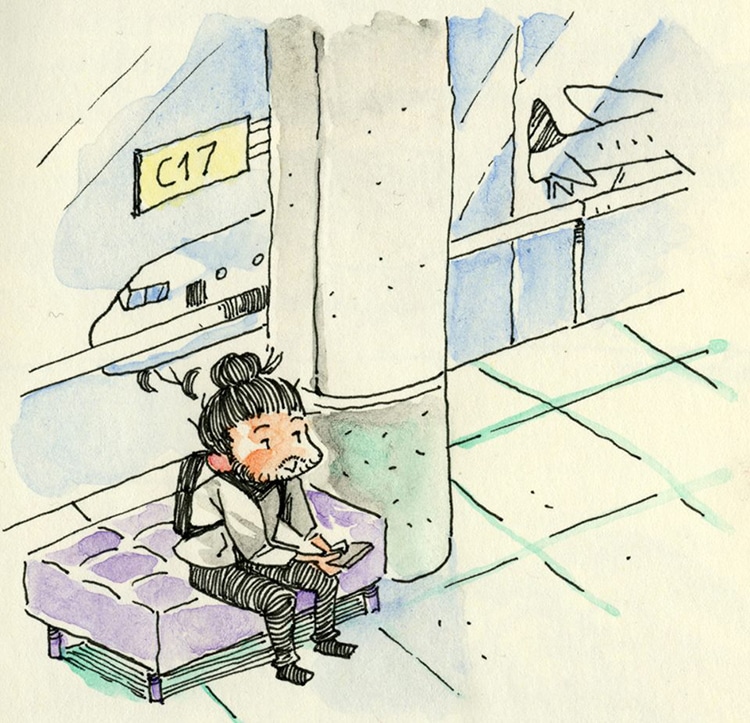
“Naples (Italy) Airport”

Italian digital artist Simone “Simz” Ferriero met and fell in love with his Toronto-based girlfriend Krisi online. The couple started to chat regularly after Krisi saw Ferriero on the streaming platform, Twitch. Soon after they began a long distance relationship, and as their love blossomed, so did their desire to meet in real life. Ferriero decided to take the plunge and book an intercontinental flight to Canada to stay with Krisi for two weeks in December 2017. From the nerve-racking plane journey, and their first kiss at the airport, Ferriero illustrated the couple’s adorable moments and published the drawings in a Facebook album series called The first time we met.

“I had a lot of stress while traveling alone,” said Ferriero. “But I was very determined.” His charming visual diary illustrates the first time the 5’6 artist set eyes on his 5’9 girlfriend, and their time together exploring the sites of Toronto. Having loved drawing ever since he was a child, Ferriero decided to study at the Academy of Fine Arts during his twenties. “After graduation, I hopped around doing a few jobs here and there for a few of startup companies as a graphic designer for a while, but then I decided to embrace the path of a full-time freelancer.”

Since publishing his heart-warming illustrations, the artist has received new-found attention and support online. Delighted, Ferriero wrote on Instagram: “I just want to say thank you, my hope has always been to inspire people with my art, and you make me feel like i did it.” The couple have already planned their next meet-up—Krisi will visit Ferrireo in Italy in May.

You can see more of Ferriero’s work on Instagram.

Italian digital artist Simone “Simz” Ferriero illustrated moments from the first time he met his Toronto-based girlfriend.

Long Distance Relationship Illustrations by Simone Ferriero

“Flying”

Ferriero’s drawings illustrate his nerve-racking plane journey…

Long Distance Relationship Illustrations by Simone Ferriero

“Airplane Wing”

Long Distance Relationship Illustrations by Simone Ferriero

“Mountains (Alps)”

Long Distance Relationship Illustrations by Simone Ferriero

“Frankfurt Airport”

…their first moments from the airport to “home” together…

Long Distance Relationship Illustrations by Simone Ferriero

“First Look”

Long Distance Relationship Illustrations by Simone Ferriero

“First Kiss”

Long Distance Relationship Illustrations by Simone Ferriero

“Escape the Airport Parking”

Long Distance Relationship Illustrations by Simone Ferriero

“Arrived”

Long Distance Relationship Illustrations by Simone Ferriero

“First night together”

…and their time exploring Toronto.

Long Distance Relationship Illustrations by Simone Ferriero

“Ripley’s Acquarium of Canada”

Long Distance Relationship Illustrations by Simone Ferriero

“Spilling Coffee”

Long Distance Relationship Illustrations by Simone Ferriero

“Coffee Shop”

Long Distance Relationship Illustrations by Simone Ferriero

“Cold weather”

Long Distance Relationship Illustrations by Simone Ferriero

“Insomnia episodes”

Long Distance Relationship Illustrations by Simone Ferriero

“Mall”

Long Distance Relationship Illustrations by Simone Ferriero

“Lazy boys”

Long Distance Relationship Illustrations by Simone Ferriero

“Royal Ontario Museum”

Long Distance Relationship Illustrations by Simone Ferriero

“Sick”

Long Distance Relationship Illustrations by Simone Ferriero

“Christmas Trip to Oshawa”

Long Distance Relationship Illustrations by Simone Ferriero

“Art Gallery of Ontario”

Long Distance Relationship Illustrations by Simone Ferriero

“Netflix & Chill”

Long Distance Relationship Illustrations by Simone Ferriero

“Tickling”

Long Distance Relationship Illustrations by Simone Ferriero

“Me Sick”

The charming visual diary could warm even the coldest of hearts.

Long Distance Relationship Illustrations by Simone Ferriero

“Promise”

Long Distance Relationship Illustrations by Simone Ferriero

“CN Tower”

Long Distance Relationship Illustrations by Simone Ferriero

“Elevator ear poppin”

Long Distance Relationship Illustrations by Simone Ferriero

“CN Tower Restaurant + Final Bill Surprise”

Long Distance Relationship Illustrations by Simone Ferriero

“Gift shop”

Long Distance Relationship Illustrations by Simone Ferriero

“Some local(?) food”

Long Distance Relationship Illustrations by Simone Ferriero

“Extra” portrait

Simone Ferriero: Facebook | Instagram | Tumblr | Deviant Art

My Modern Met granted permission to use photos by Simone Ferriero.

Related Articles:

Artist Surprises Girlfriend with Illustrations of Them Together in 10 Different Cartoon Styles

Charming Watercolor Illustrations Explore the Simple Moments of Love

Helpful Illustrations Define Feelings of Love That Have No English Translation

Korean Artist’s Illustrations Capture the Intimate Moments of a Couple in Love

Sweet Couple Illustrations Capture the Essence of True Love in Everyday Moments

The post Artist in Long-Distance Relationship Illustrates First Time Meeting His Girlfriend in Real Life appeared first on My Modern Met.

http://ift.tt/2mKcgHf

A purple and pink winter sunrise paints the sky at Charles M….

A purple and pink winter sunrise paints the sky at Charles M. Russell National Wildlife Refuge in Montana. It’s a scene Charles M. Russell would have enjoyed. The refuge was named in recognition of this colorful western artist who often portrayed the refuge’s landscape in his paintings. Along with the stunning scenery and amazing wildlife, the refuge boasts a fantastic history that includes mountain men, Native Americans and dinosaurs. Photo by Mary Jo Hill, U.S. Fish and Wildlife Service.

The Best Tips On How to Be A Successful Medical Representative

“Choose a job you love and you will never have to work a day in your life.”

Confucius almost had it right when he offered this famous advice.

You should strive to choose a job you love. However, even passion and motivation come with hard work, a strong will, and determination. As a medical sales pro, you’re no stranger to the mountains and valleys associated with loving your career.

Luckily, for many in this field, happiness associated with their medical sales jobs is higher than ever. In fact, according to a report, 76% of medical sales representatives are satisfied with their jobs. The same report also found 47% percent are not looking for a new job-  that’s almost 50% lower than last year’s results.

These medical sales pros know the secret to being happy in a demanding field and that is to be your greatest advocate. Here are some of the best tips on how to be a successful medical representative and achieve happiness in your job.

Don’t settle

True career happiness is only possible when you step outside of your comfort zone. In fact, you may not even know you’re settling for a less-than-perfect career unless you start evaluating where you stand now.

Ask yourself a few simple questions:

  • Am I passionate about the product I’m selling?
  • Is my need to help others being fulfilled?
  • What are my ultimate career goals and can I reach them here?
  • Do I feel challenged?
  • Does my personality and selling style fit with this company culture?

Most medical sales reps agree that the key to success is believing in the product you’re selling. This cultivates even more passion and allows reps to feel they’re honestly bettering the lives of their customers and patients.

If your current company isn’t investing in research and development or you’re just not excited about their product, consider what would reignite your selling fire.

Now is the time to really evaluate yourself as a salesperson.

Write down actionable steps to reach your career goals. These goals need to be challenging and intimidating. You should feel they are attainable no matter how far in the future and that you have your employers’ support.

Phone a friend

call a friend

Sales reps often forget to ask for help because they are mostly on the road and with customers.

This can be detrimental to your relationships with your co-workers. If you don’t address that right away, it can hurt your development.

Building a strong relationship with your co-workers can help you stay motivated. It can also give you an understanding shoulder to rely on. It can help you overcome obstacles, too.

Open up your schedule to meet with your co-workers. Making time for them can help you slow down, build relationships, and learn even more about your career.

Remember to always ask questions. Your peers have had different medical sales successes and failures than you. It’s important to give yourself the opportunity to carry those lessons into your own career.

Know your size

Medical sales isn’t a one-size-fits-all business.

Companies come in all shapes and sizes. Each one also has its own culture and managerial styles. Knowing what fits your personal style can help you make the best decisions regarding your career.

Start by figuring out what motivates you.

If you enjoy closer personal relationships with management and co-workers, a smaller company will fulfill those needs. However, if you like working with a big group, a large company is what you need.

You may be unsure which company size is your best fit and that’s OK!

Don’t be afraid to reach out to your network of peers from other companies. Ask them about what they love about their company, how managers help them, and what a normal day looks like for them.

Find a mentor

find a mentor

The process of finding a mentor isn’t quick and easy but it’s worth the end result. Scanning a room and picking the first person you see won’t help you. Even looking for the most successful medical sales rep isn’t the best approach.

Search for someone who has a similar personality, selling style, and attitude. This will help you connect and relate on a deeper level. The more comfortable you are, the easier it will be to ask questions about their key to medical sales success and happiness.

See Also: 6 Ways Happiness Can Help You Be Better At Work

The post The Best Tips On How to Be A Successful Medical Representative appeared first on Dumb Little Man.

http://ift.tt/2rbPv3x

5 Proven Tips To Cut Your Workout Time In Half And Double The Results

It’s the new year and it’s time for everyone’s favorite new year resolution- losing weight.

If you are one of those people who want to lose weight this year, there are 5 things I would like to share with you to help you get a good head start and build momentum to achieve your fitness goals.

We all know that weight loss is one part nutrition and one part training. However, in this post, we’re going to focus on the training part.

You see, how you approach your training is crucial to the results you’ll get. The more consistent you are with your training, the better chances you will lose weight. It can help you avoid injury, too.

Stop doing isolated exercises

I know!

The most popular type of training will always be split training. It’s where you only train certain parts of your body, like chest, biceps, triceps, back, and legs.

Instead of committing to that, try to focus on circuit training using compound movements (multiple muscles used at once).

One thing that circuit training with compound movements has done for me is it has transformed my body into a fat-burning furnace even when I’m sleeping or sitting on a sofa.

Who wouldn’t want that?

Circuit training raises your heart rate so much that your body will have a hard time making up for the oxygen deficit. As a result, it will have to compensate by consuming more oxygen after your workout is done. This causes continuous burning of calories or the EPOC effect.

I never really knew what exhausted meant until I started doing circuit training. After each round, I find myself breathless, crunched over, and feeling a little dizzy. That’s a great sign that you had an intense workout.

By the way, if you are working out hard, you won’t be able to do it for long. This is why circuit training only takes about 15 to 25 minutes, including rest periods.

Stop doing the same things over and over

For new beginners, the first few weeks of working out are typically the best time to see changes in your body.

You seem to be losing weight at a fast rate and your muscles are getting more defined. You feel like you’re getting stronger with each session- until you hit the plateau.

Suddenly, you stop seeing gains and losing weight. It gets hard to lose the remaining few pounds.

Hitting a wall can be very frustrating.

Our bodies are so smart that they can adapt to the type of training that we do. It becomes more efficient at spending energy, which can bring your weight loss to a halt.

Changing your workouts often (every 3 weeks) keeps your body guessing. This pushes your body to continuously burn fat and build muscle at optimal rates.

See Also: Finding your Fitness Passion

Stop focusing on lifting weights alone

Body weight exercises are ignored pretty often. I know I made this mistake before and there are plenty of people who commit the same mistake, too.

Athletes, like gymnasts, do body weight exercises for hours and they look phenomenal. They’re very strong and powerful, too. They look strong with well-defined muscles.

It may sound easy, but they’re not, particularly if you incorporate it into your circuit training.

Stop running for hours

running

Running is a popular weight loss exercise. It’s cheap and requires no equipment.

Although those things sound great, running isn’t for everyone. If you are new to it, make sure you do it correctly so you can avoid nagging injuries and stalled weight loss.

Just like when you lift weights, long and slow cardio exercises have a pretty good effect on the first few weeks until you reach a plateau. Once you reach that point, switch to high-intensity interval training (HIIT).

HIIT is becoming more and more popular these days because it takes a shorter amount of time (usually around 15-25 minutes) and gives better results in terms of weight loss because of EPOC.

Change your HIIT every 3 weeks and you’ll lose more weight.

See Also: How To Start Interval Training The Right Way

Stop using machines

use kettle bells

Machines are a great help in any exercise routine. Unfortunately, they can alter the way your body moves. They can even prevent you from fully using your range of motion.

In some cases, machines can also put excessive strain on your muscles and joints. If not addressed right away, you can end up with injuries which can affect your weight loss journey.

Instead of relying completely on machines, try using free weights like dumbbells, barbells or kettlebells.

BONUS TIP: Stop doing sit-ups to get awesome abs

We all have 6-pack abs. They’re just being hidden under a layer of fat in our belly. Burn the fat over it and you’ll see your abs.

The best way to do that is by doing circuit training with compound movements/body weight exercises and HIIT. If you train correctly, you do not have to do a single sit-up to see your awesome abs.

Obviously, you have to keep your nutrition in check so you don’t consume more calories than you need. In addition to that, you also need to choose the correct types of exercise so you can burn more fat efficiently.

Final Thoughts

There are a lot of people out there with busy lives. Some have to juggle work with school while others have young kids to take care of. There are people who work long hours, too.

If you are one of them, it’s important that you find the most efficient way to burn fat. This can help you get started on your weight loss journey.

After finding the best workout for you, commit to it.

If you cannot set aside 20 minutes a day to exercise (that’s 2 hours out of 168 hours in one week), you are never going to lose weight. So, give your best effort in the 20 minutes you are training and good luck on your journey!

The post 5 Proven Tips To Cut Your Workout Time In Half And Double The Results appeared first on Dumb Little Man.

http://ift.tt/2rccHia