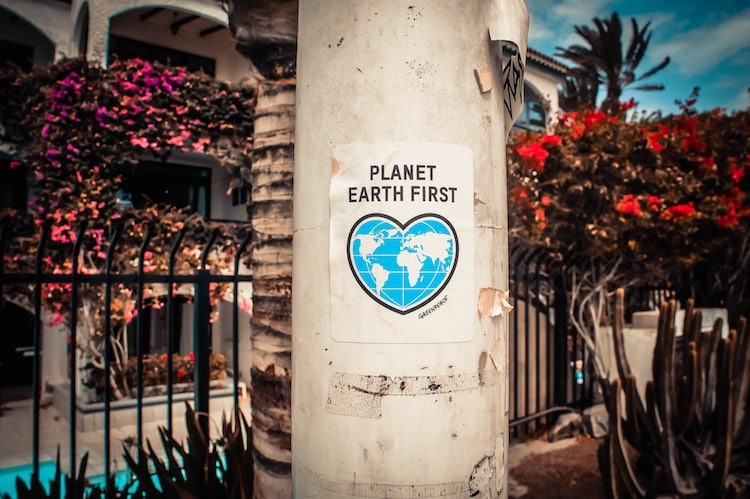
Interview: Designer Dedicates Her Career to Discovering the Hidden Impact of Consumer Goods on the Environment

Did you know that most average Americans live as though they have 4.8 planets? This is what Dutch industrial designer Babette Porcelijn discovered when she largely left behind a thriving business working with commercial clients to focus on the hidden impacts of design.

After 11 years working with agencies, she began her own design studio in 2011. And since 2015, she’s dedicated her career to studying how we can make an “eco-positive world” through our choices as designers and consumers. Her book, De Verborgen Impact (Hidden Impact), maps the environmental impact of the consumer, giving a large scale view in order for individual understanding of how each choice made contributes to the larger problem.

In her research, Porcelijn looks at everything from the global impact of importing and exporting to the environmental toll of producing single consumer items, such as a laptop computer. Her “Impact Top 10” breaks down, with surprising results, the average items used by consumers that cause the largest amount of environmental impact. Who knew that meat would come in second, beat out only by consumer products, but well above cars? (If you speak Dutch and want to understand your individual impact, answer a few questions to see how you compare to others.)

We had a chance to speak with Porcelijn about her work and how she hopes her book can help create change both for consumers and designers. Read on for our exclusive interview.

Babette Porcelijn hidden impact

How did the idea for your book come about and when did you start the research for it?

At the beginning of 2014, my husband Rick and I were at home sitting on the couch. The kids were out and we talked. He told me that the sixteen largest container ships emit as much sulfur as all the cars in the world together. I was surprised. When he told me that every day 27 million trees disappear, while trees remove CO2 from the air, I was shocked.

Rick had delved into it, and as he went on telling me more, my image of our world tilted. I thought we were doing a pretty good job here in the West, but at that moment I saw we just moved our impact out of vision, to the other side of the world.

The rich consumer buys a lot of products, but he does not see the impact the production of these goods has on the environment. How can you make sustainable choices if you don’t know what’s going on? The decision was made in a split second: I’m going to do something about this!

What surprised you the most about your findings?

When I started to investigate, I was shocked to find out that often I couldn’t find answers to my questions. Even worse, sometimes there were no words to describe the things I wanted to talk about. The worst finding, perhaps, was the fact that there was no impact top 10 of the average consumer, including hidden impacts. This is the first thing we need to know if we’re going to effectively change our daily routines, right?

Babette Porcelijn industrial designer

You found that importing and exporting goods is part of what causes the issue with products and their impact on the environment. Can you explain why this is and what solutions you see to solve the issue?

As Western consumers, we have more impact on the environment than we think. Not just at home or at the pump, but also on the other side of the world, by producing and transporting the things we buy every day. If you include this hidden impact you can change your everyday life more effectively. I investigated the hidden impact of our daily lives and my book provides the knowledge and tools to live an eco-positive life.

If we assess the impact of the consumer, we usually only consider environmental impacts caused by the use of a product. Furthermore, we mainly look at climate effects, but if we solve the climate problem, and we don’t solve problems like water scarcity, pollution or plastic soup, then we still have a problem.

Over the last few decades, rich consumer countries have moved much of their industry and agriculture to low-wage countries. Production comes with lots of impact on climate, nature, and environment. Rich countries import these products and this food and their consumers buy these. But we often leave the “hidden impact” out of the equation.

Babette Porcelijn Verborgen Impact

Why do you think it’s important, as a designer, to be aware of the environmental impact of consumer goods?

Designers can make a big difference in many ways. First, we are beginning to understand what we should NOT do anymore—and Hidden Impact reveals that thoroughly—but the next question is, what to replace the fulfillment of our needs in a sustainable way? What SHOULD we do? And that is a design challenge! I think we need to work together with scientists to come up with the best solutions.

Second, we are trained systems thinkers, and the world needs those—product designers can design circular products, and circular business models, while product designers and architects can design for long endurance products, with renewable materials and design for disassembly and reuse.

We could take responsibility for the products we put in the world; do we want to add more stuff people don’t really need into the world, while it damages the environment and brings our joint future in jeopardy, while the ones who benefit have commercial motives instead of humane motives? Also, design for communication: tell the world what’s at stake and what we can do about it, inspire them with awesome alternatives which are more attractive than our current ways

In short, we need nothing short of a paradigm shift and we need designers to make it a good one. Eco-positive and fair.

How has your research been received thus far?

When I started out, I thought nobody would be interested in a book about the environment. But I really wanted to make this book because I thought it was important, so I made the book I wanted to make. Along the way, I received a lot of positive feedback and since publication in Holland, things have gone crazy!

We’ve already sold over 5,000 copies in Holland, and today I’ve sent the fourth edition to the publisher. My inbox overflows with requests for an English version and I’m working on the U.S. edition—still looking for a publisher in the U.S. though.

I was in Brazil last week, and there it was received with enthusiasm: I was on Globo (biggest national network), headlines on BBC Brazil and Casa Vogue, etc. In Holland, I’m fully booked for lectures and interviews. All these things are great, and at the same time, I’m a bit worried, because when am I going to find the time to write my next book?

Babette Porcelijn environmental impact of consumer goods

How do you hope your findings are used by the public?

The best thing that can happen—and it does, people tell me—is that people actually change their lifestyles. I will never tell people what they should or shouldn’t do. I merely help those who want to make effective changes to improve their environmental impact. And I hope to inspire people as a side-effect of my research.

Babette Porcelijn environmentalism

Some of the biggest issues you mention, like microplastics, come from items like car tires. With this being such a common item, do you know of any companies working on alternative solutions?

It is a common item, but it isn’t common knowledge yet. Nevertheless, I’ve heard about research for better tire materials, but that’s difficult to tackle since biodegradable plastics in nature aren’t as biodegradable as in the lab. We could catch run-off from the roads and clean it, and we could choose a different means of transportation (bike, walk, and public transit).

Babette Porcelijn environmental research

Aside from a U.S. edition, do you plan on having your book released in other languages as well, to reach an even wider audience?

Oh yes, for sure! If we want to save the world, we need as many people on board as possible. Especially in rich consumer countries, which have—on average—the biggest impact. In the twelve biggest economies in the world lives 13% of the world population, but we cause 55% of the impact! That means that with 13% of the people, we can reduce over half the impact, and that’s a hopeful thought to me.

What would be your message to consumers about the impact their choices have on the environment?

We, consumers, are key. Ultimately, we decide everything that’s going on in the world, even though we often don’t realize it. We buy products and with our money, companies thrive. They can either damage or save the environment, and we get to choose which ones survive by buying their stuff. We decide who our politicians are and what they will fight for. The more money you have, the more difference you can make, either by your lifestyle and daily habits or by devoting yourself as a professional to for an eco-positive society*.

[Eco positive: when you (or a company, or a city/country etc) have a more positive impact on the environment than negative, harmful impact. Protecting and restoring nature, working on family planning and reducing population growth, designing sustainable or eco-positive solutions, cleaning up pollution etc.]

Any upcoming projects or further research you’d like to share?

Yes, I’m hoping to start working on my next book soon, because I’m curious what the best possible (feasible) future would look like. I want to put an attractive dot on the horizon!

Babette Porcelijn: Website | Twitter

My Modern Met granted permission to use photos by Babette Porcelijn.

Related Articles:

Eye-Opening Landscape Photos Explore the Environmental Cost of Human Impact

Mermaid Swims in a Sea of 10,000 Bottles to Spotlight Plastic Pollution

Eco-Friendly Logo Redesigns Promises to Save Millions a Year in Printing Costs

Interview: Photographer Travels to Alaska and Discovers Polar Bears Living With No Snow

The post Interview: Designer Dedicates Her Career to Discovering the Hidden Impact of Consumer Goods on the Environment appeared first on My Modern Met.

http://ift.tt/2i89sko

More Light!

The current retrospective of over sixty years of David Hockney’s work—reaching back to a teenager drawing what he saw in the mirror in 1954—brings together portraiture, landscape, and still life in every kind of combination. It reveals a wonderfully resourceful artist, but one whose working moods have seemed to veer between studious and strident.

http://ift.tt/2iaJD3n

Rachel Whiteread’s Solid Air

There’s something cool yet passionate about Rachel Whiteread’s work. It is calmly paradoxical, domestic but monumental, tactile but detached, nostalgic but austere: objects and dwellings from everyday lives are lifted to a different sphere, a dance in space. In a new exhibition celebrating twenty-five years of her career as an artist, Tate Britain has removed the partitions that usually divide separate rooms, creating a huge open space with white walls and glowing, pale wood floor. She asks us to see things we know—tables and chairs, the inside of a room—from the opposite of our normal perspective, looking at the space instead of the walls, the gaps instead of the frames, making the air itself solid.

http://ift.tt/2j7SVOt

First light streaks across the sky, chasing away the stars over…

First light streaks across the sky, chasing away the stars over Mount Rainier National Park in Washington. The orange dawn quickly reveals the mountains, forests, rivers and lakes scattered across this epic landscape. With beauty like this, it’s an experience you’ll never forget. Photo by Kim Dessoliers (http://ift.tt/18oFfjl).

This Poisonous Cult of Personality

Donald Trump’s election last year exposed an insidious politics of celebrity, one in which a redemptive personality is projected high above the slow toil of political parties and movements. As his latest tweets about Muslims confirm, this post-political figure seeks, above all, to commune with his entranced white nationalist supporters. Periodically offering them emotional catharsis, a powerful medium of self-expression at the White House, Trump makes sure that his fan base survives his multiple political and economic failures. This may be hard to admit but the path to such a presidency of spectacle and vicarious participation was paved by the previous occupant of the White House.

http://ift.tt/2i6Dk0m

The Magic of Appreciation: How to Practice Gratitude

Gratitude is the key to happiness in life, at work, and in relationships.

Studies show that depressed people who engaged in gratitude practice were 25% less depressed after a 12-week period. Interesting, right?

When we are down, we tend to ruminate and go over the same things over and over. Most of the time, it’s about our past and ourselves. We can’t stop being self-critical.

According to a study performed by Dr. James Pennebaker, depressed people used the “I” word at a 6.5% rate, that’s 4% higher than the average person. And those who suffer from a mental illness use “I” 11 times more than other people.

When we focus on the present and we’re grateful for what we have and who we are, we generate positive memories. These are the memories we can reflect on in the future that can help us feel better. Also, focusing on others and what we can do for other people can help us, too. We won’t be using so many “I” words.

So, do yourself a favor and focus on the present, what you have and what you’re doing. Once you are able to do that, you’ll be a happier person.

thank you

Make sure to appreciate the people around you as well. They’ll know it and they’ll reward you in kind.

In one study, twice as many people helped a second time after receiving a thank you email than when no thank you email was sent. The study showed people did it because they felt more socially valued when they’d been thanked.

Dr. Sara Algoe, a US psychologist, emphasized that “Feelings of gratitude and generosity are helpful in solidifying our relationships with people we care about and benefit to the one giving as well as the one on the receiving end.”

On the other hand, a Glassdoor study showed that more than 80 percent of employees say they’re motivated to work harder when their boss shows appreciation for their work.

gratitude

A feedback loop develops when you appreciate others. They begin to think about how they appreciate you.

It is easy to focus on what people are not and how they are different, but when you focus on people’s good qualities, you will be happier around them. They will be happier around you, too.

And what happens when you do the opposite?

Many will get defensive, angry, and lash out, causing you to do the same thing. Best to start off and focus on the right things. This is especially true in marriage.

So, appreciate people for what they are, what they bring to the table and for who they are and not who they are not. This way, you’ll be better off individually and together.

What can you tell about people who don’t say thank you?

Well, the inability to say thank you could be a sign of narcissism. When people feel entitled or full of themselves, they fail to appreciate the complement or the contribution of others. They think they deserve the special treatment or special praise because they are special.

No one wants to be with someone like that. So, make sure to show how thankful you are to those around you.

See Also: A Little Bit of Gratitude, Everyday!

How to get started?

Make it easy.

Try thinking or writing down three simple things you’re grateful for each day. Tony Robbins makes this a daily practice and he starts with something easy, like the wind on the face or the peacefulness of no wind.

You can show gratitude for anything or anyone in your life. It can be as simple as being alive and the opportunity to do things better the next time.

Make it a habit and do it every single day. Over time, your view of the world and life will dramatically change.

Thank you for reading this!

The post The Magic of Appreciation: How to Practice Gratitude appeared first on Dumb Little Man.

http://ift.tt/2jAmW8U

The Power of Forgiveness: How to Forgive (and Ask for Forgiveness) to Regain Inner Peace

You’re reading The Power of Forgiveness: How to Forgive (and Ask for Forgiveness) to Regain Inner Peace, originally posted on Pick the Brain | Motivation and Self Improvement. If you’re enjoying this, please visit our site for more inspirational articles.

Accumulating research supports what spiritual teachers from nearly all traditions have long taught: forgiveness heals. It improves our mood and optimism, brings inner peace, and helps us recover from challenges of all kinds. Even medical doctors are endorsing that forgiveness helps patients recover from injuries and ailments. Forgiveness improves the quality of our lives, helping us to be healthier and happier.

What do we mean by forgiveness? Simply put, we mean to consciously, lovingly pardon someone; to forgive a debt or release a mistake. It’s not about who’s right or wrong. It’s about freedom and acceptance. It’s about letting go of expectations, resentment, and blame. Forgiveness frees us of negativity we might otherwise hold, which is like swallowing poison.

But true forgiveness goes farther than offering forgiveness when we are hurt or harmed. To truly regain our inner peace, we must also seek forgiveness. Most people believe that “what goes around comes around.” This is the essence of the law of karma. When we offer loving and helpful service to others, good karma is accumulated, which blesses us. When we offer unpleasant service to others, bad karma is accumulated, which can block us.

The good news is that we can transform our karma and our lives through forgiveness practice. It helps to consider that our current life experiences are somehow a reflection of our past and present karma. Thus, when we are upset or believe others should ask for our forgiveness, this is also the time that we should go into our hearts and ask for their forgiveness, for any time we or our ancestors may have hurt them similarly before. This is not always easy, but it is quite a beautiful and transformative practice.

While forgiveness can be hard to accomplish, we can succeed with some well-designed practices. We will share a practice with you, but first, here are some tips that may help you open your heart to practice forgiveness more easily:

Keep in mind that we all make mistakes. People who hurt others are also hurting inside. This will help you find compassion, which will help you forgive.

Even if you are not a Christian, you can benefit from the story of what Jesus said during his final hours: “Forgive them Father, for they know not what they do.” This helps us understand that people often hurt others in ignorance. With this wisdom, we may again find compassion for our offenders.

Remember how it feels to receive forgiveness. This will also help you offer it. Recall a time you made a big mistake and were forgiven. Remember how it felt to be forgiven. This will help you understand how important it can be to forgive.

Finally, according to karma wisdom, a very good practice is to turn your situation around. In other words, consider that you have harmed the one(s) who have harmed you, in the past. Sincerely apologize (at the soul level) and ask for forgiveness in addition to offering it. You may be totally surprised by the impact.

Here is a simple forgiveness practice you can do, adapted from the book, Greatest Love – How to Unblock Your Life in 30 Minutes a Day with Unconditional Love by Dr. & Master Zhi Gang Sha, Master Maya Mackie and Master Francisco Quintero:

Dear ____ (name your higher power, such as “God, Divine, the Creator, the Universe), 

I love you. 

Could you please bless my forgiveness practice?

I am very grateful. 

Thank you.

Dear _____ (name any soul(s) you are practicing with, or you can practice with “all souls”),

I love you. 

I deeply apologize for ________ (anything specific, or “all the mistakes my ancestors and I have made that have hurt or harmed you in any way”)

I sincerely ask for forgiveness

Please forgive us.

I forgive you unconditionally.

I would be grateful for your forgiveness.

Thank you.

Dear the “Greatest Love”

I love and honor you.

You have the power to help us love and forgive

Please bless our practice.

Thank you.

Repeatedly chant silently or aloud the mantra, “Greatest Love”. Close your eyes and visualize the beautiful light of Greatest Love coming into your hearts to help you forgive. Feel the Greatest Love helping you to love and forgive unconditionally while you chant. When you are finished, simply close the practice by thanking all the souls.

Love and forgiveness are the golden keys to life. This is a practice you can do daily. You can practice for any challenge by calling the souls that are involved. There is no downside. Everybody wins. Practice love and forgiveness for a happy, healthy and successful life.


Master Francisco Quintero is the co-author of Greatest Love (BenBella Books). He is a Certified Master Teacher trained by renowned spiritual teacher and humanitarian Master Zhi Gang Sha, and the author of Divine Joy: How to Find Joy in Daily Life. A leading teacher at the Tao Academy™, Master Francisco has developed training programs worldwide. With his expertise, wisdom, and knowledge, he has assisted in training over 6,000 soul practitioners and teachers around the world. For more information, please visit http://ift.tt/2nkoIQv and follow the author on Twitter.

You’ve read The Power of Forgiveness: How to Forgive (and Ask for Forgiveness) to Regain Inner Peace, originally posted on Pick the Brain | Motivation and Self Improvement. If you’ve enjoyed this, please visit our site for more inspirational articles.

>