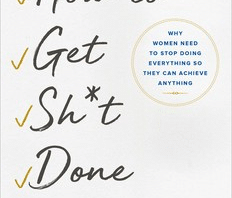
How To Get Sh*t Done – Book Review


Here’s something we could all use in this New Year – How To Get Shit DONE! I stumbled upon this book recently, and to my surprise, it had a huge impact on me. Erin Falconer, the author of the book, states that we are not doing what’s exactly needed to achieve success. As we all know, life isn’t easy; it’s as complicated as can be. But Erin says that this complexity is necessary for us to perform to the best of our abilities. You need to create a crystal clear plan and stop underestimating your self-worth to get work done better, faster, and in a smarter way.

The book discusses the power of being before the power of doing to achieve your goals. The journey begins with the Power of POP. “What’s that,” you ask? Well, simply put, it is Personality, Opportunity, and Productivity. What women want is a huge mystery – we are lost trying to prove our worth to others and are often sidetracked from our paths. What we need is a personality fix. We often wonder how others reap more benefits from work when we put in more hours of efforts. It’s a mindset that has dug its way into our minds, and that’s why we are judged much more harshly. To avoid feeling that way, we need a clear-cut purpose for everything we do so that our productivity is rightly measured.

We are all busy, but the things we spend the day doing, do we need them all? The only approval you need is yours. This is a lesson we could all use. Do things that give you the most satisfaction and not what others expect from you. Before that, you need to be clear about who you are. Be your true, natural, “wild” self. Think and reflect on what you are doing to judge the situation better. When you talk about opportunities, you might assume that you are seizing them all, but, in reality, you are not. Understand what is holding you back, and you will be able to overcome any obstacle in your path.

Erin stresses that it is important to listen to the voice inside of you so that you can prioritize what you need. By taking charge, you make sure that you are your own boss. Women have been so conveniently objectified, not just by men, but even women too. We have been stereotyped to be just observed and not observe. Don’t you agree? My main takeaway from this part of the book was to stop focusing on what others think and monitor your judgments. In Erin’s words “Bring your focus back to what you’re doing rather than how you’re looking.”

Moving on to one of my favorite chapters from the book, “You and Your Smart Mouth.” You get a rulebook as to when and how you can say no. I believe its something we women could use. When you stop doing and saying what you don’t want, you will be able to focus on things you want to. It doesn’t need to end with a no; you can suggest an alternative. Do not be so bothered about disappointing someone else. Instead, look out for yourself. When you have a short list of things you need to work on, you will be more focused and move forward at full speed without worrying about the rest that you don’t need.

Check yourself always before setting those goals you have in mind. The author is right about this; you need to know the kind of person you are and set your goals to fit your personality. Once I grasped this concept, I knew I had to start afresh. You may think that you are using your time well. Well, that’s what I thought before I read this book! I realized that I could use it better than I did earlier. When we talk about time, we are not talking about how you can stop it or slow it down. We can’t control time, but what we can do is make priorities. Use your time well, and use it to get what’s most important done first and scrape off what you hate doing.

Reading this book helped me make my peace with people. You will come across all kinds of people along your way. You need to be a good judge of character and identify the ones who will help you grow. The relationships in your life, friends, family, and acquaintances are all said to have a strong influence on your professional life as well and vice versa. The best way to get work done and maintain relationships is to be honest and be yourself. I must say that this part changed my perspective. I started paying more attention to how I felt and began being more intentional in everything I did.

Why just aim for success when you can make an effort to enjoy your journey by investing in your well-being and helping yourself grow? The moment I read this book, I knew I had to start putting things into action. You need to get moving if you want to get sh*t done. Don’t just go about aimlessly striking things off your to-do list. Analyze your final goal and work accordingly. Thanks to Erin, I seem to have figured things out much better now.

———————

Nisha is passionate about writing and loves to share her thoughts with the world. She has written many articles on yoga, fitness, wellness, remedies, and beauty. She keeps herself updated by going through interesting blogs every day. This fuels her passion and motivates her to write appealing and engaging articles. She is a regular contributor to StyleCraze.com and a few other websites.

You’ve read How To Get Sh*t Done – Book Review, originally posted on Pick the Brain | Motivation and Self Improvement. If you’ve enjoyed this, please visit our site for more inspirational articles.

>
It’s not what you see, it’s how you see it…

Here are all the countries kicking out Russian diplomats over…

Profitability is directly linked to political stability. Decision makers need to connect the dots..

Stop wasting time...cropped, London or Japan can impact the success of most decisions; you’ll be surprised how much political volatility costs. Political risk analysis needs to be an integral part of the decision making process. What impact will tensions in certain political areas have on your business? Make political risk analysis an integral part of your business making process. Interested? Please text; +1 917-935-4744

The Recovering: Intoxication and Its Aftermath

I once attended a screening of The Lost Weekend, the film version of Charles Jackson’s 1944 novel about an alcoholic, where the audience fell captive to a college campus projectionist. Around two-thirds of the way through, it became clear that something was off with the movie — the protagonist was about to take a stumble, but didn’t he fall down a stairwell a few minutes ago? The film stopped, the house lights came on, and the projectionist apologized for mixing up the reels. We all carried on like it didn’t matter, because it didn’t: Until the film’s pat, upbeat redemption arc at the very end, the film was all drunken despair anyway.

In her superb new book on alcoholism, The Recovering, Leslie Jamison deliberately shuffles the reels of the familiar recovery narrative, even while acknowledging the futility of doing so. An alcoholic in recovery herself, she opens her story announcing that she’s “wary of the tedious architecture and tawdry self-congratulation of a redemption story.” Every good writer instinctually wants to explode clichés and familiar tropes, and there’s much about The Recovering that’s inventive: its careful braiding of memoir and literary criticism, its close observation of addiction and creativity, its comprehensive grasp of the way alcoholism provokes scapegoating, solipsism, fear, shame, and solitude. And yet the redemption story won’t be blown up, behaving as if it were encased in twenty feet of concrete. Familiar as it may be, the redemption story is what helps save her. There may be nothing new to say about the AA meeting in the church basement — indeed, its central virtue is its familiarity. But the power of the book is in Jamison’s openness about how conflicted the redemption story makes her anyway, enchanted and skeptical and back again.

The struggle is worth pursuing, because while there may be one redemption story, it’s one that shifts often at its margins. The day after the second time she went sober, Jamison crashes a friend’s car. “If I was going to stop drinking, I was supposed to discover a spectacular new version of myself, or at least recover the presence of mind not to accelerate into a concrete wall,” she writes. “But sobriety didn’t work like that. It works like this: You go to work. You call your friend. You say, I’m sorry I crashed your car into a wall. You say you’ll fix it. Then you do.” Those sentences are among the simplest in the book, and the simplicity is hard fought for, because she’s invested in the notion that words and stories are relevant to recovery. Interpolated into her own story are the stories of other artists who struggled with drinking, and how it shaped their art. In poet John Berryman she sees “the sweet boozy whiff of tangle and rupture.” In Jean Rhys she sees a writer who wasn’t allowed to see herself “as a rogue genius, like the drunk male writers of her generation. She was always forced to understand herself as a failed mother instead.” Even a rather straightforward work like The Lost Weekend offers something telling in what it doesn’t do: Jackson “refused the idea of drinking as metaphysical portal. In the novel, alcoholism isn’t particularly meaningful, it just is.”

And so on, including David Foster Wallace, George Cain, Malcolm Lowry, and Raymond Carver. Jamison seeks a common thread between these writers, their drinking, their recovery, and their creativity. (The book began as a dissertation on the topic.) But such threads prove elusive. A sober Charles Jackson wrote an unpublished second novel of impenetrable doggerel. Carver’s literary career had an infamously redemptive second act after he quit drinking, but he also used cocaine during his “sober” years. So what kind of sobriety are we thinking of, exactly? “My dissertation was reckoning with a question I hoped might bridge these worlds, examining authors who’d tried to get sober and exploring how recovery had become part of their creative lives,” she writes. “It wasn’t criticism as autobiography, exactly, so much as speculative autobiography — trying to find a map for what my own sober creativity might look like.” Ultimately, though, what she finds isn’t a model so much as an accrual of usable evidence to consider. Many writers had tried sobriety. Some had succeeded. She could try and succeed too.

Jamison is an adherent of Alcoholics Anonymous, which she acknowledges isn’t the sole proven path to sobriety. (Though that acknowledgment may be too brief to please some readers.) She’s less focused, though, on the Higher Power than with the we in Step One, those who find themselves helpless over alcohol. For Jamison, the communal aspect of meetings, the sharing of “drunkalogs,” is what helps. The urge for sharing makes sense, since so many of the agonizing anecdotes she shares about herself involve moments when she is isolated and unprotected: walking home drunk one night and getting punched in the face; another night when she was raped; many other nights drinking alone or going to parties and chasing isolation. “I got so drunk I had to lock myself in our bedroom and slap myself — hard, across the cheek — to get myself undrunk again. It didn’t work.” Her boyfriend throughout the period is a poet whose flirtatious personality stokes her jealousy, but without any actual infidelity to point to, her jealousy is a projection of an unresolved loneliness.

Is it too easy to connect those fears to her drinking? Is it too simplistic to call the fellowship she finds in church basements a balm to those fears? The book’s very bulk answers the question: The Recovering is nearly 500 pages and has such as intense and clarified energy, such a bone-deep compulsion to work out recovery’s paradoxes, that you feel she could go on for twice as long. (And I would happily read that book.) And yet, in the same way that all those literary writers’ experiences matter, the drunkalogs she hears in meetings matter, because they become part of a more basic story. “The paradox of recovery stories, I was learning, was that you were supposed to relinquish your ego by authoring a story in which you also starred,” she says.

She’s the star of The Recovering, but her experience is rooted in those of countless others. They make meaning not because they’re unique, but because they’re shared; they live in their telling.

The post The Recovering: Intoxication and Its Aftermath appeared first on The Barnes & Noble Review.

The Barnes & Noble Review https://ift.tt/2GvkNsF

A New Dawn in Uzbekistan?

After spending decades as a pariah state, feared or at best ignored by even its near neighbors because of its reputation as one of the most repressive and closed nations in the world, Uzbekistan is slowly emerging from the shadows. Along with other Central Asian countries, Uzbekistan is worried about the expansion of the Taliban and ISIS into Afghanistan—and, under a new president, is for the first time taking the lead on making peace in the region.

https://ift.tt/2Gfzukg

On foggy mornings, an eerie calm falls over Sam D. Hamilton…

On foggy mornings, an eerie calm falls over Sam D. Hamilton Noxubee National Wildlife Refuge in Mississippi. The water is still and the air is thick. With 48,000 acres of forests, fields and waters, the refuge is excellent habitat for eagles, alligators and the endangered red-cockaded woodpecker. Visitors enjoy fishing, hunting, hiking, and wildlife photography and observation. The refuge also serves as an outdoor classroom for Mississippi State University and other local educational institutions. Photo by U.S. Fish and Wildlife Service.


‘Così’ in Coney

There are few operatic works so cheerfully indifferent to morals as Così fan tutte, and it was largely deplored and rarely performed through most of the nineteenth century. Mozart’s librettist, Lorenzo Da Ponte, Jewish by birth, became a Catholic priest and then caused scandal by his libertine love affairs before leaving the priesthood; he was having an affair with the soprano who created the role of Fiordiligi. As for Mozart, he was the man who knew all about the serial courtship of sisters, since he first fell in love with Aloysia Weber and then married her younger sister Constanze.



https://ift.tt/2pI1Yc9

Creating A Car Budget: 7 Things You Can Give Up For That Brand New Car

Getting a new car is way cheaper than you think. In fact, buying a car on finance can even be less expensive than the monthly cost of a fancy new iPhone, broadband contract or your gym membership!

So, ready to hit the open road?

Here’s how to set your car budget by giving up some of your unnecessary expenses.

Cut: Daily coffee fix
Get: Honda Jazz

daily caffeine fix

It’s easy to fall into the trap of buying a latte on your way to work every day, especially when every other store is a coffee house. But do you really want that expensive coffee or is it simply a force of habit?

The average American spends a whopping $1,100 a year or $91 a month on coffee. Forgo the daily coffee spend and make your own at home instead and you could easily afford to buy a Honda Jazz with those savings. It’s perfect for zooming around the city.

See Also: Top Tips In Buying A Car With Your Significant Other

Cut: Apple iPhone X 64GB
Get: Toyota Aygo

The new Apple iPhone created a buzz as soon as it was released. Unfortunately, the buzz subsided once consumers saw the monthly contract prices that come with the phone- an eye-watering $157 a month!

If you don’t really need the latest smartphone and all its associated tech, why not go for a lesser and cheaper model. Do so and you could afford to buy a Toyota Aygo!

Cut: Monthly nights out
Get: Seat Ibiza

A night out in a big city costs around $83 a pop by the time you’ve bought drinks, paid entry, and possibly had a late-night snack. To sum that up, that’s about $332 a month.

Do yourself a favor by giving up a few big nights out. You won’t only enjoy more hangover-free mornings (which your head will love you for) but you’ll also be able to treat yourself to a Seat Ibiza instead.

Cut: Takeout food
Get: Peugeot 108

pizza takeout

Leading a busy life means it’s tempting to call in a takeout after a hard day at work. And the rise of fast-food ordering apps means you can order a pizza in a matter of moments.

But at a monthly cost of $153, takeaways don’t come cheap. Do your waistline and your wallet a favor and ditch them. That way, you can drive away in a gorgeous Peugeot 108 instead.

Cut: Cigarettes
Get: Audi A1

Smoking your way through a 20-pack cigarette costs a staggering $447 a month. Not only is it a painfully expensive habit, it is also proven terrible for your health. Why spend that much money on something so bad for you when you could put that money towards a set of wheels instead?

Forget your cigarettes and you’ll start to look, feel, and smell better in days. You can treat yourself to an Audi A1 as a reward.

Cut: Luxury subscription services
Get: Toyota Previa

Luxury subscription box services where you get, for example, some tasty organic food delivered to your door a few times a month are super trendy right now. They’re also expensive, costing around $86 a month.

If you find that most of the food usually ends up left uneaten, your subscription might not be all that worth it. Cut it out and you could afford to make monthly payments for a Toyota Previa.

Cut: Date night
Get: Vauxhall Corsa

Now, we’re not for a minute suggesting you shouldn’t go on dates. But if you’re willing to go on one less a month, you’d be saving yourself a sizeable $104. That’s enough to buy a Vauxhall Corsa! Log off Tinder and get behind the wheel instead. Dating is overrated anyway, right?

By cutting out some of your non-essential expenses, you can easily create your car budget. If you are still in doubt how to start, you can use a car finance calculator to find out which vehicles will suit your budget.

The post Creating A Car Budget: 7 Things You Can Give Up For That Brand New Car appeared first on Dumb Little Man.

https://ift.tt/2IVEIiP

5 Effective Ways to Overcome Chronic Substance Abuse

When you are deeply addicted to drugs or alcohol, you pretty well know how the craving and yearning for getting intoxicated overpower your senses. At some point in time, you want to give up your addiction, break the shackles and get back to life, but to no avail. This is what the chronic nature of substance abuse does to you; it just takes a turn for the worse – a condition called “relapse”. In simple words, the term relapse refers to a person stopping the use of drugs or alcohol for a period of time and then starting to use again.

On the face of it, conquering substance abuse seems difficult and challenging, but it is certainly not impossible. With the right kind of treatment, support and direction, you can defeat addiction along with self-help and determination. If you have already tried and failed to overcome substance abuse, don’t think there’s no way out. However, the road to recovery is not that easy either; but with a sheer willpower and a strong resolve you are bound to succeed.

Here are some powerful ways to overcome chronic substance abuse:

  1. Understand your cravings

Being aware of your craving and knowing how to manage it is a constructive way to stay on track with your recovery from addiction. During the process of recovery, many people assume that cravings are a sign of relapsing. The truth is you only relapse when you revert back to using a substance to ostensibly cope with life stress and demands. It is quite natural that you feel that strong desire of getting intoxicated from time to time. The effort of eliminating cravings, therefore, is futile, rather you should recognize when your craving cycle begins and curb it before it pulls you in a downward spiral. Typically craving cycle works in three phases – trigger response, obsessive thinking, and full-blown craving. However, powerful these symptoms might be, the craving cycle is definitely not beyond your control. The key is to nip it in the bud the moment trigger response begins.

  1. Find an alternative source of pleasure

There are many reasons why people turn to drugs and alcohol, and all of them can be fulfilled with other activities. So you can still experience your life’s blessings without abusing substances. Since everyone wants to feel good and changing societal norms have become such that one naturally gets drifted towards mind-altering substances, so you have to understand that there are other ways of enjoying life. Drug and alcohol intake encourage your brain to release dopamine; however when the substance abuse becomes overwhelmed with time, the release of dopamine becomes less and less, and you become deeply indulged. As a result, cravings get harder to handle. Therefore, you need to fill your life with a wide variety of fun and engaging activities that will make you feel satisfied and happy.

  1. Seek professional intervention

Quitting drugs and alcohol cold turkey is often very difficult; therefore it is better to look out for professional intervention. The National Council on Alcoholism and drug dependence defines intervention as a “professionally directed education process resulting in face-to-face meeting of family members and friends along with the person in trouble with drugs and alcohol. When you find the best interventionist, it will be easier for you and your family through the initial recovery process and finally bring about positive change. Since quitting cold turkey might exacerbate side effects and relapse, medical supervision will be the best bet for you. The different treatment options available in the intervention are: rapid detox, inpatient/outpatient treatment, and drug/alcohol rehab. In addition to that, counseling is also very important part of substance abuse treatment.

  1. Change your lifestyle

If you have determined to overcome your drug/alcohol addiction once and for all, you need to change your lifestyle for better. You have to overhaul everything from your daily routine to the way you handle daily stress and down to the family and friends that you rely on for support and guidance. To that effect, following a healthy routine is very important for you to give a new lease of life to yourself. Apart from that, physical activity and exercise can prove highly effective ways in fighting substance abuse and getting back to life. You should focus on both cardiovascular exercise and strength training.

  1. Stay away from high-risk situations

In order to overcome your cravings, you need to distance yourself from people and situations that encourage addictions. You have to say no to your former drinking buddies, and instead surround yourself by the people who have a positive influence on you. If you are fighting chronic alcoholism, just avoid social gatherings and stopping by bars, while staying connected to friends who don’t drink. You need to eliminate those people, places, and things that are triggered for relapse. The reason for this is simple: you need to make it as easy on you as possible to stay sober.

Final Words

Overcoming substance abuse is difficult and there are not doubts about that, but taking proper steps and availing right kind of support will help you defeat your cravings. Sincerely follow the above five steps and you will see the results.

You’ve read 5 Effective Ways to Overcome Chronic Substance Abuse, originally posted on Pick the Brain | Motivation and Self Improvement. If you’ve enjoyed this, please visit our site for more inspirational articles.

>