Why it Took me 15 Years to Live My Dreams

You’re reading Why it Took me 15 Years to Live My Dreams, originally posted on Pick the Brain | Motivation and Self Improvement. If you’re enjoying this, please visit our site for more inspirational articles.

‘The goal is to die with memories, not dreams’
– Unknown

In 2002, I had a vision while studying at University. Although disinterested in my Politics course, I’d become fascinated by hypnotherapy and personal development. While pondering what to do when I left, and how I had no desire to follow a conventional path, this vision hit me. I saw myself speaking to an audience and inspiring them with my words.

What followed was a 15-year journey to become a personal development leader. It’s a journey that took many twists and turns. Via the route of becoming a tennis coach and then a hypnotherapist, while overcoming personal problems like insomnia, IBS, chronic shoulder pain, and loneliness, I was finally able to publish my book and embark on my life as an author and speaker.

Now, I know what you’re thinking. Fifteen years is a long time! It’s too much effort, heartache and rejection.

Furthermore, you might be thinking it won’t take me that long to live my dreams. There’s an easier way and I’m smarter than that.

And maybe there is and maybe you are. However, what I’m about to share with you applies to any dreamer irrespective of their abilities or the nature of their dream.

There’s a three-stage process you must pass through to live your dreams. I want you to understand it. This way, you’ll appreciate why it can take longer than expected and, most importantly, not be discouraged.

The Hero’s Journey

The three-stage process I’m talking about is The Hero’s Journey. It’s creator is the writer Joseph Campbell, who developed this theory while studying ancient mythology. He discovered that there were certain key stages that every adventurer must pass through to achieve their goal.

Originally numbering 21, for the sake of brevity, I’m going to describe them under their 3 main headings (and use my journey as an example of how they apply). I want you to understand that you too are a potential hero. It’s my belief that we all have a meaningful contribution to make to this world.

Will you heed yours?

Stage 1: The Departure – February 2002 to September 2003

The Departure occurs the moment you set out on your quest. It also shines a light on the confusion you may experience.

In The Departure, the hero has ‘a calling’ (an idea for a new business, a goal they want to achieve). However, they are torn between the excitement of this dream and the comfort of the world they know.

For me, this occurred in February 2002 with the vision I mentioned at the start. I felt compelled to pursue it and, yet, it seemed impossible to achieve. Much deliberation ensued as my mind wavered between the two options.

The Hero’s Journey states that when making your Departure, you will face a ‘Threshold Guardian’ – an obstacle in the form of a monster or evil being that seeks to prevent your advance. For our times, this will present itself in the form of fearful/disapproving parents, colleagues, friends, a bank manager refusing to give a loan or a so-called expert warning that your journey will be fraught with hardship, or just plain impossible. Typically, they play on your greatest fears, claiming your quest could leave you broke and lonely.

Overcoming ‘Threshold Guardians’ is hard. As you can see from the length of time it took me to embark on my Departure (a full year and a half), their influence can cause a great deal of doubt.

Part of me accepted the ‘fact’ it’s virtually impossible to get a book published. Furthermore, I believed people when they told me I was too young and lacking in life experience. For a while, my fears of what might go wrong were stronger than my desire to explore the possibilities of my ‘calling’.

Eventually, I decided that I must stay true to my heart. Rejecting my parent’s pleas to consider a mainstream career in law or the corporate world, I trained, and then began working, as a tennis coach (the first step to me pursuing my greater dream of writing a book and becoming a personal development leader).

Stage 2: The Initiation: September 2003 – February 2012

This stage is about the trials you’ll experience in seeking to achieve the object of your quest. They’ll test you on three levels – physical, mental, spiritual – and the outcome, if passed through successful, will be a change in your consciousness.

My initiation was twofold. Not only did I need to learn a range of professional skills – how to coach and hypnotise people, how to write convincingly, how to build rapport, how to cope with failure – I also had to overcome my personal issues.

Both Luke Skywalker and Neo experience something similar in Star Wars and The Matrix. Their mentors – Yoda and Morpheus – push them through a series of trials aimed at altering their concept of reality. By mastering The Force and, for Neo, ‘setting his mind free’, they maximise their potential and develop the belief they can do anything.

It’s likely that your initiation will test you on many levels. You’ll need to develop the discipline to go the extra mile, the leadership qualities to convince others of your ideas and the resilience to overcome adversity. This may sound unappealing. However, it’s important to remember that going through these trials is what gives you the strength to rise above your old reality.

My Initiation took a lot longer than I’d have hoped or anticipated (eight and a half years). This was because I kept looking for an easy way out. I didn’t embrace the necessary hard work and, instead, told myself that I would only work when feeling inspired.

Eventually, I learned to accept the challenge of The Initiation. I made sure I did a minimum amount of writing every single day (1 hour). This was irrespective of how motivated I felt. Doing so enabled me to finish my book and prepared me for the final stage in my journey.

Stage 3: The Return: February 2012 – February 2017

The Return marks the moment the hero reveals themselves to the world. They make a stand. They say, this is who I am (by launching their product, creation, entering a competition etc) and set out to achieve what they initially intended.

For me, this occurred when I pressed enter on my laptop and published the first edition of my book on Amazon. It was the 8th February 2012 and I thought I was ready for superstardom.

What I soon learned, though, was that The Return doesn’t necessarily signify ‘the end’. I was hoping to sit back, watch the sales role in, live off the royalties and enjoy some speaking opportunities off the back the books success. This didn’t happen and it taught me an important lesson.

When you make your Return, you may well face even greater failure and rejection than you experienced during The Initiation. You may present yourself or, your project, to the world, and the world may turn around and say, ‘we’re not interested’.

But this is ok. It’s what The Initiation has prepared you for. You’ve already been tested to the limit and developed an unbreakable inner strength.

It’s normal to face inner resistance upon making your Return. The Hero’s Journey mentions that the hero will often feel the world cannot understand the new person they’ve become.

This was certainly the case with me. When I first published my book and launched my website, I was painfully aware that many people would find my point of view controversial.
This held me back. It stopped me promoting myself wholeheartedly. I hoped that people would chance upon my work without me having to make any noise.

Of course, this didn’t happen. Instead, I learned I needed to change my approach. Just as Luke Skywalker had to confront Darth Vader, and Neo had to fight Agent Smith, The Return demands that you face your greatest fear. For me, this was speaking my truth.

To be successful with my book and wider message, I had to get comfortable with bearing my soul to the world. For someone who had previously sought to cut himself off, it was a trying time. However, the more I forced myself out of my comfort zone, the more I realised that people warm to others who aren’t afraid to be themselves.

Soon, the result came in. The sales of my book increased, the interest in my website grew, I received some fantastic reviews on Amazon and I finally got some speaking gigs.

15 years after my original vision, I was finally living my dream.

***** Special Offer to Pick The Brain readers from the author*****

Do you want to learn more about living your own dreams? If so, grab a copy of my FREE course by clicking the link below. I call it, ‘How to Escape The System’ and it will provide you with the blueprint for breaking free form the 9 to 5, finding your passion and overcoming your fear. It also includes a 30 Day Challenge to get you started.

How to Escape The System

Joe Barnes is creator of the Screw The System website, author of the critically acclaimed Escape The System and long time contributor to Pick The Brain. His mission is to give all Dreamers, Adventurers and Entrepreneurs the inspiration and information necessary to pursue their true calling. He also works as a hypnotherapist and tennis coach.


You’ve read Why it Took me 15 Years to Live My Dreams, originally posted on Pick the Brain | Motivation and Self Improvement. If you’ve enjoyed this, please visit our site for more inspirational articles.

>
Anni Albers: Picking Up the Thread

What strikes you as you enter the Guggenheim show is: Why on earth should she have been forgotten at all? One of the first pieces is also one of Albers’s earliest, a design for a wall hanging executed in 1926, while she was still a student at the Bauhaus in Weimar. She had arrived feeling “a tangle of hopelessness” and taken a textile class, grudgingly, because it was the only one on offer to her as a female student. Despite the poor tuition, she quickly realized that she had found her métier. The design is only thirteen-and-a-half inches high, in pencil and gouache: a rectilinear, Mondrian-like puzzle of yellow, black, and blue stripes and blocks, enforced by the weaving style Albers selected. Woven into a silk, rayon, and linen hanging by her Bauhaus colleague Gunta Stölzl, forty-one years later, it still looks immaculately contemporary. From the “tangle,” she had found shape and line.

http://ift.tt/2jdMoAK

New Large-Scale Finger Paintings of Vibrant Animals in Action by Iris Scott

Finger Painting Artist Iris Scott

This post may contain affiliate links. If you make a purchase, My Modern Met may earn an affiliate commission. Please read our disclosure for more info.

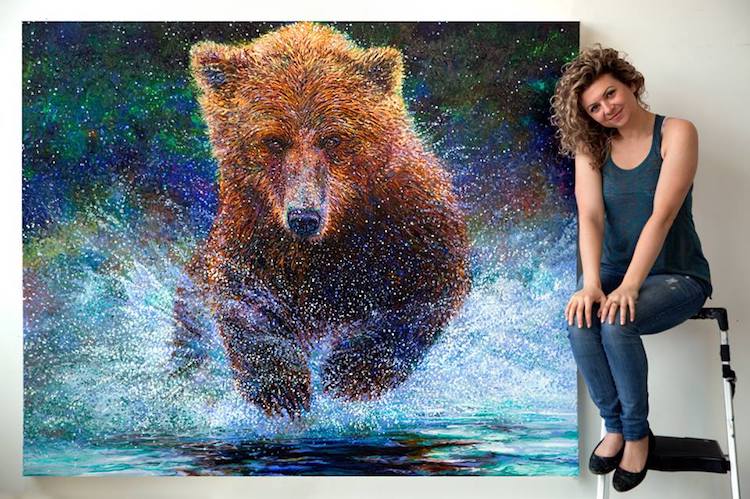
We often think of finger painting as something that’s just for children, but Iris Scott has continually shown us that it’s a viable way to produce stunning works of art. For years, the Brooklyn-based creative has broken the barrier between herself and the canvas by creating elaborate, colorful paintings using her hand in place of a brush.

Scott isn’t afraid to get her hands dirty with art, but she wears a pair of gloves to move the paint around. (This also keeps her fingernails clean!) After suiting up, she treats the pigment like clay and layers thick applications of it on canvas. The result is a jubilant subject matter that’s depicted in a rainbow palette. Together, they highlight the simpler side of life that’s best seen in her ongoing series called Shakin’ Dogs. In this collection, Scott paints canines that are drying off after a jaunt in the water. They radiate pure joy that’s sure to make you smile.

While Scott’s finger painting airs on the unconventional side, she’s not shy about sharing her technique with others. Her book, Finger Painting Weekend Workshop, invites anyone to try this type of Impressionist art.

Finger painting artist Iris Scott trades her bush for her hands to create vibrant works of art.

Finger Painting Artist Iris Scott
Finger Paint Art
Finger Painting for Adults
Finger Paint Art
Finger Paint Art
Finger Painting Artist Iris Scott
Finger Paint Art by Iris Scott
Finger Painting Artist Iris Scott
Finger Painting for Adults
Finger Paint Art by Iris Scott
Finger Painting for Adults
Finger Painting Artist Iris Scott
Finger Paint Art by Iris Scott
Finger Paint Art
Finger Paint Art by Iris Scott

Iris Scott: Website | Facebook | Instagram

My Modern Met granted permission to use images by Iris Scott.

Related Articles:

Artist Creates Striking Prints of Realistic Portraits Using His Hands as Stamps

Blind Artist Relies on Touch and Texture to Create Stunningly Vivid Paintings

Photorealistic Finger Paintings Full of Raw Emotion

Japanese Office Worker’s Gorgeous iPhone Finger Paintings

The post New Large-Scale Finger Paintings of Vibrant Animals in Action by Iris Scott appeared first on My Modern Met.

http://ift.tt/2BbsnmP

Big Money Rules

Two recent books—Nancy MacLean’s Democracy in Chains: The Deep History of the Radical Right’s Stealth Plan for America and Gordon Lafer’s The One Percent Solution: How Corporations Are Remaking America One State at a Time—seek to explain several puzzling aspects of American politics today. Why do people of modest means who depend on government-funded health care and Social Security or other supplements to their income continue to vote for candidates who promise to privatize or get rid of those very programs? Why do people who are poor vote for politicians who promise to cut corporate taxes?

http://ift.tt/2zb5oXw

Prairie Fires: The American Dreams of Laura Ingalls Wilder

This year marks the 150th anniversary of the birth of Laura Ingalls Wilder, whose “Little House” books are sweet, yearning stories of a bygone childhood on a vanished American frontier. They are also dark tales of crushing adversity in a land gained by dispossession of others and hostile to the purposes to which it was being put. Scenes of a loving, self-sufficient family working, talking, and eating together are offset by those of starvation, sudden blizzard, frigid cold, wildfire, drought, disease, blindness, infant death, isolation, madness, plagues of locusts: loss after loss. The books, written for children but read by the world, are autobiographical, with some jiggering and embellishment. But the tribulations they describe are only a portion of those endured by their creator, as described in absorbing, if distressing, detail by Caroline Fraser in Prairie Fires: The American Dreams of Laura Ingalls Wilder.

Born on a farm in Wisconsin in 1867, Laura Ingalls was the second of Charles and Caroline Ingalls’s eventual five children, four whom survived to adulthood. Charles began to chafe under Wisconsin’s growing population, never seeming to grasp, as Fraser observes, “that his ambition for a profitable farm was irreconcilable with a love of untrammeled and unpopulated wilderness.” He moved the family to Missouri, then Kansas in 1869, to territory assigned to the Osage in the 1830 Indian Removal Act; thus the Ingallses became squatters, the government’s “weapon of choice,” in Fraser’s words, for displacing Indians. Unlike most of the would-be settlers, the Ingallses did not stick it out to see white settlers legitimized by the government — as, of course, they were. After two years, the Ingalls family returned to their farm in Wisconsin and from there to Minnesota, and thence to small-town Iowa to run a hotel, where the general insalubriousness of the place and their own indebtedness caused them to vamoose in the night and return again to Minnesota. In 1879 they moved to De Smet, in the Dakota territory, land promoted by the railroads in “one of the greatest boondoggles of all.” All told, by age eighteen, Laura had lost something like a dozen homes, thanks, in part, to her father, a dreamer and master of miscalculation, but thanks, also, to some of the worst luck imaginable, including the most severe drought and most destructive swarm of locusts in recorded history, along with bruising economic conditions.

In 1885 Laura Ingalls married Almanzo Wilder in De Smet. Soon enough her trials resumed, beginning with the discovery that her husband had taken on a frightening debt to build an overelaborate house — which they then had to rent out, moving to a claim shanty where Laura gave birth to a healthy daughter, Rose, in 1886. Their troubles continued: their crops were destroyed by drought and in one case hail, for three successive years. In 1888, both Laura and Almanzo nearly died of diphtheria, and Almanzo suffered a stroke that left him partially crippled. They had a second child who died in infancy. Their house burned down. They moved to a larger town, Spring Valley, but soon sold up and moved, disastrously, to Florida, seduced by railroad propaganda, much as Laura’s own parents had been. They lasted less than a year there and returned to De Smet. They were buffeted by a “free-market” economy gone awry, spinning off panics and “price famines.” Two years later they sold up again and traveled by covered wagon across drought-blasted Nebraska and Kansas to Missouri, eventually ending up in Mansfield, Missouri, a little town in the Ozarks. It was 1894, and here they stayed, first in town and later at a farm. Times remained very hard.

Wilder’s professional writing career began in 1911 with a regular column for the Missouri Ruralist that she kept up until 1924. With its harking back to pioneer days and the concreteness and clarity of style that she gained from having served for years as the eyes of her blind sister, Mary, the column was an excellent apprenticeship for the subsequent books. Just how those works came to be obliges Fraser to lay out the story of Wilder’s daughter, Rose’s, astoundingly messy life; and in this way, the latter part of the book becomes a dual biography of mother and daughter, the latter of whom Fraser clearly despises.

There is much to say in Rose’s favor from our perspective: She was intrepid, leaving home, becoming a telegraph operator and eventually traveling the world as a freelance journalist. She married Claire Gillette Lane, a traveling man and ne’er-do-well — but dumped him, preferring her independence. She contributed her editing prowess to her mother’s work. And, indeed, in all the “Little House” books, it was, Fraser writes, “the unique combination of [Laura’s and Rose’s] skills that created a transcendent whole.”

Still, Rose Lane was a thoroughly bad egg. The reader — this one at least — begins to look forward to her next laughably awful crime against decency. Among them were the “autobiographies” of Charlie Chaplin and Jack London she fabricated, making up quotations and incidents to the horror of Chaplin — upon whom she conferred a “vicious drunk” for a father — and the deceased London’s sister. After the success of Little House in the Big Woods, her mother’s first book, Rose wrote her own, poaching the stories from her mother’s past, “competing with her . . . over her material, first in secret and then openly, trying to put her own imprimatur on the family stories before her mother could.” Though her book sold, it lacked the peculiar genius of Wilder’s vision of the West, which Fraser describes perfectly as having been drawn “from her inner life” and “a work of pure folk art.” After her mother’s death Rose claimed to have been the true author of the books, thus setting in train a controversy that lasts to this day — and which Fraser’s tireless sorting-out of the record should lay to rest. Though it probably will not.

As Fraser points out, Laura Ingalls Wilder’s work takes an en ever-changing place in our culture. The novels have always appealed to readers for the feisty girl at their center, for their absorbing material detail and scrupulous attention to the mechanics of domestic and farm life, and as celebrations of home and, indeed, of the national obsession: home ownership. But where once they were read chiefly as stories that exalted independence and hard work, we, in our time, are more likely to notice what is also there: the dispossession of Native Americans, the rape of the land, the extortionate terms of homestead claims, and, in general, the use of poor settlers by the government in league with the railroads for opening the West. Fraser discusses all this, devoting special attention to the ecological and climatological mayhem caused by plowing up the great grasslands of the prairie to plant wheat. The result was desiccating climate change, soil erosion, and the monstrous dust storms that beggared the land. (In 1935 alone, winds swept away 850 million tons of topsoil.)

Prairie Fires is a brilliant contribution to our understanding of Laura Ingalls Wilder and of how her influential books were conceived, composed, and understood over time. Beyond that, it presents a great slice of American history — cultural, economic, political, demographic, climatological — and of the role of women in the agricultural sphere. It is an extraordinary book, far richer, deeper, and more complex than anything but actually reading it can convey.


The post Prairie Fires: The American Dreams of Laura Ingalls Wilder appeared first on The Barnes & Noble Review.

The Barnes & Noble Review http://ift.tt/2z9cb3S

Stunning Aerial Photos Tell the Stories of New York City and Los Angeles From Above

Aerial Photography

This post may contain affiliate links. If you make a purchase, My Modern Met may earn an affiliate commission. Please read our disclosure for more info.

Photographer Jeffrey Milstein tells the tale of two cities through aerial photography. His series LA NY features a birds-eye-view look at two world-famous metropolises: Los Angeles and New York City. In breathtaking shots, we get a sense of the idiosyncrasies between the two coastal locales, from their architecture to commutes to leisure activities.

Milstein captured all of his LA NY shots from the air, without the help of a drone. Pointing his camera downward a 90-degree angle, the vantage point highlights the unique patterns found in everyday landscapes. In New York, this is especially striking with its grid system that neatly organizes the neighborhoods into geometric shapes—a motif that highlights greater, more fundamental differences between the two places. With its hustle and bustle, New York City has a reputation for being rigid and high strung. By contrast, Los Angeles is seen as more laid back with a go-with-the-flow attitude. We see this in Milstein’s documentation, particularly as colorful umbrellas dot the beach along the Pacific Ocean; even Los Angeles’ freeways have a more whimsical feel with giant, sweeping curves.

Milstein has compiled the beautiful aerial real estate photography into a book of the same name. LA NY was published by Thames & Hudson and features incredible details of both cities’ architecture as well as cultural events like the annual Macy’s Thanksgiving Day Parade in New York. LA NY is now available on Amazon.

Photographer Jeffrey Milstein tells the tale of New York City and Los Angeles with his striking aerial real estate photography.

Aerial Photography by Jeffrey Milstein

“Columbus Circle, NY.” © Jeffrey Milstein

Aerial Photography by Jeffrey Milstein

“Century and Harbor Freeway Interchange, LA.” © Jeffrey Milstein

Aerial Photography by Jeffrey Milstein

“Stuyvesant Town, NY.” © Jeffrey Milstein

Aerial Photography by Jeffrey Milstein

“Long Beach Shoreline Marina, Long Beach, LA.” © Jeffrey Milstein

Aerial Real Estate Photography

“Times Square, NY.” © Jeffrey Milstein

Aerial Photography by Jeffrey Milstein

“Beverly Hills, LA.” © Jeffrey Milstein

Aerial Photography by Jeffrey Milstein

“American Museum of Natural History, NY.” © Jeffrey Milstein

Aerial Photography by Jeffrey Milstein

“Park La Brea, LA.” © Jeffrey Milstein

Aerial Real Estate Photography

“Empire State Building, NY.” © Jeffrey Milstein

Aerial Real Estate Photography

Jeffrey Milstein: Website | Instagram

My Modern Met granted permission to use photos by Jeffrey Milstein.

Related Articles:

Spectacular Aerial Shots of International Airports

10 Aerial Photographers Reveal How They Capture the World from Above

Aerial Photos Taken From Helicopter Reveal the Stunning Symmetry of Airports

Commercial Photographer Takes to the Skies to Follow His Passion for Aerial Photography

Self-Taught Photographer Captures Stunning Aerial Images of Chicago’s Skyline

The post Stunning Aerial Photos Tell the Stories of New York City and Los Angeles From Above appeared first on My Modern Met.

http://ift.tt/2hPvJHa

What Makes A Great Website? 10 Helpful Tips For Every Aspiring Entrepreneur

If you are a fledgling businessperson who does not have a website and thinks that you can do well without one, think again.

Your website functions as your business’ online recognition. When created right, a website can promote your business, bring in new leads and glue your present customers. It can also provide your company an edge over your competitors in the industry.

So, what makes a great website?

Below, we have highlighted all the elements that should be on your company’s website.

User-Friendliness

user friendly website

Your site’s homepage undoubtedly needs to be attractive but that doesn’t mean you should invest all your efforts, time and attention on just the aesthetics. Remember that the interaction weighs more than the beauty of your website. Think as a visitor.

What would your targeted visitor look for or do when landing on your website?

Once you have the answer to that, you can start working on the usability of your website.

Validation and Credibility

Time matters a lot. Your customers are not going to spend a long time deciding whether they can trust you or not. You have to find a way to make them trust you.

One of the best ways is to exhibit customers’ reviews and testimonials on your website. Video testimonials look more authentic and they can engage customers to a greater level. Moreover, you can also exhibit your physical address where your customers can find you in person.

User-Friendly Navigation

A user-friendly layout doesn’t demand much effort. You can start by keeping your navigation bars easy to discover and with clearly marked titles. You should make the important details on your website easy to read and locate for your users.

Ingenious 404 Error Page

The thing about technology is that it breaks and this is where a 404 page comes to play. But, why not use that page to clearly convey your brand story? Fill in all points with creative ideas as each of them is a valuable chance to convey your brand story.

An About Us Video

about us

You have to be sure that your value proposition is clearly communicated to your website’s users. A great way to do this is by having an introductory explainer video on the homepage.

Many of your website visitors will watch it before skimming the text-based content. This makes an explainer video effective in making visitors take your company’s branding seriously. Furthermore, videos do not demand much time to grab visitor’s attention and get viewed.

Page Load Time

Humans want quick solutions. An effective way to increase your website’s conversion rate is to keep your homepage clean, streamlined and easy to navigate. Not all of your visitors have a speedy broadband. In fact, a lot of people use their phones to surf the Internet and their network speed may vary.

As stated by a Web Development Company in Dubai, a website should be responsive to get scaled on multiple screen resolutions and devices, such as smartphones, laptops, tablets and desktop computers.

Clear Concise copy

A good copy has the power to convert potential customers. Successful websites are known for the clarity, concision, and relevancy of their content to their visitors’ demands.

If you want to convert your customers effectively, write a copy that can enlighten them about your company’s value. Because of that, it is essential to know who you are writing for, what they are looking for and where they are coming from.

Case Studies

Case studies are essential, particularly for more serious customers who want to discover about your previous customers and how they are benefited by your offerings. This will give them a clearer and tangible standpoint about how your business functions. They help customers discover more about your business, objectives and the effectiveness of your products/services.

A Powerful Call to Action

Call actions can do wonders when used correctly. It is important to have an influential call-to-action on your homepage as that is what you want your customers to do when they hit your website.

Your call to actions should be clear on what your website visitors should do. Guide them to write a mail, call a number or register for a free trial if that is what you want them to do.

Links to Social Pages

A number of startup websites are unable to mention direct links to their social profiles. If you are one of them, it’s probably the right time to reconsider your strategy.

Rather than using these links on the “Contact Us” page, place them somewhere they are visible to your visitors. This will allow your visitors to connect with your company directly on the social platforms.

See Also: 4 Ways to Make Your Website an Effective Business Tool

The post What Makes A Great Website? 10 Helpful Tips For Every Aspiring Entrepreneur appeared first on Dumb Little Man.

http://ift.tt/2zpCaYU

It’s a great time to flock to Sacramento National Wildlife…

It’s a great time to flock to Sacramento National Wildlife Refuge. An hour’s drive north of California’s state capital, the refuge provides critical habitat to migrating waterfowl. Duck and geese numbers peak in November and December with huge groups filling the sky. It’s an amazing experience, and another great reason to #OptOutside. Photo of snow geese by Steve McDonald, U.S. Fish and Wildlife Service.

Using The New LinkedIn For Personal Branding And Career Success

Are you making the most of the new LinkedIn?

If you’re like most people, you log in to LinkedIn whenever you need to update your resume, click “like” on your colleagues’ work anniversaries and maybe post a link relevant to your field. Then, you log off for the next six months until something else happens in your career that you need to update.

If you haven’t logged in for a while, you might not have noticed the changes taking place all over LinkedIn. And with that, you also might not know what you are really missing out.

What’s New on LinkedIn?

linkedin

To start, there are literally millions of more people on LinkedIn now than there probably were when you first signed up. Back in 2011, there were just 140 million users. Today, there are 500 million users, 9 million companies, more than 10 million active job listings and 100,000 new articles published daily.

There are new features that tell you when people are online so you can chat with them on the new messaging system. You can share your story via native video with filters, too. You also have access to top leaders in your field and there’s a possibility that mentoring services will roll out soon, in addition to many other updates rolling out weekly.

Forget Resumes – Get Hired on the New LinkedIn

The days of mailing out hundreds of copies of your resume in hopes of getting a few job interviews are in the past. These days, if you want to advance your career, you need to connect with people in your field on LinkedIn.

Where do you want to work and what do you want to do there?

Highlight your skills set on LinkedIn and show them why you would be a great fit for the job. Grow your network by engaging with people one on one. Show people what you’re made of by creating engaging posts. It’s all about ongoing engagement.

Remember, people log on to LinkedIn now more frequently than ever and they spend more time there. This creates a more open and collaborative environment. So, find the job you want on LinkedIn and then go after it.

In fact, 75% of people who recently changed jobs used LinkedIn to research their options and make decisions about where to go. More than a third of job seekers use social media to contact potential employers.

When you think about it, it totally makes sense – we don’t fax our resumes to potential employers anymore. How do people communicate these days? The answer is social media.

So, it only makes sense that we search for new jobs through the platforms where we do most of our communicating.

Personal Branding is the New Resume

linkedin personal branding

What do you think makes a bigger impact — a piece of paper with a few facts about you or your longstanding digital footprint?

These days employers are searching for you online before you ever step foot in their office. This is where personal branding comes into play and your LinkedIn profile is the perfect place to build it.

We all know that networking is crucial for professional growth, but we all also know that going to “networking events” is not the most effective way to do so. You need to connect with people who share your interests and work in your field. The mishmash of people who show up to “networking events” aren’t always going to be the people you will make the deepest connections with.

Networking on LinkedIn gives you the opportunity to network with people who share your interests on a whole other level. 61% of professionals say that this kind of interaction has led to new job opportunities for them.

On LinkedIn, half of its users say that they have found a job through a mutual connection while 35% say that a casual conversation on LinkedIn has led to a new opportunity. There’s power in the new LinkedIn and you just have to take the steps to unlock it.

See Also: 10 Proven Ways To Build Your Personal Branding in 2018

Learn more about the new LinkedIn by the numbers from this infographic. Are you making the most of the power of LinkedIn?

The New LinkedIn
Source: Number Sleuth

The post Using The New LinkedIn For Personal Branding And Career Success appeared first on Dumb Little Man.

http://ift.tt/2iChP8C