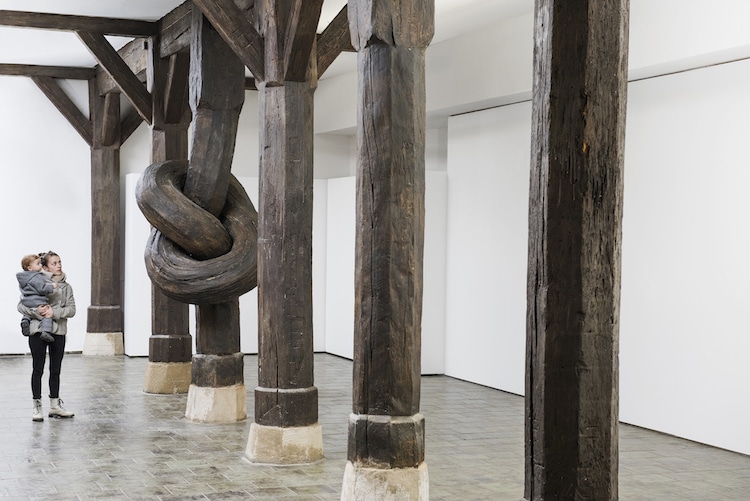
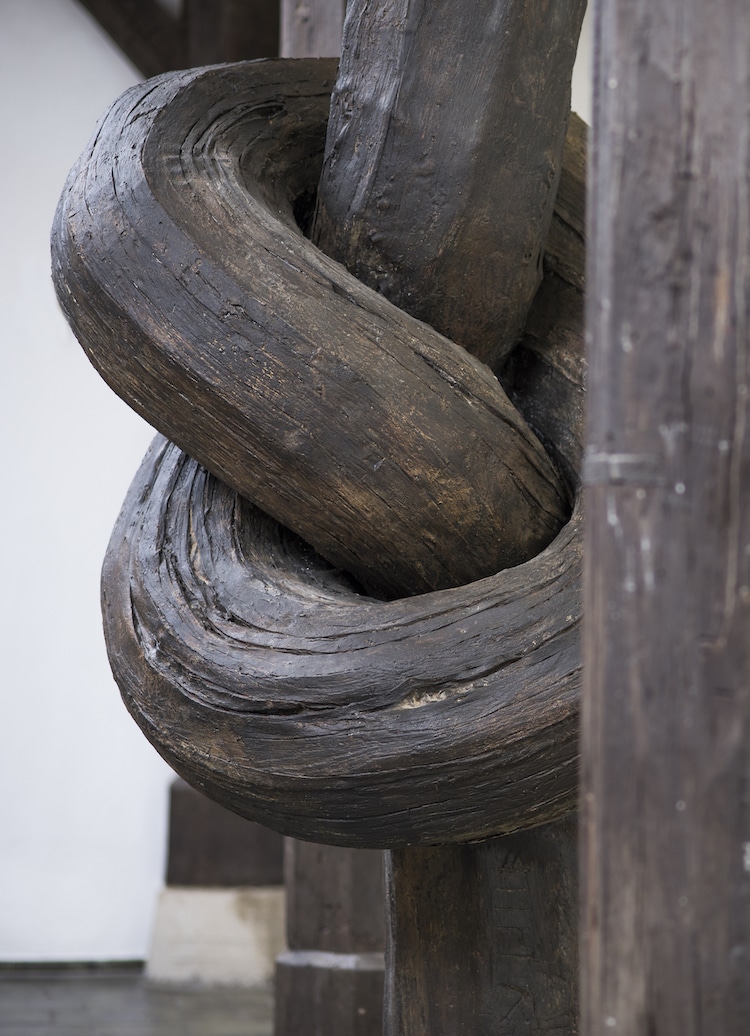
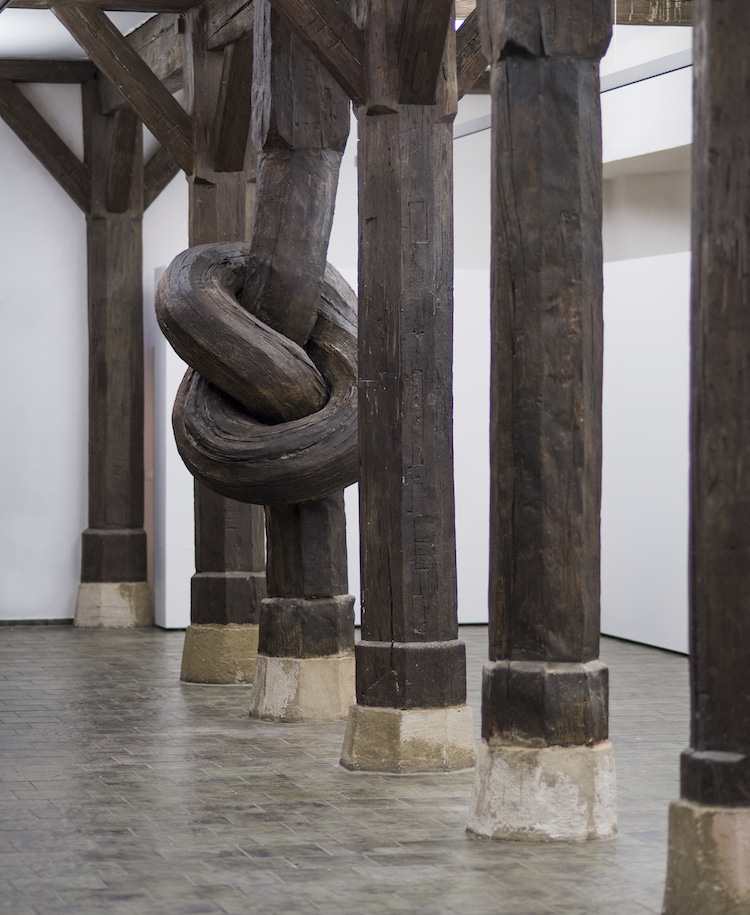
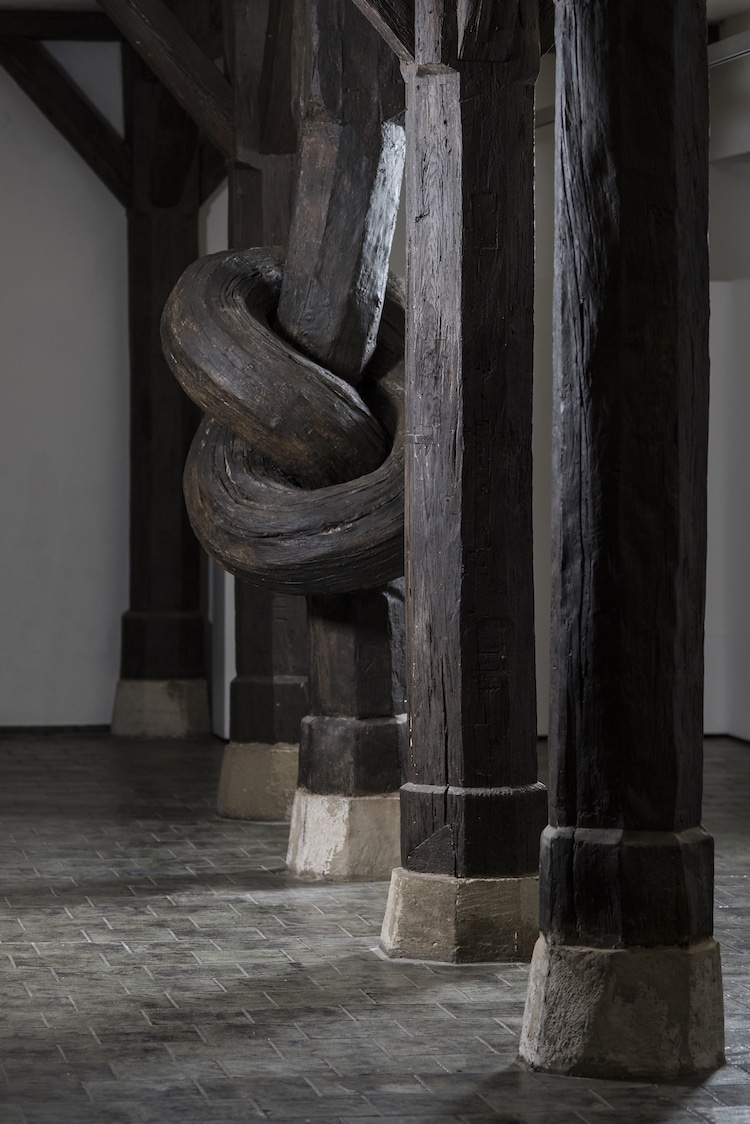
Known for his mind-bending installation art, Alex Chinneck has moved indoors for his latest art installation, tying a 450-year-old wood column into a knot. With Birth, Death, and a Midlife Crisis, the British sculptor has conceived another stunning piece of optical illusion art, one that sees him installing an indoor sculpture for the first time in five years.
After his hovering stone building and seemingly melted building facade, both in England, Chinneck brings his unique background in architecture, sculpture, engineering, and set design to the interior of a German museum. Located in the small town of Kirchheim Unter Teck, the museum’s historic wooden columns served as the inspiration for Chinneck’s artwork.
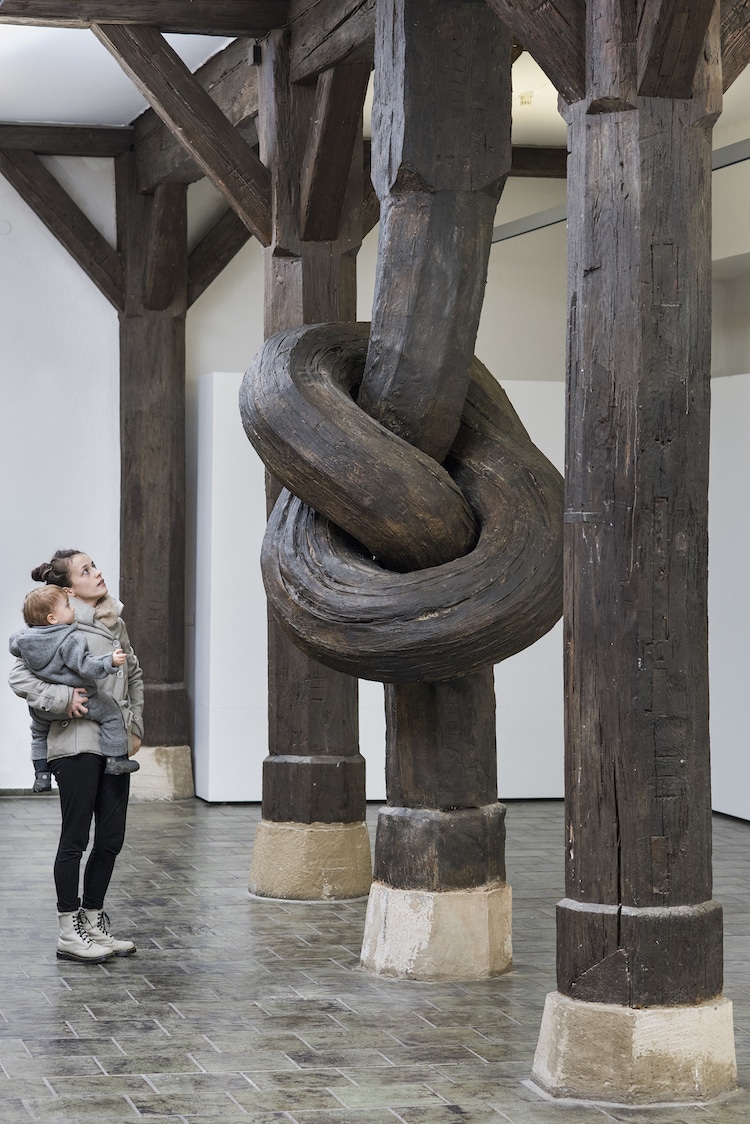
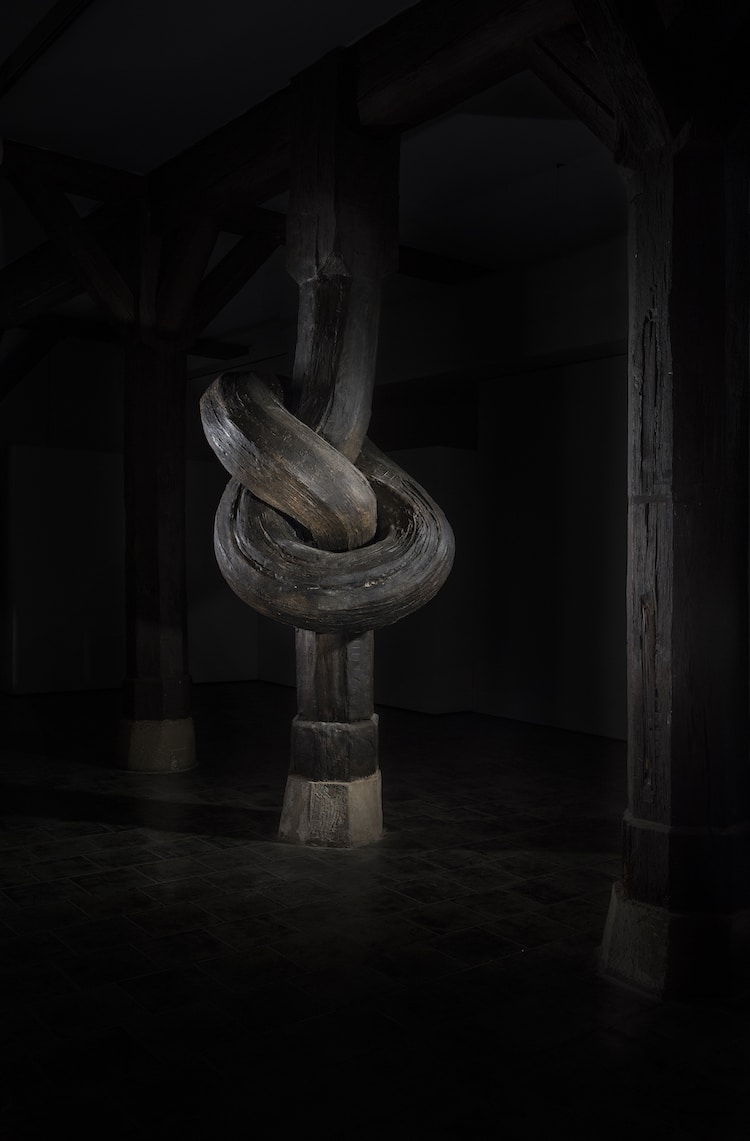
His knotted column seems to defy logic—even when one knows it’s simply an art installation, it’s impossible not to feel as though it fits perfectly into place within the gallery. Indeed, Chinneck’s approach was purposely sensitive, teasing out the illusion while paying respect to the surroundings.
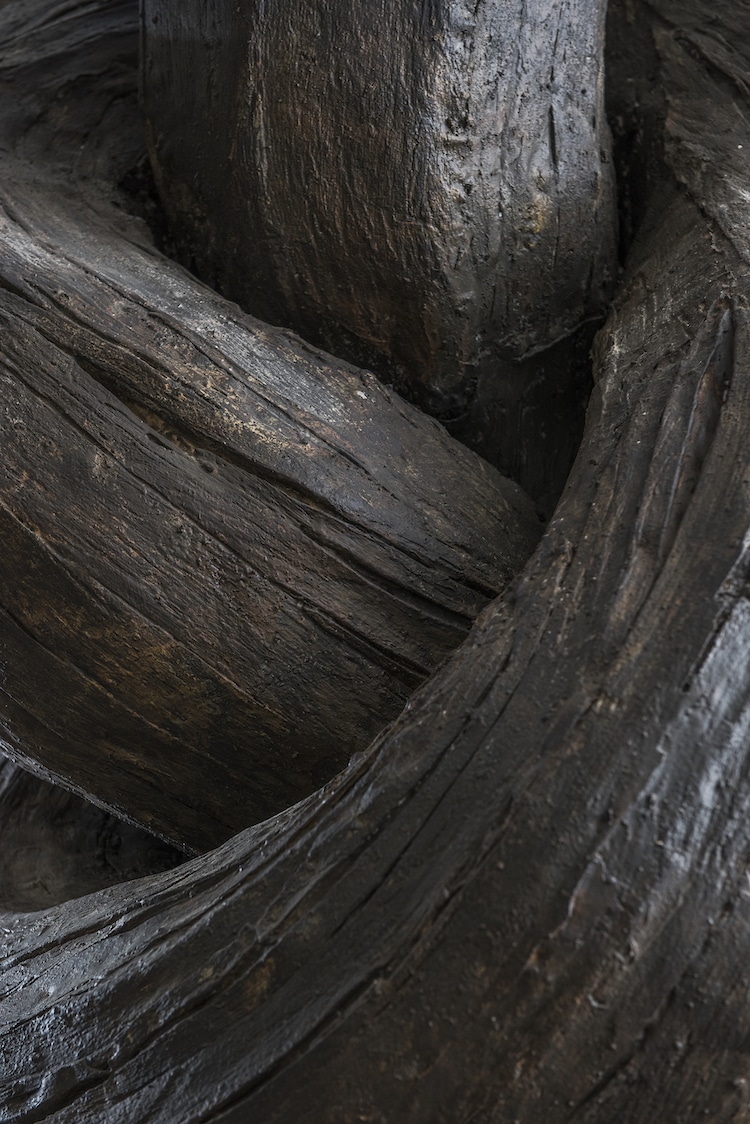
“I wanted to create the impression that we had only changed what was already physically present in the museum and the work was born through the manipulation, rather than introduction, of material,” Chinneck shares. “With this approach, the objective was to produce something sculpturally bold but contextually sensitive.”
The result is a startling, yet fascinating, work of art that blends in flawlessly with the environment, demonstrating Chinneck’s ability to transition between exterior and interior spaces. In addition to the knotted pillar, the artist also added a straight column in order to give the overall installation balance and symmetry. It’s this attention to detail that helps bring the illusion to life.
“I like to give fluidity to typically inflexible things, transcending their material nature. The columns are the prominent feature in the 450-year-old museum and this intervention took an opportunity to defy logic and distort history.”
For his newest logic-defying art installation, Alex Chinneck has created a knot in a 450-year-old wood column.
Alex Chinneck: Website | Instagram
All photos by Charles Emerson. My Modern Met granted permission to use photos by Alex Chinneck.
Related Articles:
Artist Creates the Illusion of an Upside Down Car Stuck to a Wave of Road
12 Stunningly Surreal Sculptures
15+ Artists Whose Mind-Bending Optical Illusions Will Make You Look Twice
20+ Amazing 3D Street Art Illusions That Will Play Tricks on Your Mind
The post 450-Year-Old Wood Column Tied Into a Knot Is a Logic-Defying Art Installation appeared first on My Modern Met.

 Joseph Conrad’s heroes were often alone, and close to hostility and danger. Sometimes, when Conrad’s imagination was at its most fertile and his command of English at its most precise, the danger came darkly from within the self. At other times, however, it came from what could not be named. Conrad sought then to evoke rather than delineate, using something close to the language of prayer. While his imagination was content at times with the tiny, vivid, perfectly observed detail, it was also nourished by the need to suggest and symbolize. Like a poet, he often left the space in between strangely, alluringly vacant.
 A woman walks down the red stairs of a tall roofless building. Her dress is almost black. Her hair is pulled back, her arms crossed against the cold, her face melancholy. She walks past denuded trees up a darkened street, curves into another, and another. The wind seems to be propelling her, tugging at her, so that at one point her hair tumbles free, her dress whirls. Lamplight turns pavement and road a stormy sea blue. As she comes closer her path is outlined in blood red, until red takes her over to transform her into a drowning figure in a blackened lake.







 When the march of progressivism seemed inexorable, Sweden was happy to play poster child and humbly let uninformed outsiders label the place a social paradise. Now that the spread of progressive values around the world is facing its stiffest test in decades, Sweden finds itself on the front line. And for the traditionalists seeking to reverse the liberal trend, to show that Sweden—Sweden—is failing offers an effective way to shortcut the argument.
 Sig Nordal