“Imagine, if you will, that I am an idiot. Then, imagine that I am also a Congressman. But, alas, I repeat myself.” Mark Twain

twain

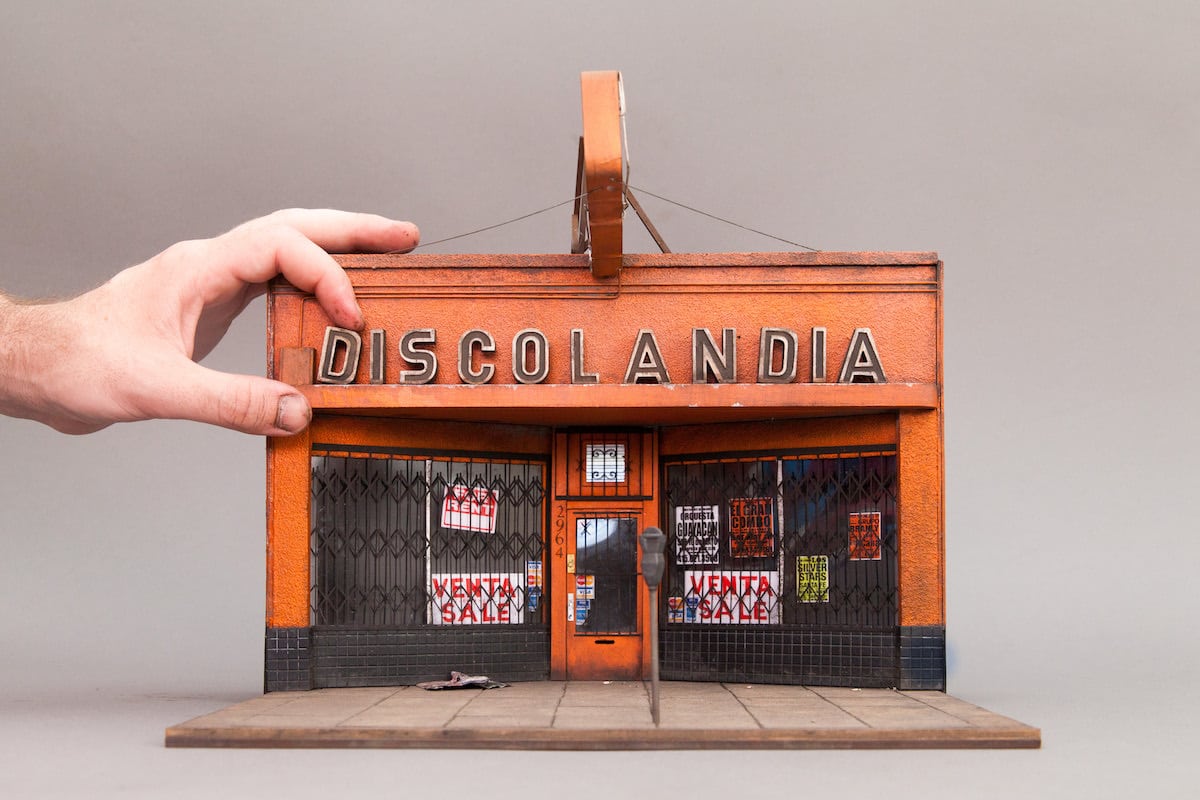
Incredibly Detailed Miniature Sculpture of San Francisco’s Historic Record Store

Joshua Smith - Discolandia Miniature

For an upcoming exhibition at Palo Alto Art Center, self-taught miniaturist Joshua Smith has once again created a scale model that is a slice of urban life. Following his recent venture into the architecture of Taiwan, Smith has jumped across the ocean, this time tackling elements of San Francisco.

The centerpiece of the show is the legendary Discolandia Record Store in San Francisco’s Mission District. Known for catering to Latin music aficionados, the record store closed its doors in 2011 after almost 30 years in business when the owner decided to retire. Smith touches on this piece of Mission District history, perfectly capturing the nostalgia of a musical paradise now abandoned. From the slightly tilted signage to the signature orange paint, he’s able to pay homage to what was and what is now the reality.

Smith rounds out his contribution with a Golden Gate dumpster, complete with graffiti tags and a street art poster. Perched next to a chain-link fence topped with barbed wire, tiny cigarettes scattered on the ground, there’s no detail overlooked by Smith. And in fact, this aspect is part of what drives Smith’s work. “I love a challenge and the problem-solving skills that come with trying to figure out how to get miniatures to look realistic,” he revealed. His dedication to realism and ability to pull beauty out of the most unexpected places is part of what makes him one of our favorite miniaturists.

Through That Which is Seen runs from January 20, 2018 to April 8, 2018.

Joshua Smith - Discolandia Miniature
Joshua Smith - Discolandia model
Joshua Smith - Discolandia Miniature
Joshua Smith - Discolandia model
Joshua Smith - Discolandia Miniature
joshua smith miniaturist

Joshua Smith: Website | Facebook | Instagram

All images by Ben Neale. My Modern Met granted permission to use photos by Joshua Smith.

Related Articles:

Artist Creates Miniature Worlds Mimicking the Grit and Grime of Urban Architecture

Mini Sculptures of Los Angeles Capture the Gritty Personality of City Neighborhoods

Model Maker Creates Spooky Miniature Scenes Framed Within Shadow Box Dioramas

“AnonyMouse” Artists Open Tiny Shops for Mice on the Streets

The post Incredibly Detailed Miniature Sculpture of San Francisco’s Historic Record Store appeared first on My Modern Met.

http://ift.tt/2EGaMnS

The Nuclear Worrier

Daniel Ellsberg in his youth and Daniel Ellsberg in his age are the same man—a born worrier quick to spot trouble, take alarm, and issue warning. He is best known for worrying about the American war in Vietnam, which time in the war zone convinced him was a crime, and for doing what he could to bring it to an end. In that case he copied and illegally released a huge collection of secret documents about the war, which came to be known as the Pentagon Papers. But Vietnam was not the first or the biggest thing that worried Ellsberg after he went to work in his late twenties as an analyst for the RAND Corporation in 1959. His first and biggest worry was the American effort to defend itself with nuclear weapons.

http://ift.tt/2CvMFLV

Between Nouveau and Deco

The imaginative fervor that gripped avant-garde master builders and artisans around 1900 in Vienna, the capital of the vast and culturally diverse Austro-Hungarian Empire, paralleled equally radical innovation in other creative realms, including the music of Gustav Mahler and Arnold Schoenberg, the painting of Gustav Klimt and Oskar Kokoschka, and the writings of Arthur Schnitzler and Sigmund Freud. Yet the singular contributions to the visual arts that the Viennese made during this epoch have never loomed large enough in general chronicles of modernism.

http://ift.tt/2C7NYwp

Tucson, Arizona, is home to the nation’s largest cacti. The…

Tucson, Arizona, is home to the nation’s largest cacti. The universal symbol of the American west, these majestic plants are found only in a small portion of the United States and protected by Saguaro National Park. Here you have a chance to see these enormous cacti silhouetted by the beauty of a magnificent desert sunset. Photo by Debbie Angel (http://ift.tt/18oFfjl).

Patty Chang’s Arbitrary Acts of Devotion

Alternating between particular and general experience in “The Wandering Lake,” Patty Chang demonstrates the power of arbitrary acts, executed with devotion, to produce their own truth. This is a guide to mourning; but Chang widens the scope to include political conflict and environmental degradation, and argues that, despite the losses we’ve incurred, we are still collaborators in the making of our worlds.

http://ift.tt/2r4c9eb

Spreading across Long Valley in California, the Volcanic…

Spreading across Long Valley in California, the Volcanic Tablelands are a vast and unique landscape formed 700,000 years ago. Small canyons and bluffs dot the mostly flat area, offering amazing night sky views. Carved into the gray, red and pink rocks are extraordinary petroglyphs, mysterious symbols created by Native Americans centuries ago. Archaeologists can only speculate on their meaning. Photo of Bureau of Land Management site by Brandon Yoshizawa (http://ift.tt/18oFfjl).


The Pattern and Passion of ‘Phantom Thread’

The metaphor of couture is hard to avoid in a film so centrally involved with measuring and cutting and sewing, stitching and unstitching. The very visible boldness of the editing, the leaps and ellipses, keep the idea of cutting very much at the forefront. A crucial scene in which a wedding dress must be repaired overnight evokes both an emergency medical operation and the race against time to reshape a film in the editing room.

http://ift.tt/2FxUrTv

“It’s much harder to be a liberal than a conservative. Why? Because it is easier to give someone the finger than a helping hand.” – Mike Royko

ro

Peculiar Ground


Lucy Hughes-Hallett, prizewinning biographer and cultural historian, here turns her talents to fiction with a first novel, Peculiar Ground. The story begins in 1663 as the Royalist earl of Woldingham returns to his grand estate, Wychwood, following his exile during the upheaval of the English Civil War and the subsequent periods of the Commonwealth and Protectorate. In his absence, his cousin Cecily presided over the place, thus keeping it in the family. Now, even with the Stuarts back on the throne and his house and lands returned, the earl feels uneasy and has caused a great wall to be erected around the entire estate. His hope is to create his own little Eden, and to this end he has employed an ingenious landscape designer, John Norris, who is pushing forward plans for two great avenues of trees, a sequence of three linked lakes, and a prodigious fountain. Also in his employ are Robert Rose, an architect; George Goodyear, head forester; a man simply called Lane, the estate steward; and another, Armstrong, whose special care is game: deer and pheasant, chiefly.

But all is not well. A group of radical religious dissenters continue their heterodox worship in a meetinghouse on the grounds, a structure that has been built over a relict of the Romans, a mosaic depicting two boys with joined hands. The image possesses great, if highly mysterious, import. An old woman, accompanied by a young, rustic boy, flits through the woods. She is Meg Leafield and is thought to be a witch. One of the earl’s young sons drowns. Cecily dresses up Meg’s young companion in clothes similar to the dead boy’s, to whom he bears a striking likeness. Something very strange happens — and with that we leave the seventeenth century for some 300 pages.

The story next makes landfall in 1961, as we find that the estate has new owners, the Rossiters, whose son has also drowned. And, just to continue on this parallel track, the place is peopled by the descendants of the earl of Woldingham’s men. Once again we have a Goodyear and an Armstrong. A Hugo Lane is the steward or land agent and lives on the estate with his wife and children. An old woman called Meg is in circulation, up to a lot of witchy business in the shape of herbal nostrums and charms. A house party finds among the guests another Rose (this one a restaurateur, designer, and libertine). There is also an Anthony Blunt−style spy, a freelance journalist, a luscious young siren, and an enfant terrible. There are carryings-on. The wall surrounding the parklands still stands — but everyone’s attention is drawn to another one just going up in Berlin.

The novel goes on to give full throttle to the theme of walls and continues to dangle the notion that there is a parallel or even a connection between events of the distant past and those of the present. We follow the lives of the twentieth-century characters over ensuing years, the story making further stops in 1973 (an invitation-only pop concert on the walled estate) and 1989 (and the fall of the Berlin Wall), before returning to the seventeenth century, to 1665, just in time for the bubonic plague, the wall in this moment serving to keep fleeing Londoners, nearby villagers, and their attendant contagion out of the estate.

In the novel’s favor, I can say that it shows a fine sense of time and place in each venue, and there are some terrific set pieces: a battle against a raging fire, the experience and calamitous outcome of the storm dubbed the Great Wind of 1987 (here set in 1989), and the evacuation of plague-stricken London. A number of images are truly arresting, one being a waterfront street ending at a great wall of steel: the vast hull of a ship rising to inconceivable heights. There are, too, a couple of excellently drawn self-important characters, though their time on the stage is sadly brief. All in all, however, the story has an awful rattle of devices: the recurrent theme of walls, random echoes of the past, some portentous stories-within-stories, and that truly irksome mosaic — which is meant, it is suggested, to explain . . . something. Rather than pulling the story together, these literary maneuvers serve to diminish it, making it serve as a showcase, while the plot itself becomes a litter of miscellaneous parts. Perhaps next time — and I hope there will be one — Hughes-Hallett will leave these literary exercises behind and get on with the story.

Image of Bibury Court by  John Menard via Wikipedia.

The post Peculiar Ground appeared first on The Barnes & Noble Review.

The Barnes & Noble Review http://ift.tt/2EDyH7r