The Evolution of Picasso’s Painting Style and What Each Artistic Choice Represents

Pablo Picasso Periods Picasso Famous Paintings

Throughout an artist’s lifetime, changes in approach, subject matter, and even style are to be expected. This phenomenon is apparent in the evolution of modern art‘s most beloved painters, from Monet‘s move toward abstraction to Van Gogh‘s brightened color palette. Though prevalent among most master painters, it is particularly emphasized in the paintings of Pablo Picasso (1881-1973).

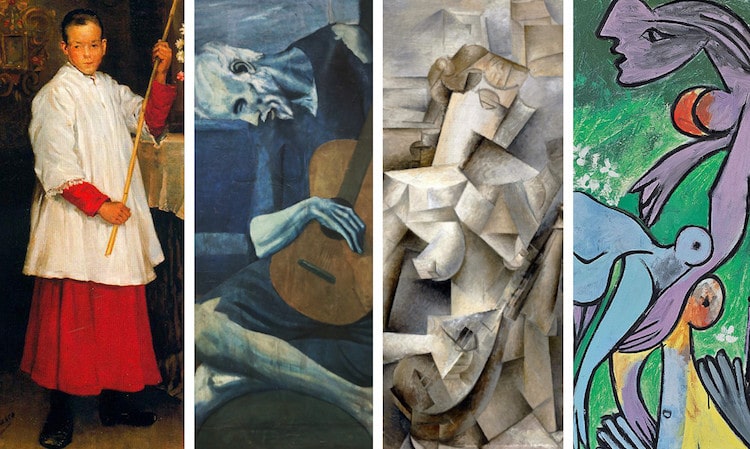
With a career that spanned 79 years and included success in painting, sculpting, ceramics, poetry, stage design, and writing, his tendency to experiment with his craft is unsurprising. However, the extent to which his style changed in each discipline—particularly, in painting—is unlike that of any other artist. Therefore, in order to trace his stylistic evolution, his body of work is often divided into periods: early work, Blue Period, Rose Period, African Period, Cubism, Neoclassicism, Surrealism, and later work.

Here, we explore these changes, beginning with a phase that is often widely overlooked or even unknown: Picasso’s roots in realism.

Early Work

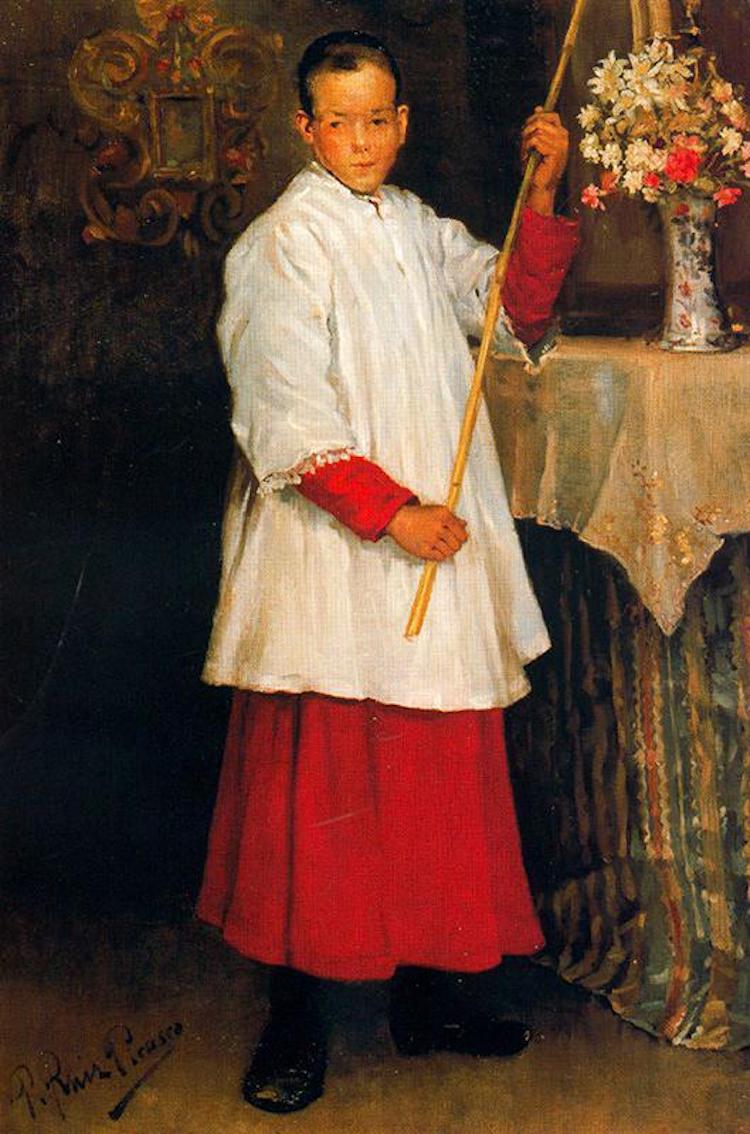
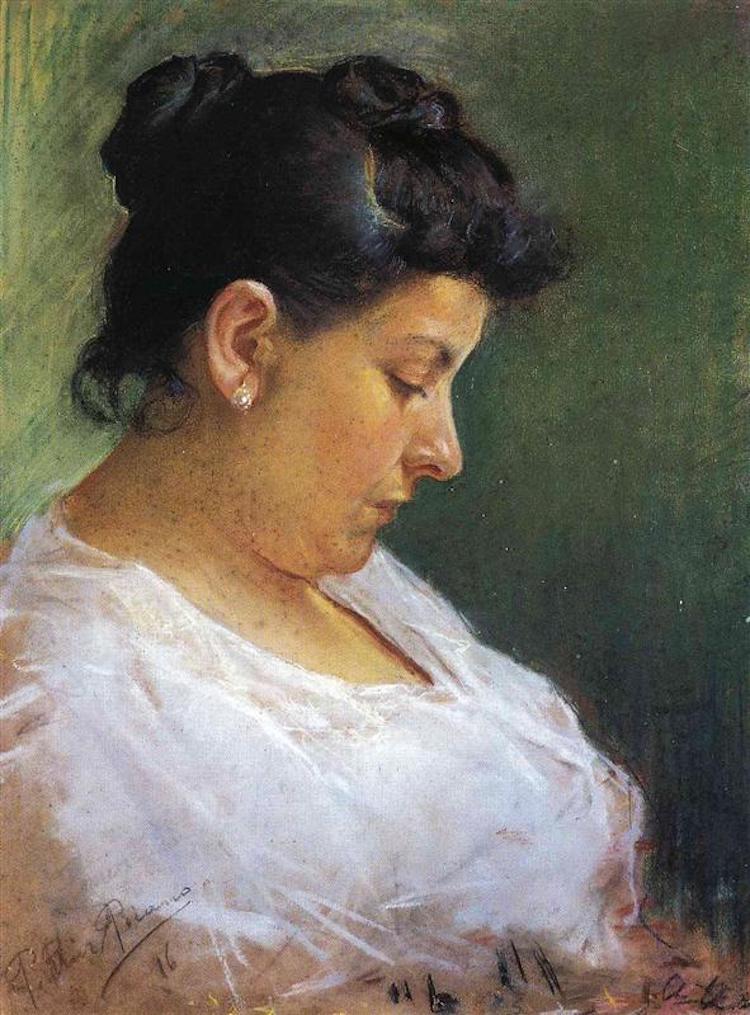
When Picasso began his career as an artist in 1894, he worked in a realist style. He depicted subjects authentically, and employed a true-to-life color palette. This traditional, academic approach is evident in his church-inspired paintings and his portrayals of loved ones, like The Altarboy and Portrait of the Artist’s Mother, respectively.
Pablo Picasso Periods Picasso Famous Paintings

‘The Altarboy’ (1896) (Image via Wiki Art)
Pablo Picasso Periods Picasso Famous Paintings

‘Portrait of the Artist’s Mother’ (1896) (Image via Wiki Art)

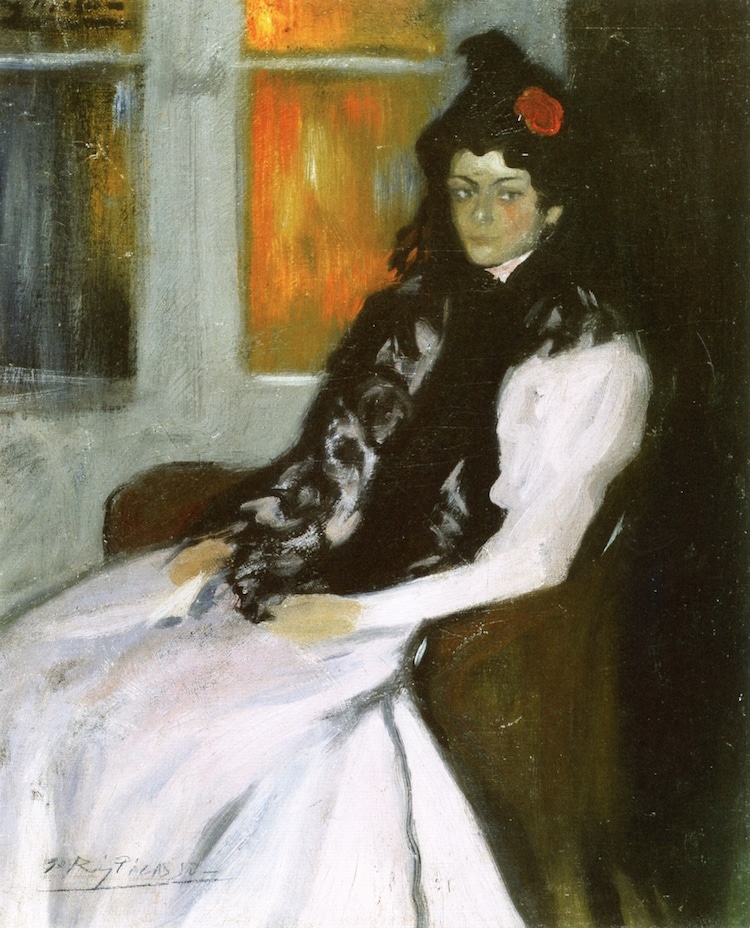
Beginning in 1897, however, his paintings took on a less lifelike quality. Undoubtedly influenced by Expressionist Edvard Munch and Post-Impressionist painter Toulouse-Lautrec, these pieces—like The Artist’s Sister Lola—convey Picasso’s growing interest in experimenting with a more freeform, avant-garde style.
Pablo Picasso Periods Picasso Famous Paintings

‘The Artist’s Sister Lola’ (ca. 1899-1900) (Image via The Athenaeum)

Blue Period (1901-1904)

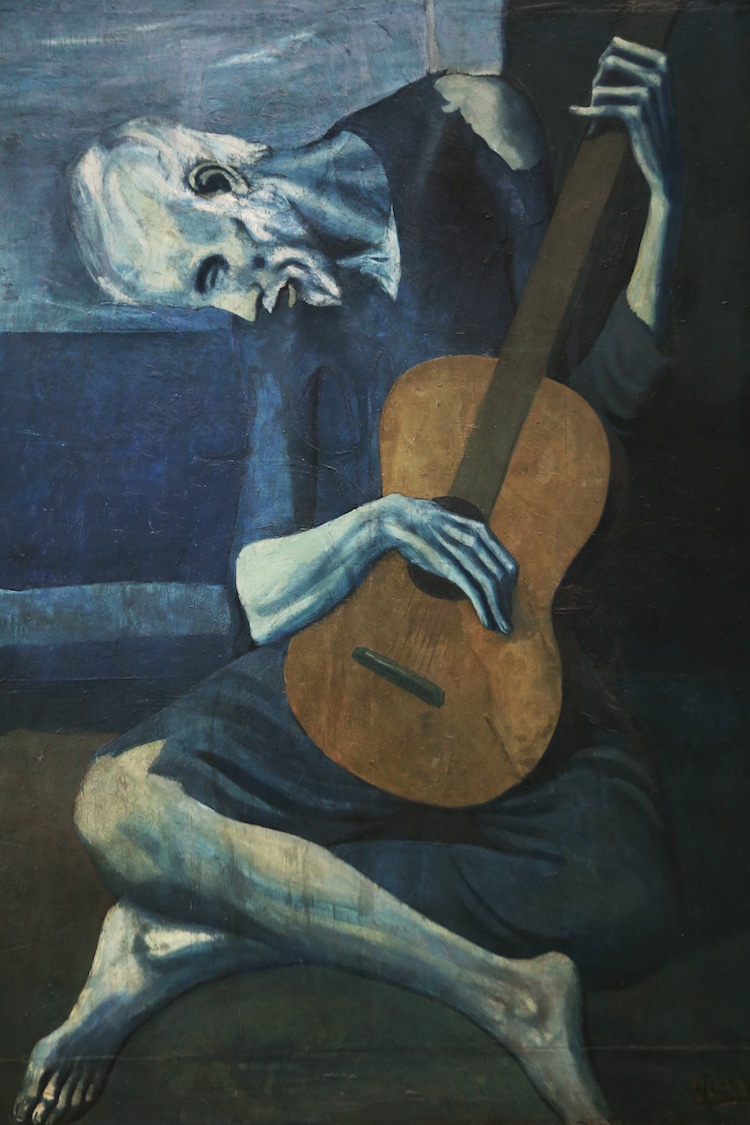
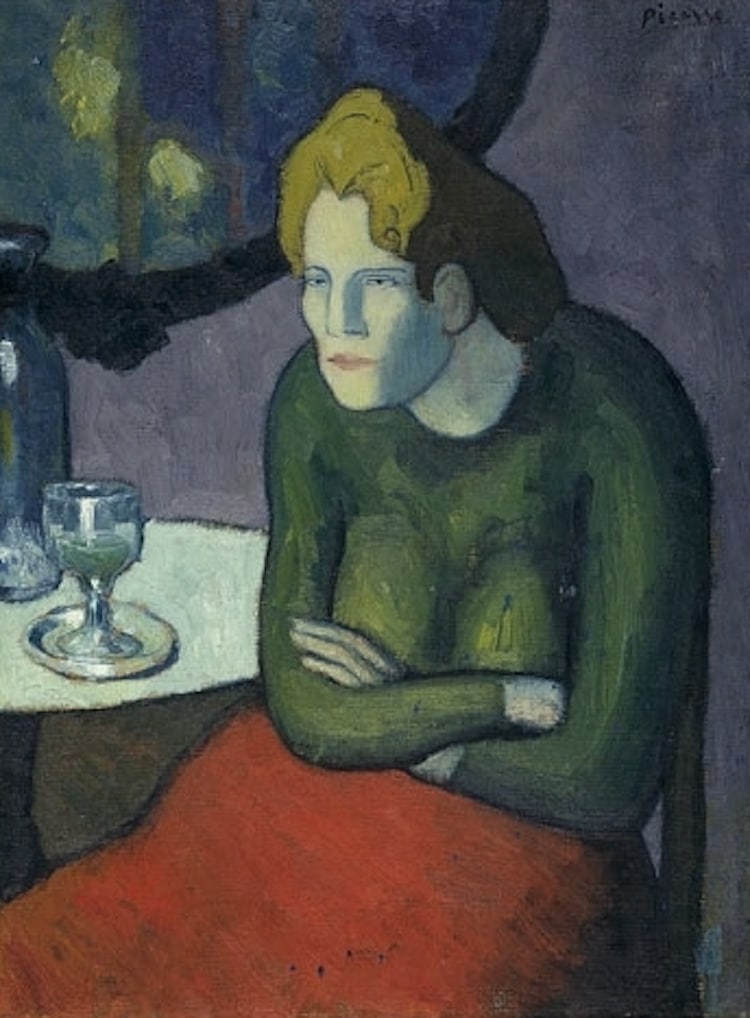
In 1901, Picasso appeared to have entirely abandoned realism. This is particularly clear in his preference for color, which evolved from naturalistic hues to cooler tones. This change in pigment lasted until 1904, and is now characterized as the artist’s Blue Period.

Art of this period is somber in both color and in subject matter—an approach likely caused by depression due to a close friend’s suicide. The monochromatic pieces often feature figures living in poverty or despair, like the gaunt guitar player in The Old Guitarist, the unhappy Absinthe Drinker who sits with her arms folded, and the embracing Mother and Child who actually live in a disease-ridden women’s prison.
Pablo Picasso Periods Picasso Famous Paintings Picasso Blue Period

‘The Old Guitarist’ (ca. 1903-1904) (Image: Coldcreation via Wikipedia)
Pablo Picasso Periods Picasso Famous Paintings Picasso Blue Period

‘The Absinthe Drinker’ (1901) (Image via The Athenaeum)
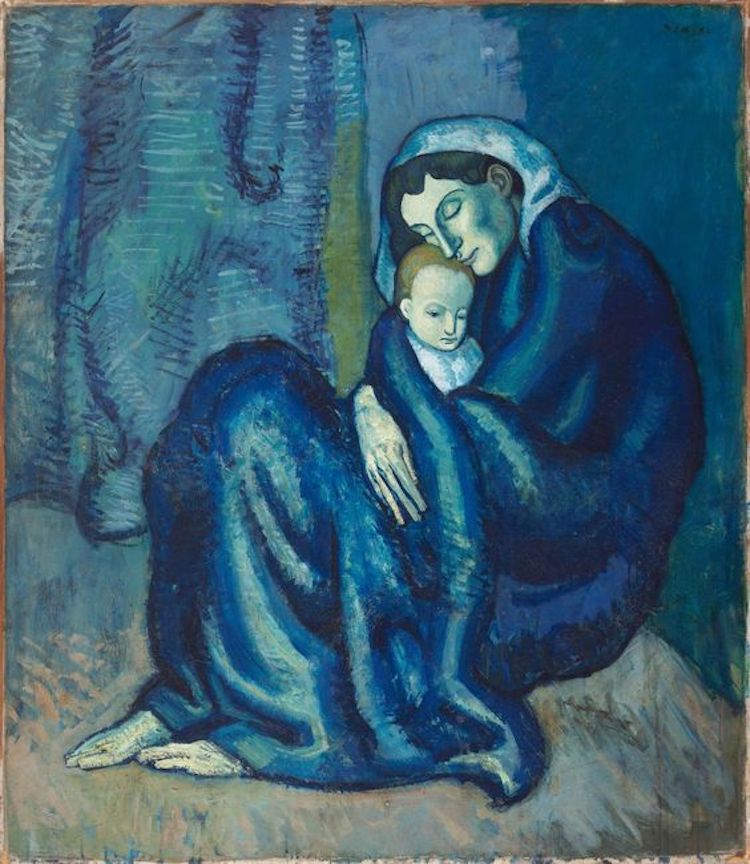
Pablo Picasso Periods Picasso Famous Paintings Picasso Blue Period

‘Mother and Child’ (1901) (Image via The Athenaeum)

Picasso’s Blue Period (and causal depression) lasted until 1904. At this time, less solemn subjects and a warmer color scheme began to pop up in his paintings.

Rose Period (1904-1906)

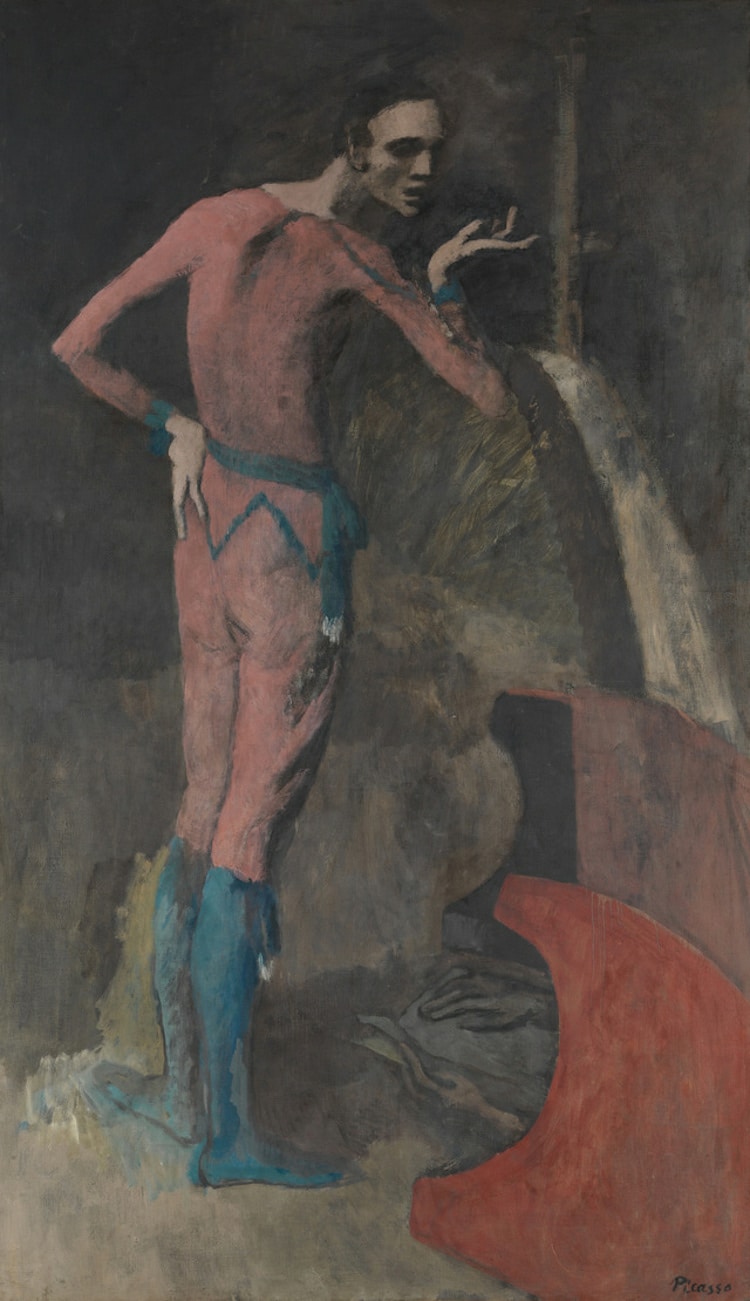
As Picasso transitioned to his Rose Period in 1904, he continued to depict figures in his characteristically painterly style. While blue tones are still present in these paintings, they are contrasted by warmer shades. Similarly, after moving to Montmartre, a Bohemian district in Paris, he shifted his focus from individuals living in despair to entertainers, including harlequins, acrobats, and other circus performers.
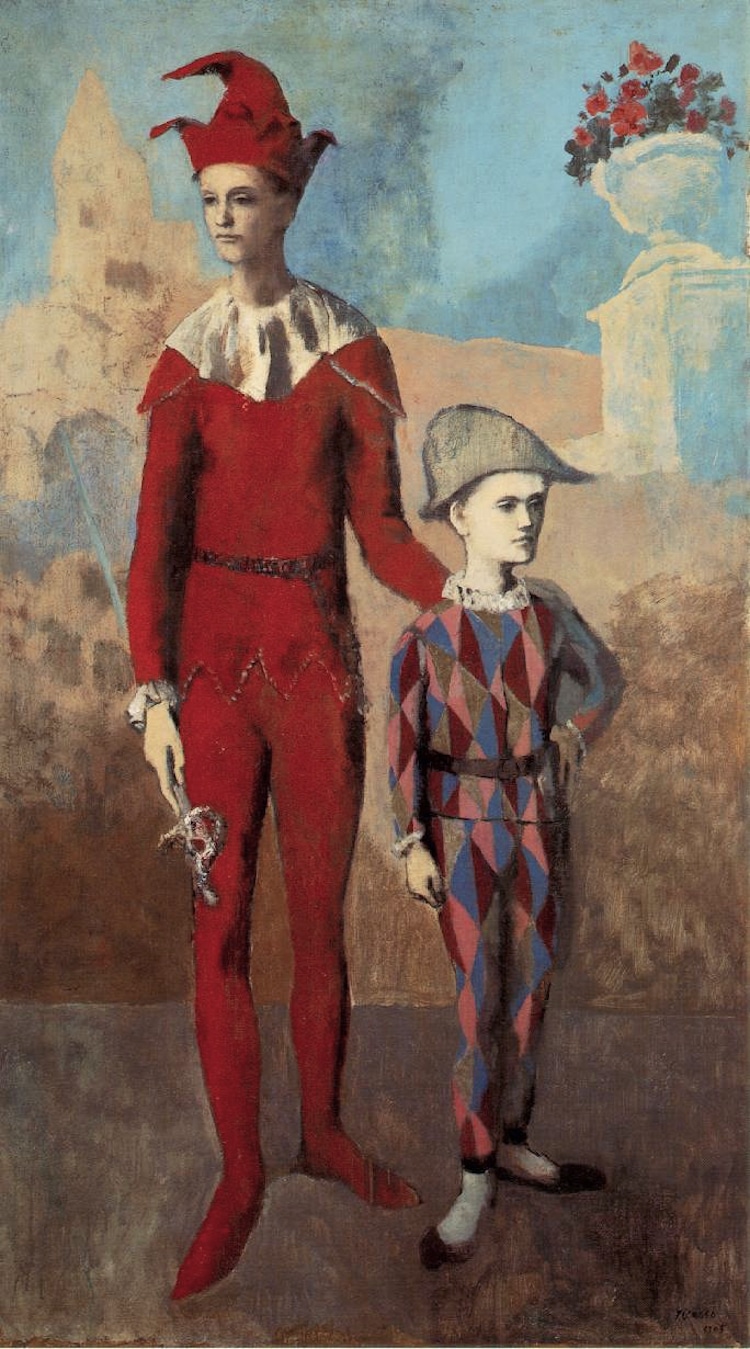
Pablo Picasso Periods Picasso Famous Paintings Picasso Rose Period

‘Acrobat and Young Harlequin’ (1905) (Image: UGA via Wikipedia)
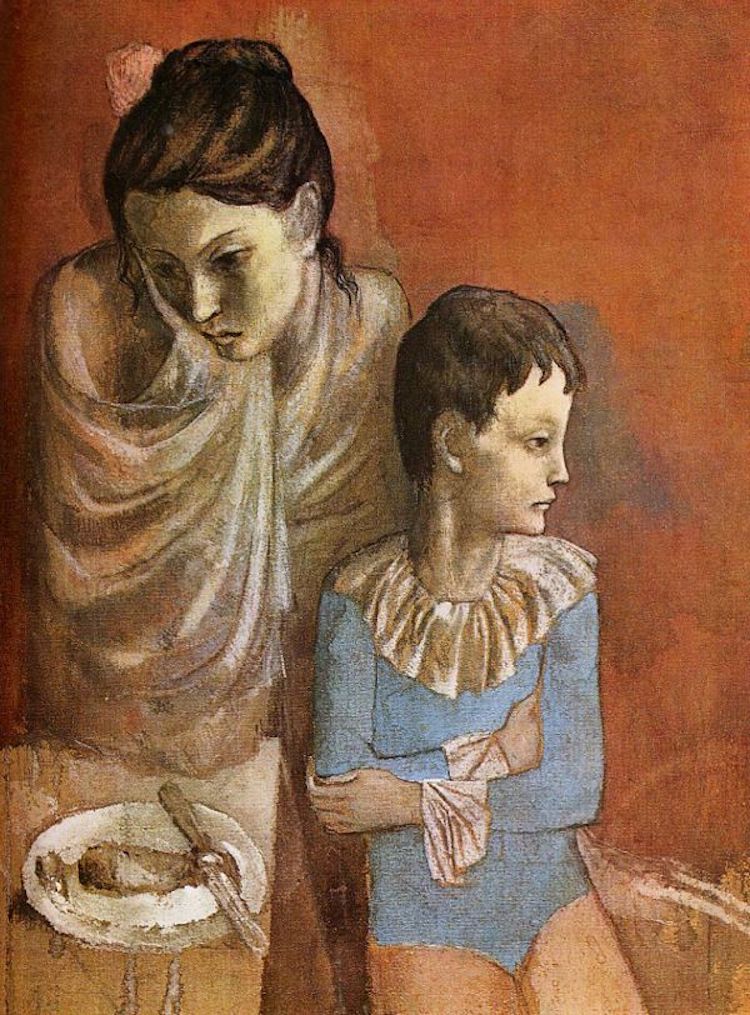
Pablo Picasso Periods Picasso Famous Paintings Picasso Rose Period

‘Mother and Child, Acrobats’ (ca. 1904-1905) (Image: Pictify via Wikipedia)

Pablo Picasso Periods

‘The Actor’ (ca. 1904-1905) (Image via Wikipedia)

At this time, Picasso began to experiment with Primitivism, a style that he would eventually embrace in in 1906.

The post The Evolution of Picasso’s Painting Style and What Each Artistic Choice Represents appeared first on My Modern Met.
http://ift.tt/2DURD5R

Cubism: How Picasso and Others Broke From Tradition to Transform Modern Art

What is Cubism Definition Cubism Art Picasso Cubism

Since its emergence over 100 years ago, Cubism has been regarded as one of modern art‘s most famous and fascinating art movements. Cubism is closely associated with iconic artists like Pablo Picasso, whose avant-garde approach to everyday subject matter turned art history on its head.

Featuring fractured forms and topsy-turvy compositions, Cubism abandoned the figurative portrayals found in genres of art and moved toward total abstraction. This aspect—along with its unique evolution and lasting influence—has made Cubism one of the 20th century’s most celebrated forms of art.

What is Cubism?

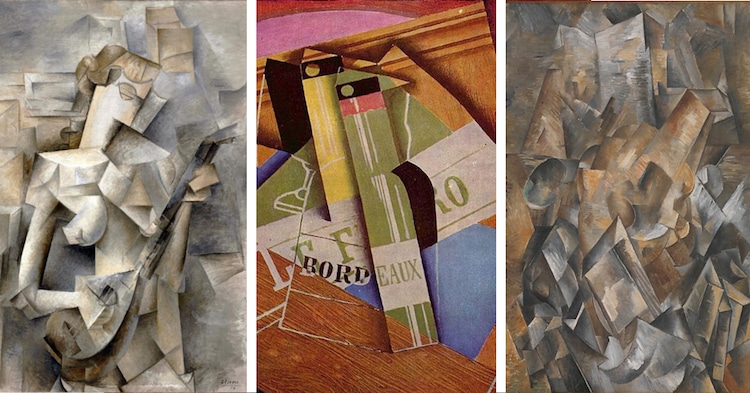
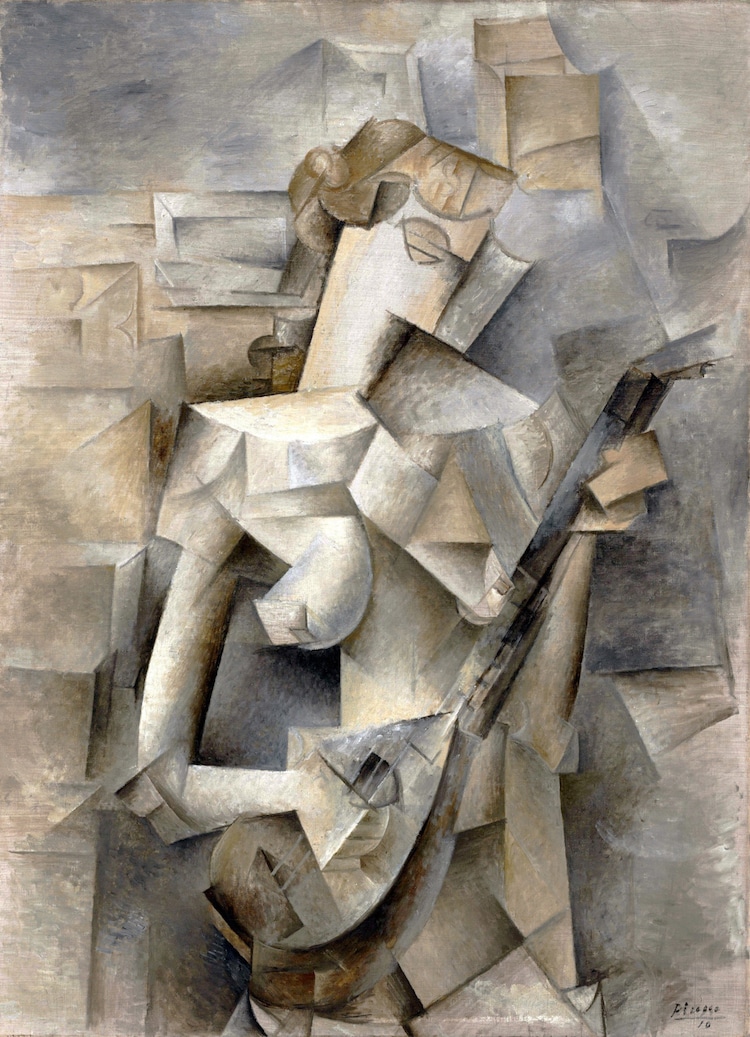
Cubism is an art movement that made its debut in 1907. Pioneered by Pablo Picasso and Georges Braque, the style is characterized by fragmented subject matter deconstructed in such a way that it can be viewed from multiple angles simultaneously.

What is Cubism Definition Cubism Art Picasso Cubism

Pablo Picasso, ‘Girl with a Mandolin’ (1910) (Photo: MoMA via Wikimedia Commons)
History

At the turn of the century, Post-Impressionism and Fauvism—movements inspired by the Impressionists‘ experimental approach to painting—dominated European art. French painter, sculptor, printmaker, and draughtsman Georges Braque contributed to the Fauvist movement with his polychromatic paintings of stylized landscapes and seascapes.

[ B ] Georges Braque - Passage à la Ciotat (1907) - Detail

Georges Braque, Detail of ‘Landscape at La Ciotat’ (1907)

//embedr.flickr.com/assets/client-code.js

In 1907, Braque met Spanish painter, sculptor, printmaker, and designer Pablo Picasso. At this time, Picasso was in his “African Period,” producing primitive works influenced by African sculpture and masks. Like Braque’s Post-Impressionist paintings, these pieces played with form (and sometimes color), but remained figurative.

Pablo Picasso, Gertrude Stein, 1905-06, Met

Pablo Picasso, ‘Gertrude Stein’ (1905-1906)

//embedr.flickr.com/assets/client-code.js

After they met, however, Braque and Picasso began working together, deviating further from their previous styles and collaboratively creating a new genre: Cubism.

The post Cubism: How Picasso and Others Broke From Tradition to Transform Modern Art appeared first on My Modern Met.

http://ift.tt/2EtDPMI

How to Successfully Find Gallery Representation as an Artist

artist career advice

Photo: Ryan Stefan

For most emerging artists, seeing their work hung in a gallery for the first time is a major milestone. Even though the art market is shifting, there is something about the intangible prestige of working with a gallery. The best gallerists not only know how to make collectors fall in love with their artist’s work, they can also serve a fundamental role in helping an artist grow and reach their potential.

These long-term relationships—with the gallerist often acting as an artist’s mentor, critic, and biggest champion—can help bring an artist’s creativity to new heights, and new countries. One need only think of historic gallerists, such as Ileana Sonnabend. Her gallery Paris was paramount in introducing American art into Europe throughout the 1960s, and when it relocated to New York, it helped make SoHo one of the hottest art districts in the United States. By helping unearth hidden talent or making underground trends go mainstream, gallerists have an undeniable influence on the art world.

But for all these lofty dreams, entering into a relationship with a gallery can be obtuse. If, as a creative, you are trying to work with galleries that support their artists, how do you get yourself on their radar? As with many things in the art world, it’s not straightforward. If you think that simply emailing a portfolio or some links will get you an exhibition—think again. Well-established galleries are inundated with these messages, most of which find their way into the trash.

So where to begin?

Finding the proper gallery—and gallerist—takes careful consideration. Understanding your niche and who you are as an artist will be fundamental in ensuring you know who to approach.

We chatted with three different gallery owners, each with their own specialty, to see what they look for when scouting for new talent. Remember, here we are speaking about galleries who do not rent their spaces to artists for exhibitions, but gallerists who invest their time, money, and energy in helping artists bring their art into homes and institutions, as well as help them push their creative vision. In the end, no matter what the gallery specialty or location, some clear trends emerged that can help you before you approach a gallery with your work.

how to get into a gallery as an artist

Photo: Ian Williams

What’s the key to getting gallery representation?

Do Your Homework

Just as understanding who you are as an artist will help you identify your artistic niche and allow you to properly market your artwork, it will also naturally lead you to understand what type of gallery might best suit your needs. Why waste their time, and yours, if the artists they represent are completely off target with what you create?

In order to properly network and approach galleries, you need to be prepared—just like you would be for a job interview.

“The biggest mistake many artists/photographers make is not understanding the focus and purpose of galleries,” Sid Monroe of the Monroe Gallery of Photography in Santa Fe, New Mexico tells My Modern Met. “Each gallery is different, each has a point of view and a focus for what the gallery exhibits. Way too may photographers take a shotgun approach and do little or no investigation as to what a particular gallery’s concentration is.”

A good starting point is to think about artists in your niche, both at your same career level and at a slightly higher level. What galleries are they working with? Once you know this, investigate the gallery’s website to see the other artists they work with and what type of exhibitions they are putting together. This will help you understand if it’s a gallery you’d want to eventually approach—as well as give you something to reach for—and help you understand what the gallerist might be looking for.

Monroe Gallery

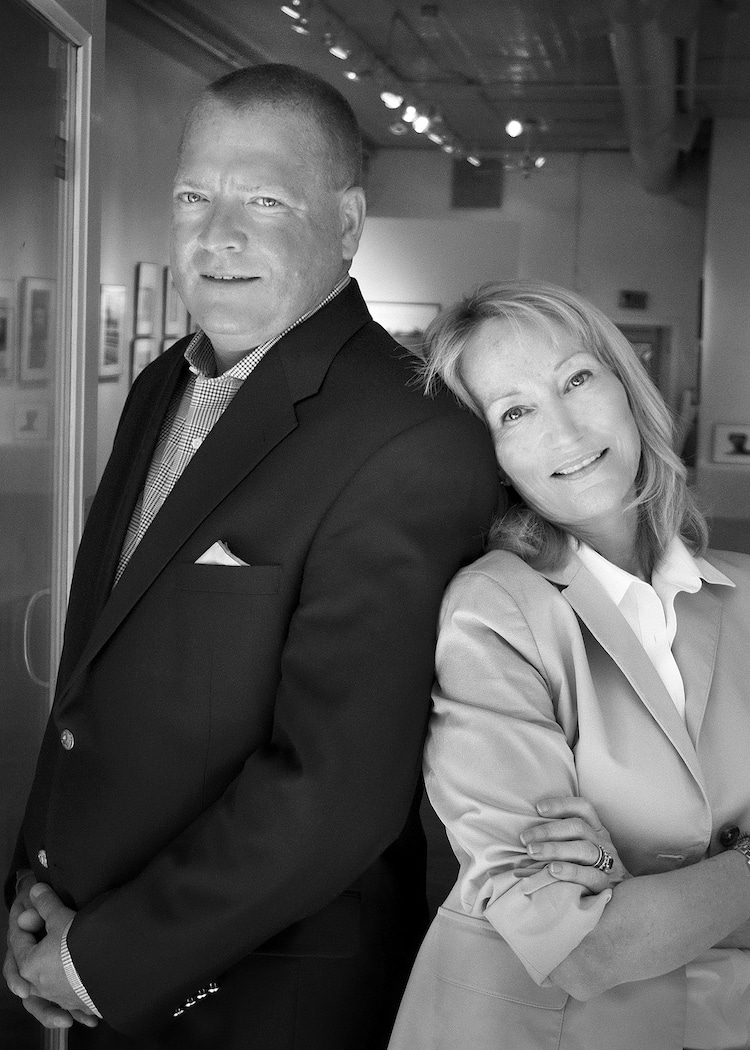
Sid and Michelle Monroe, owners of the Monroe Gallery of Photography, which specializes in photojournalism and historical documentary photography. (Photo: R. David Marks)

How to Get Gallery Representation as an Artist

Photo: Samuel Zeller

Get Out and Network

If you have a grand dream of waltzing into a major gallery, portfolio in hand, and waltzing out with a solo show, you may be in for grave disappointment. Some overeager artists feel that if they knock on enough doors and show up unannounced to abruptly display their work, they’ll get an in. Unfortunately, this is far from the truth.

Most gallery relationships begin by networking and getting an introduction at the right time. This is why good communication and networking skills are key for an artist, as often times it might be a collector, journalist, or curator to first mention an artist’s work to a gallerist. In fact, gallerists often consider who an artist’s collectors are or if they’ve worked with public institutions in the past when looking at how a new relationship may fit into the gallery’s existing roster.

Magda Danysz - Vhils

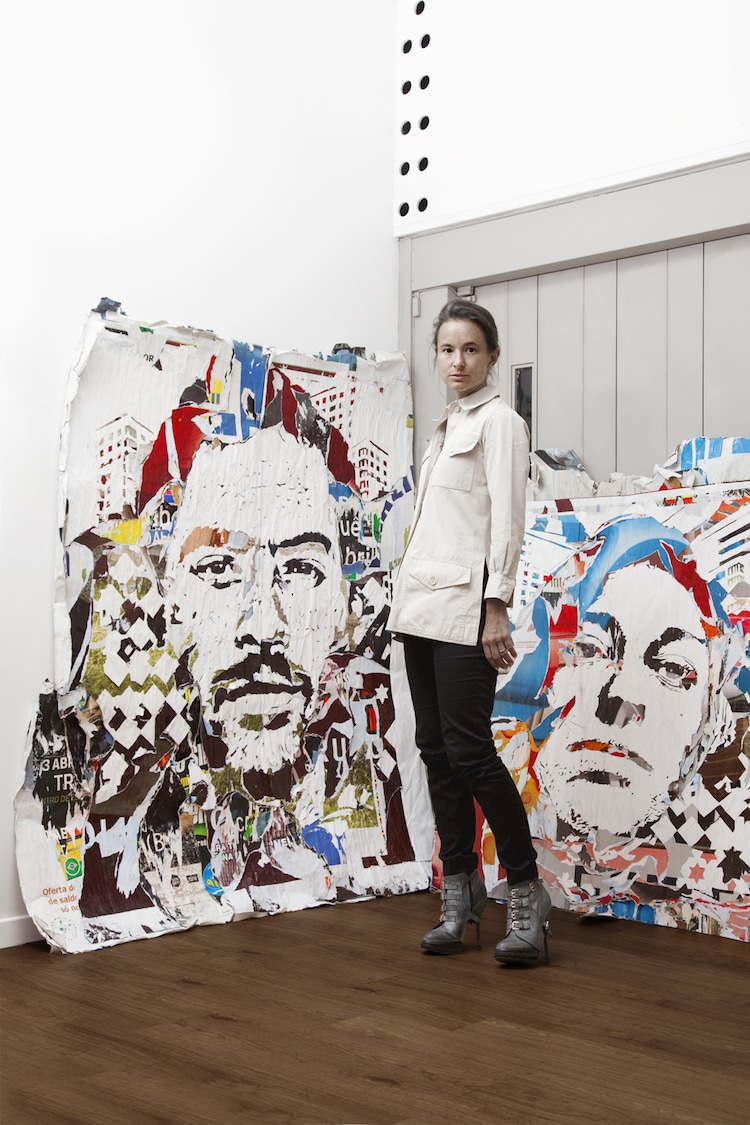
Magda Danysz, owner of the Magda Danysz Gallery in Shanghai, Paris, and London, in front of artwork by Vhils. (Photo: Céline Barrere)

Magda Danysz, of the Magda Danysz Gallery in London, Shanghai, and Paris has worked with some of the top contemporary urban artists today, such as Vhils, JR, and Liu Bolin. For her, the gallerist-artist relationship is an important coming together of a team, and as such, she is sure to observe an artist from afar well before they may ever work together.

“The gallery and the artist are supposed to be a team, so the most important is to be able to find right introductions and the right moment on how to meet. A gallery and an artist can only do wonderful things if they work together.”

And remember, many galleries also have group shows, where they may test out new talent before making a commitment to a larger working relationship. These are opportunities for both parties to put their best efforts forward and use the situation to test if you and the gallery are compatible for future projects.

Keep reading to find out what else gallerists look for when seeking out emerging talent.

The post How to Successfully Find Gallery Representation as an Artist appeared first on My Modern Met.

http://ift.tt/2Gz7dBM

Map Reveals Where Modern Countries Would Be Located If Pangea Still Existed

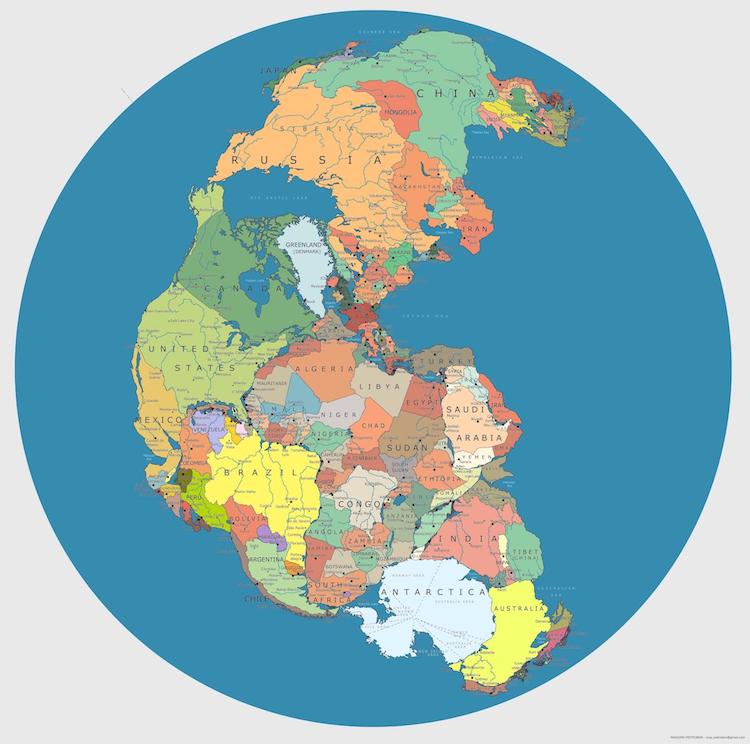
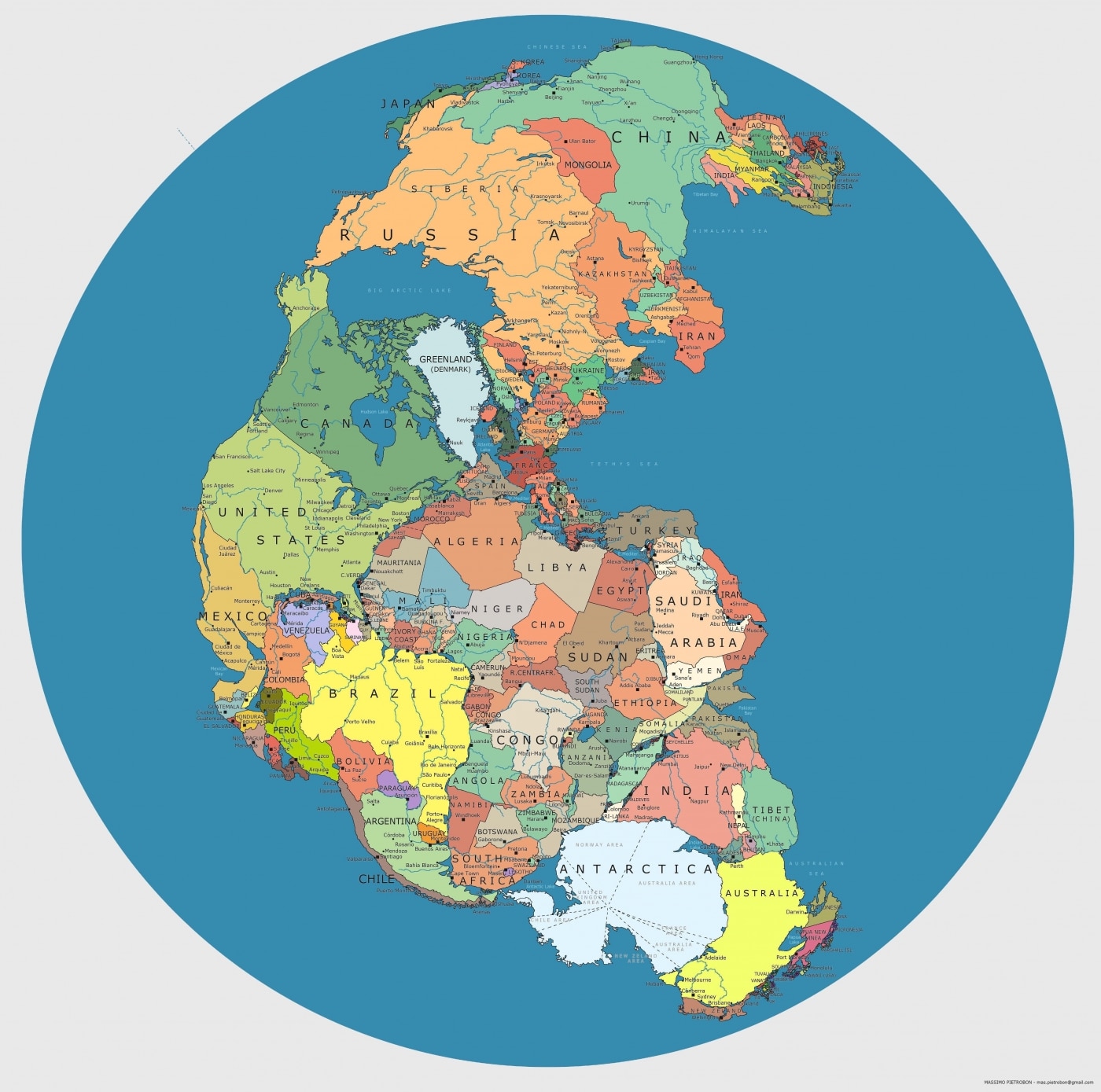
Modern Pangea Map by Massimo Pietrobon

Click to view in high-resolution.

When we think about the world as we know it, and how humans developed from pre-historic times, inevitably the word Pangea enters the discussion. This supercontinent, formed approximately 335 million years ago, slowly started to break apart around 175 million years ago into the continents we now know. In a day and age where borders are constantly on our mind, just who would have been our neighbors—and how would the world be different—if Pangea existed today?

It’s a question Massimo Pietrobon had on his mind when he created Pangea Politica, a conceptual map demonstrating where modern countries would fall within Pangea if it still existed today. “Joining the world into one piece of land represents a return to unity with the planet and within the human race, in spite of the divisions that make our rulers quite comfortable,” Pietrobon writes.

And so, in Pietrobon’s world, the United States cuddles up to Russia, while Africa dominates the map. Neighboring North America, South America, Antarctica, Europe, and the Middle East, Africa’s imposing stature reminds us of just how large the continent really is. While the designer notes that the scale of some countries could be better—see this true size map to verify dimensions—for him, it is the concept that counts.

Where do you think we’d be today if Pangea had stayed together?

Modern Pangea Map by Massimo Pietrobon

Massimo Pietrobon: Website | Vimeo
h/t: [Open Culture]

All images via Massimo Pietrobon.

Related Articles:

Ingeniously Redesigned World Map Looks Unusual, But Is Highly Accurate

Eye-Opening Map Reveals the Most Peaceful Countries in the World

Top 25 Informative Maps That Teach Us Something Uniquely Different About the World

Interactive Map Shows Where on Earth You’d Be If You Dug Straight Through the Ground

The post Map Reveals Where Modern Countries Would Be Located If Pangea Still Existed appeared first on My Modern Met.

http://ift.tt/2np2nPF

Meet William Morris: The Most Celebrated Designer of the Arts & Crafts Movement

The Arts and Crafts Movement and William Morris

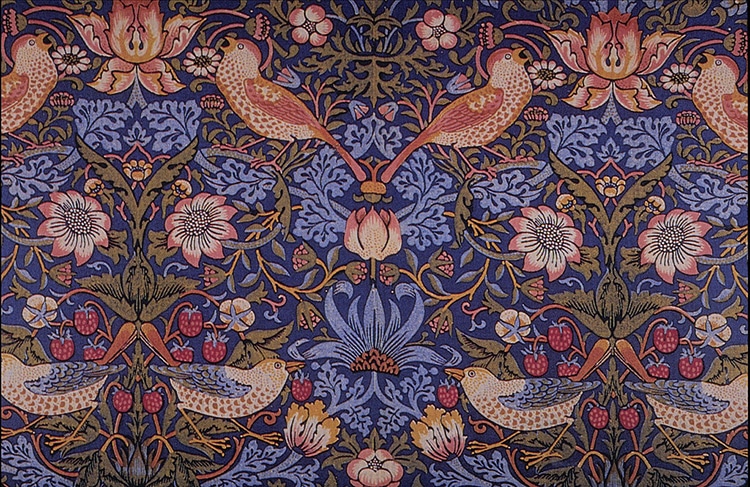
“Strawberry Thief” 1883 via Wikimedia Commons

Elegant swirls of vines, flowers, and leaves in perfect symmetry, William Morris’ iconic patterns are instantly recognizable. Designed during the 1800s, Morris’ woodblock-printed wallpaper designs were revolutionary for their time, and can still be found all over the world, printed for furniture upholstery, curtains, ceramics, and even fashion accessories. But do you know the history of how they came to be?

The Arts and Crafts Movement

Beginning in Britain around 1880, the Arts and Crafts movement was born from the values of people concerned about the effects of industrialization on design and traditional craft. In response, architects, designers, craftsmen, and artists turned to new ways of living and working, pioneering new approaches to create decorative arts.

One of the most influential figures during this time was William Morris, who actively promoted the joy of craftsmanship and the beauty of the nature. Having produced over 50 wallpaper designs throughout his career, Morris became an internationally renowned designer and manufacturer. Other creatives such as architects, painters, sculptors and designers began to take up his ideas. They began a unified art and craft approach to design, which soon spread across Europe and America, and eventually Japan, emerging as its own folk crafts movement called Mingei.

Who was William Morris?

Born in Walthamstow, East London in March 1834, William Morris was a poet, artist, philosopher, typographer, political theorist, and arguably the most celebrated designer of the Arts & Crafts movement. He strived to protect and revive the traditional techniques of handmade production that were being replaced by machines during the Victorian era’s Industrial Revolution. Although he dabbled in embroidery, carpet-making, poetry and literature, he mastered the art of woodblock printing, and created some of the most recognizable textile patterns of the 19th century.

The Arts and Crafts Movement and William Morris

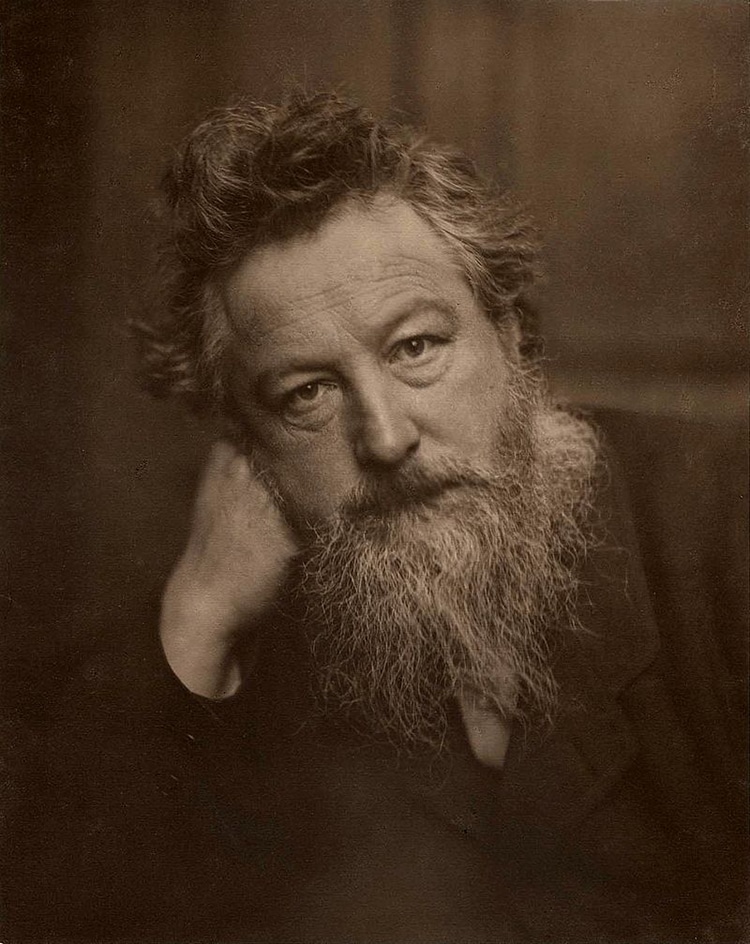
Portrait of William Morris by Frederick Hollyer via Wikimedia Commons


Born into a wealthy middle-class family, Morris enjoyed a privileged childhood, as well as a sizable inheritance, meaning he would never struggle to earn his own income. He spent his childhood drawing, reading, and exploring forests and grand buildings, which triggered his fascination with natural landscapes and architecture.

Having developed his own particular taste from a young age, he began to realize the only way he could have the beautiful home he wanted was if he designed every part of it himself. As he famously once said, “Have nothing in your houses that you do not know to be useful or believe to be beautiful.”


The Red House

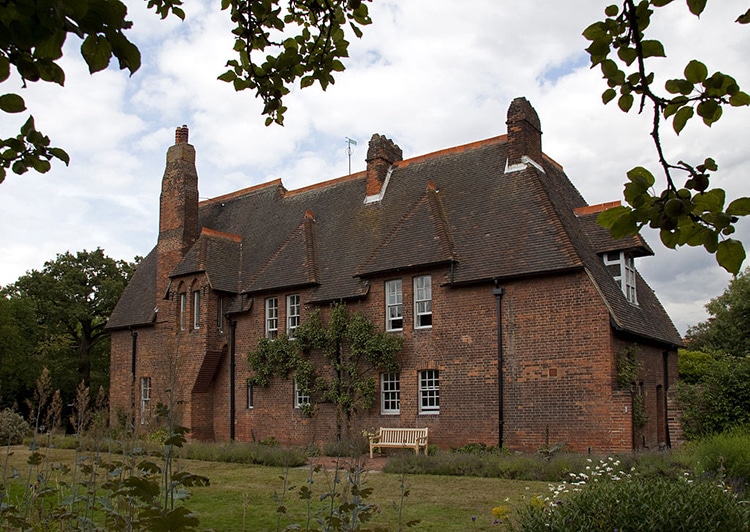
While studying at Oxford, Morris met his lifelong friend, architect Philip Webb. His dear friend helped him design and construct his Medieval-inspired, Neo-Gothic style family home in Bexleyheath, where he lived with his wife, Jane Morris, and his two children, Jane “Jenny” Alice Morris and Mary “May” Morris. Built in 1860, it became known as the Red House, and is now one of the most significant buildings of the Arts and Crafts era. Today, the house is owned by the National Trust and is open to visitors.

The Arts and Crafts Movement and William Morris

The “Red House,” home of William Morris. via Wikimedia Commons

A number of Morris’ creative friends spent a lot of time at the Red House, including Pre-Raphaelite painters Edward Burne-Jones and Dante Gabriel Rossetti, who both helped him elaborately decorate the abode. While he envisioned living there for the rest of his life, Morris’ perfectionism caused him to move on after only five years. Over the course of his short stay, he discovered a number problems with the property. However, he enjoyed the process so much that he decided to set up his own design company, with a desire to create affordable “art for all.”

Morris, Marshall, Faulkner & Co. which was later known as simply Morris & Co., was incredibly successful, and produced reams of fabric and wallpaper designs for over 150 years.

The Arts and Crafts Movement and William Morris

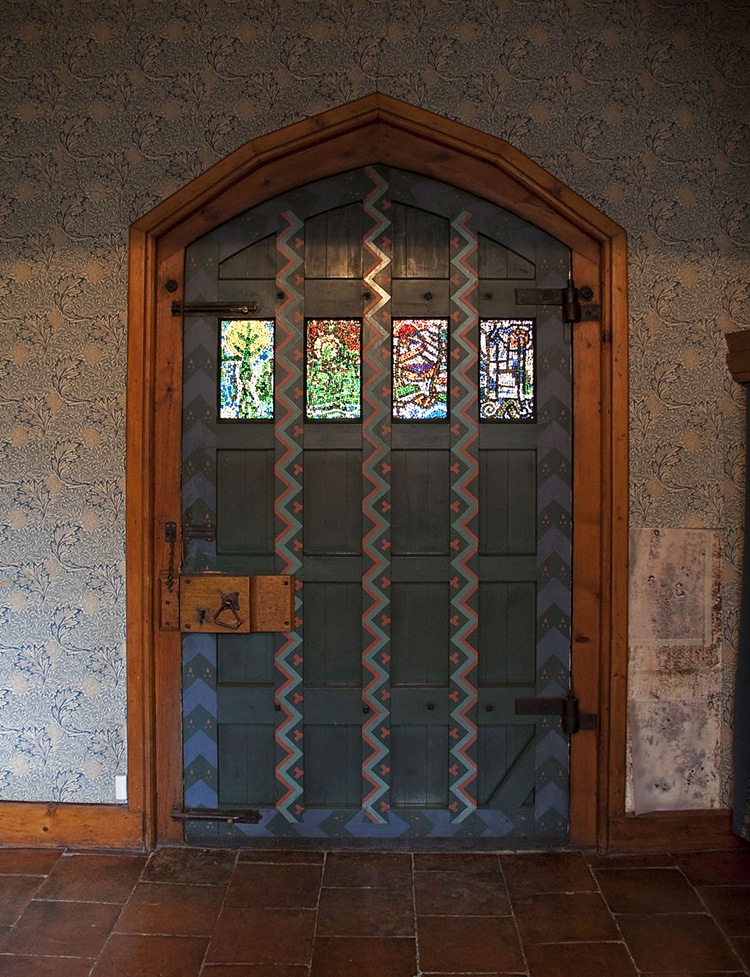
The Red House front door from inside. Photo: Tony Hisgett (CC BY 2.0) via Wikimedia Commons


Morris’ Wallpaper Designs

Featuring swirling leaves, thieving birds, rose-filled trellises, and fruit tree branches, the designs of William Morris have a unique timeless quality. He began designing wallpapers in 1862, but their sale was delayed by several years while he experimented with printing from zinc plates.

The Arts and Crafts Movement and William Morris

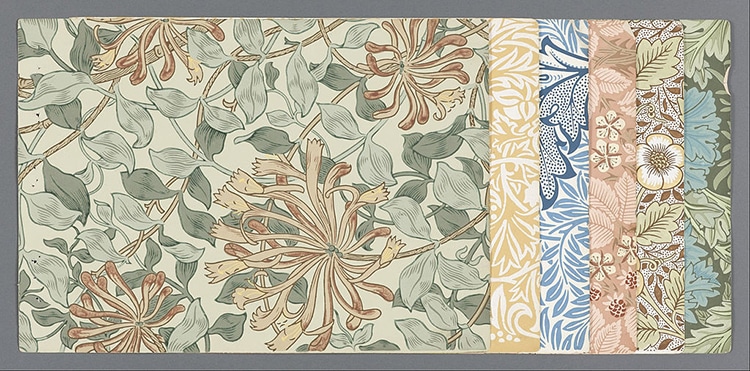
Morris & Co. sample book via Wikimedia Commons

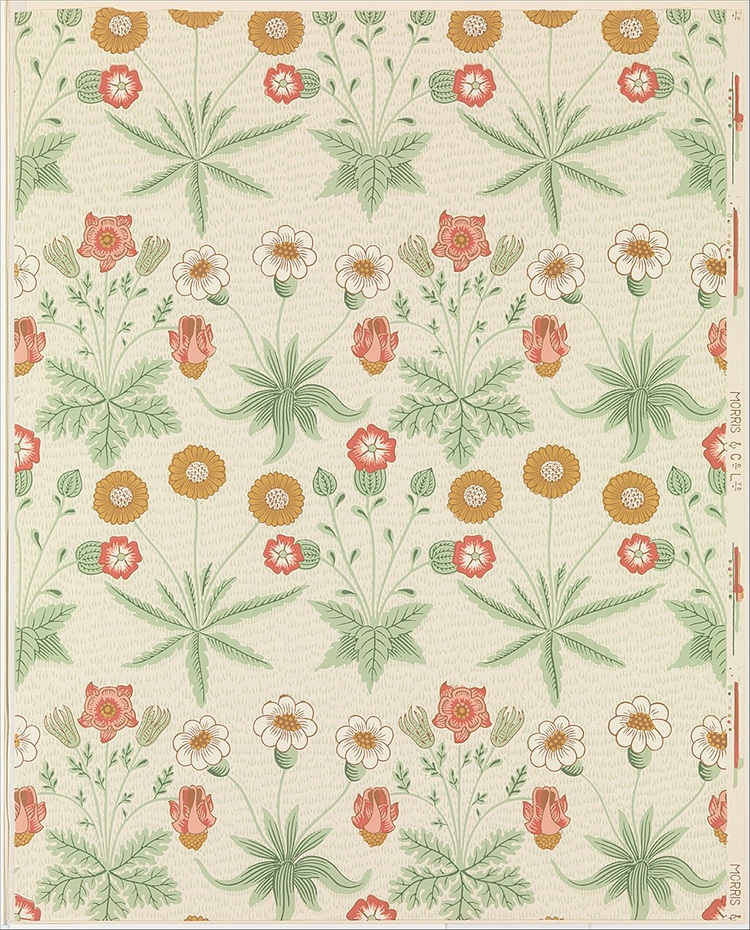
Inspired by nature, Morris’ designs feature leaves, vines, and flowers that he observed in his gardens or on walks in the countryside. Rather than life-like illustrations, his drawings are subtly stylized versions. Daisy, a simple design featuring meadow flowers, was the first of Morris’ wallpaper designs to go on sale in 1864.

The Arts and Crafts Movement and William Morris

“Diasy” 1864 via Wikimedia Commons

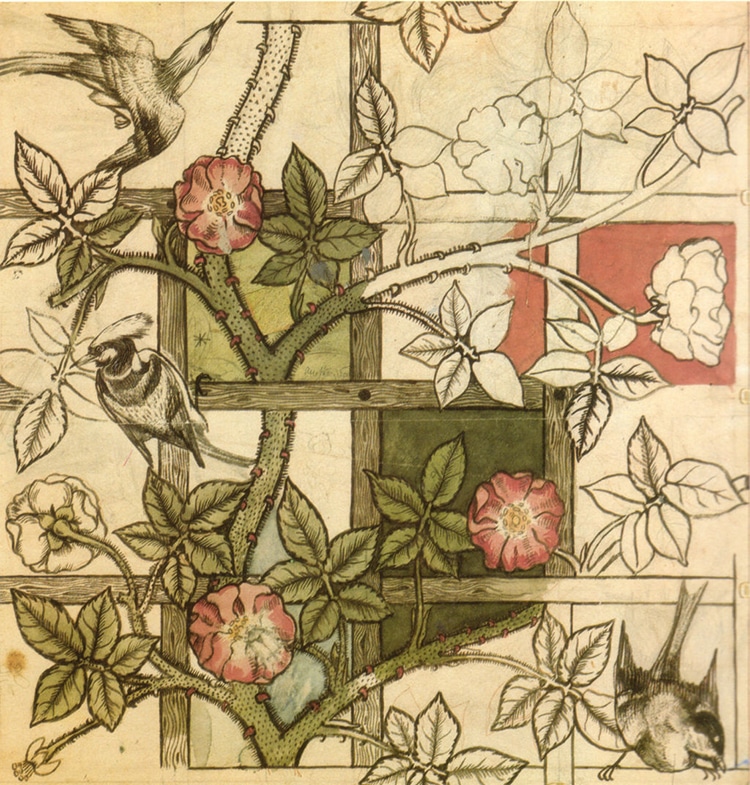
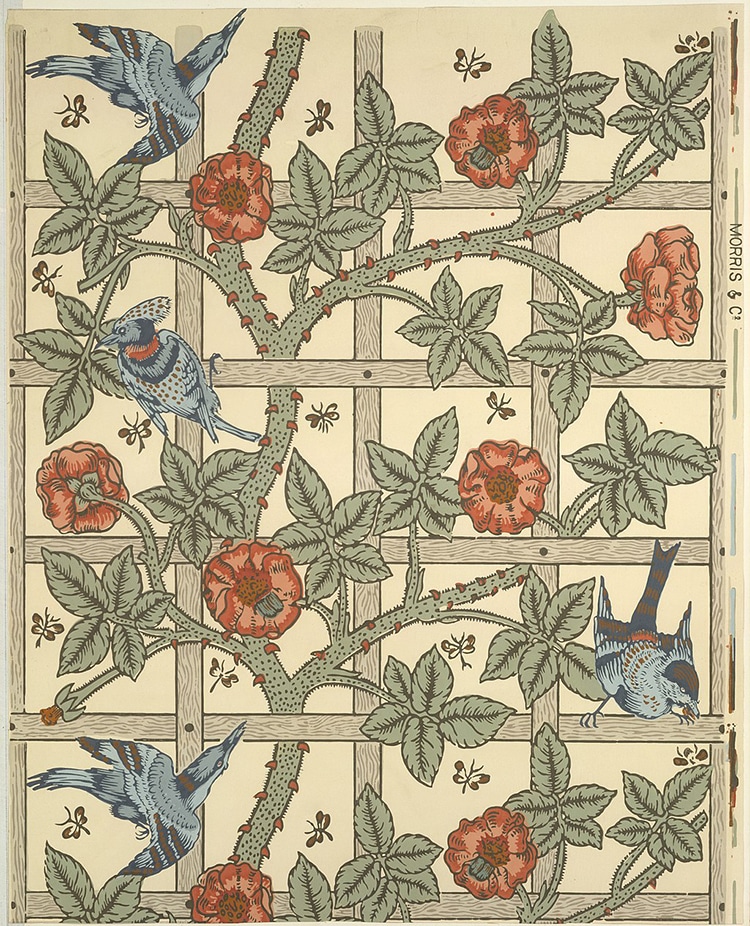
Morris designed Trellis after being unable to find a wallpaper that he liked enough for his own home. Inspired by the rose trellis in the garden of the Red House, Morris designed the pattern which went on sale in 1864. Interestingly, Morris could not draw birds, and the birds for this design were actually sketched by Philip Webb, the same friend and architect who designed the Red House.

The Arts and Crafts Movement and William Morris

William Morris design for “Trellis” wallpaper 1862 via Wikimedia Commons

The Arts and Crafts Movement and William Morris

“Trellis” wallpaper designed by William Morris 1862 and first produced in 1864. Via Wikimedia Commons

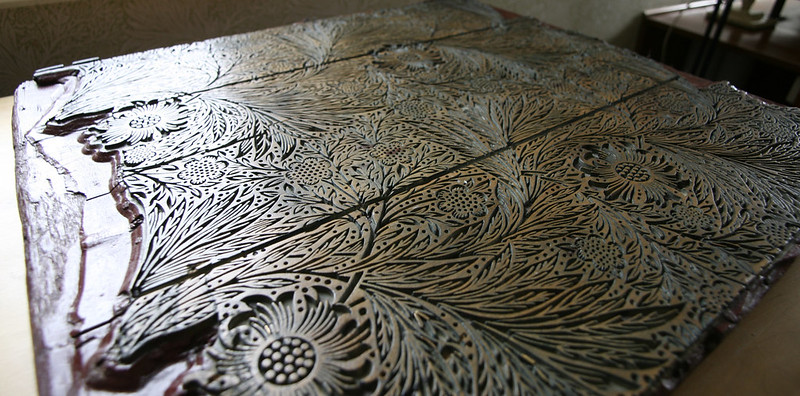
Morris had his wallpapers printed by hand, using carved, pear woodblocks loaded with natural, mineral-based dyes, and pressed down with the aid of a foot-operated weight. Each design was made by carefully lining up and printing the woodblock motifs again and again to create a seamless repeat. Morris once spoke about the precise process, saying, “Remember that a pattern is either right or wrong. It cannot be forgiven for blundering, as a picture may be which has otherwise great qualities in it. It is with a pattern as with a fortress, it is no stronger than its weakest point.”

He employed the printers Jeffrey & Co. to print his wallpapers up until his death in 1896, when the Merton factory took over production until the company’s voluntary liquidation in 1940.

The Red House Kent//embedr.flickr.com/assets/client-code.js

Wood printing block William Morris - The Red House//embedr.flickr.com/assets/client-code.js

The post Meet William Morris: The Most Celebrated Designer of the Arts & Crafts Movement appeared first on My Modern Met.

http://ift.tt/2DFdppR

Striking Winners of the 2018 Black + White Photographer of the Year Competition

Rachael Talibart Black + White Photographer of the Year 2018

Rachael Talibart, Winner – Black + White Photographer of the Year 2018

Celebrating the best of monochromatic photography, the Black+White Photographer of the Year (BPOTY) contest has awarded the winners of the 2018 competition. The biennial contest is organized by Black+White Photography Magazine in partnership with Fujifilm and is open to amateur and professional photographers.

Rachael Talibart was awarded the top prize for her striking image of a breaking wave captured off the southern coast of England. The ocean spray, frozen in time, is a dramatic shot that takes on even greater mystery in black and white. “With the right image, I find that shooting black and white can powerfully enhance the emotion I’m trying to evoke and, being one step removed from reality, it can offer a fresh perspective,” she shared.

Talibart, who is both an experienced sailor and professional photographer, beat out a field of talented international photographers to win the title of Black+White Photographer of the Year. Participants were asked to submit images across three categories: The World of People, The World Around Us, and The Creative World. The winners were judged by an expert panel that included Elizabeth Roberts (editor of Black + White Photography Magazine), Shoair Mavlian (assistant curator of Photography at the Tate Modern), and 2015 BPOTY winner Vicki Painting.

Talibart’s image was selected for its combination of technical skill and artistry, which tipped the balance in favor of the landscape photograph. In a field heavily peppered with imagery including people, Talibart’s win proves that this type of photography is just as powerful as portraiture or photojournalism.

Take a look at the other winning and shortlisted entries from the Black+White Photographer of the Year 2018 competition.

bpoty 2018

Eduardo Lopez Moreno, Second Prize

best black and white photography contest

Aqua Lin, Third Prize

best black and white photography contest

Patrick Dumont, Shortlisted

black and white photography contest

Carla Kogelman, Shortlisted

black and white photography contest

Saeed Rezvanian, Shortlisted

Black + White Photographer of the Year 2018

Szymon Barylski, Shortlisted

Black + White Photographer of the Year 2018 contest

Richard Pilnick, Shortlisted

black and white photography contest

Nicola Davison Reed, Shortlisted

best black and white photography contest

Joseph Chung, Shortlisted

Black + White Photographer of the Year 2018

Mark Bickerdike, Shortlisted

black and white photography contest

Andre du Plessis, Shortlisted

Black+White Photography Magazine: Website | Facebook | Instagram

My Modern Met granted permission to use photos by Black+White Photography Magazine.

Related Articles:

Hasselblad Announces 2018 “Masters” of Its Iconic Photography Competition

Winners of the 2017 MonoVisions Photography Awards Explore the World in Black & White

Winners of the Sony World Photography Awards 2017 Open Competition Revealed

Winners of the B&W Child Photography Contest Capture the Universal Essence of Childhood

The post Striking Winners of the 2018 Black + White Photographer of the Year Competition appeared first on My Modern Met.

http://ift.tt/2rNY3xE

How Female Painter Mary Cassatt Became an Important Impressionist Figure

Mary Cassatt Biography Mary Cassatt Art Mary Cassatt Paintings Famous Female Painters

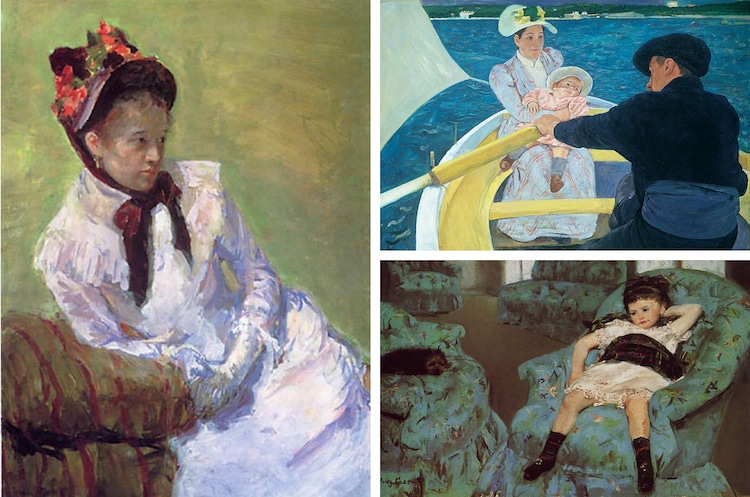
Left: Mary Cassatt, Self-Portrait (1878) (Photo: The Met via Wikimedia Commons)

As a prominent Impressionist artist, Mary Cassatt (1844-1926) is often regarded as one of art history’s most famous female painters. An unmarried American woman living in Paris, Cassatt was able to make a name for herself in the male-dominated movement, defying 19th century gender expectations and paving the way for future female artists.

In addition to admiring her canvases, understanding the context of her art is an important aspect of appreciating her role in both Impressionism and in the realm of modern art. While her most well-known pieces were produced when she was an established artist, her desire to become a painter can be traced back to her childhood.

Early Interest in Art

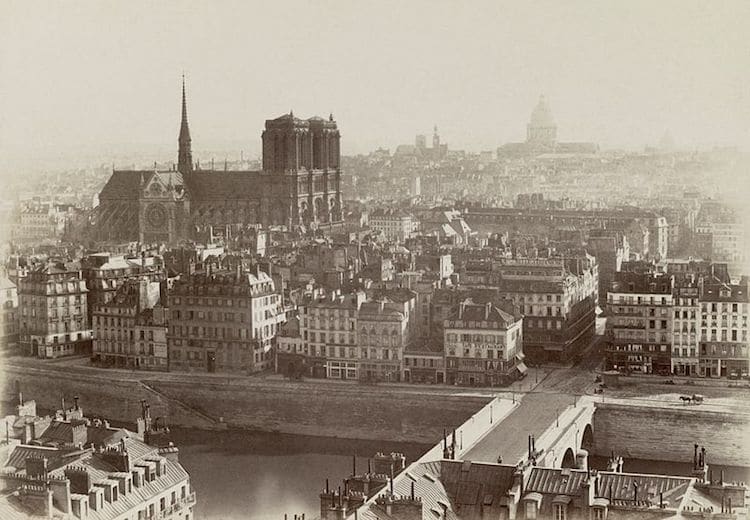
As Cassatt’s career was largely based in Europe, it is no surprise that traveling abroad as a child is what sparked her interest in art. In the 1850s, Cassatt spent many years in Germany and France, where she picked up the languages and developed an interest in drawing. Following her return to Philadelphia, she enrolled in the Pennsylvania Academy of the Fine Arts, where she began to study painting in 1861.

While her parents supported her interest in the arts, they—like many other people during this time—did not deem it a suitable career for a woman. Nevertheless, she continued her artistic education until 1865, when she grew tired of the restraints placed upon female students. One year later, she moved to Paris, France, where her career came to fruition.

Mary Cassatt Biography Mary Cassatt Art Mary Cassatt Paintings Famous Female Painters

Charles Soulier, Paris in 1865 (Photo: Library of Congress via The National Gallery of Art via Wikimedia Commons)

Life in Paris

Traditionally, most aspiring artists living in Paris studied at the École des Beaux-Arts (School of Fine Arts). Due to her gender, however, Cassatt was not allowed to attend. To make up for this loss, she paired independent study (she was privately taught by Jean-Léon Gérôme, a prominent French painter) with hands-on learning as a Louvre copyist.

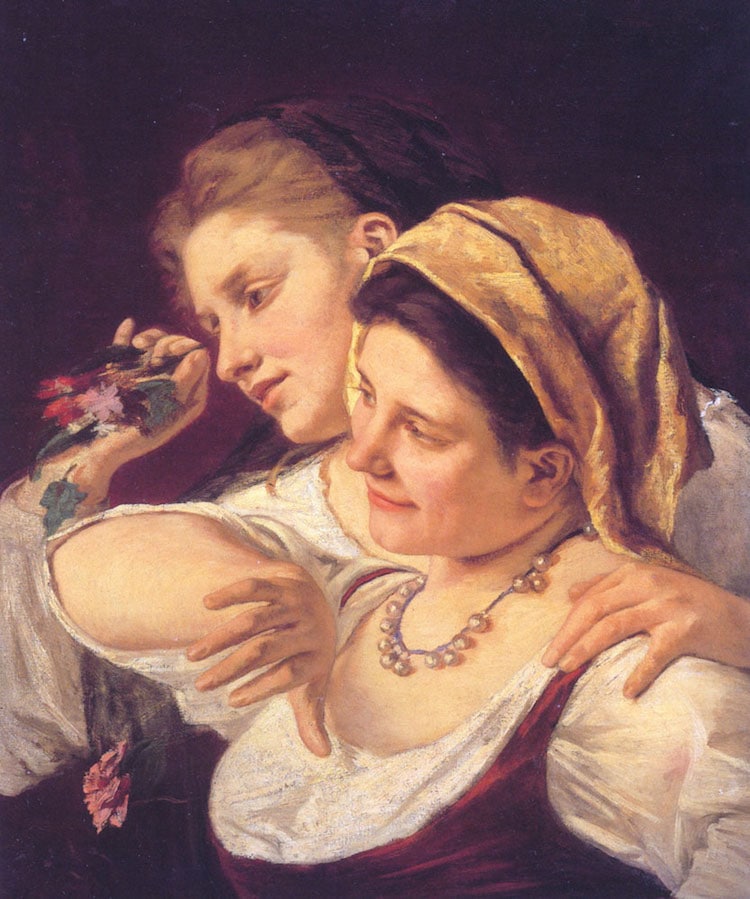
In addition to producing copies of masterpieces, Cassatt created original paintings during her early years in Paris, including Two Women Throwing Flowers. With the hope of being selected for the traditional salon—an annual exhibition that featured hand-picked paintings—most of these works are painted in a realist style. Frustrated by a string of salon rejections and unhappy with the treatment of female participants, however, she abandoned this path and found her place among Paris’ avant-garde up-and-comers, the “Impressionists.”

Mary Cassatt Biography Mary Cassatt Art Mary Cassatt Paintings Famous Female Painters

Mary Cassatt, Two Women Throwing Flowers (1872) (Image via Wikimedia Commons)

Impressionism

Cassatt was invited to exhibit with the Impressionists by Edgar Degas, an established artist whose work Cassatt had admired for years. The Impressionists were connected by a unique approach to painting, characterized by a preference for thick brushstrokes, an interest in everyday subject matter, and a habit of painting en plein air, or outdoors. While most of the artists associated with the movement—including Claude Monet, Édouard Manet, and Pierre-Auguste Renoir—were male, the Impressionists accepted and exhibited female artists, including “virtuoso colorist” Berthe Morisot and, of course, Mary Cassatt.

Cassatt began showing her work—like the iconic Little Girl in Blue Armchair—with the Impressionists in 1879, five years after the group’s first independent exhibition. For the remainder of her career, she would reject realism and abandon the confines of her studio in order to produce Impressionist paintings and pastels.

Mary Cassatt Biography Mary Cassatt Art Mary Cassatt Paintings Famous Female Painters

Mary Cassatt, Little Girl in Blue Armchair (1878) (Image via Wikimedia Commons)

The post How Female Painter Mary Cassatt Became an Important Impressionist Figure appeared first on My Modern Met.

http://ift.tt/2rIpau2

Scientists Piece Together One of the Last Unsolved Dead Sea Scrolls

dead sea scroll deciphered

Photo: University of Haifa

Researchers have deciphered one of last remaining Dead Sea Scrolls from over 900 that were originally found in the Qumran Caves more than 60 years ago. Since their discovery, these ancient religious texts—which date to at least the 4th-century BCE—have shed new light on how the Jewish religion was practiced and include the oldest known manuscripts of the Hebrew Bible.

Now, Dr. Eshbal Ratson and Prof. Jonathan Ben-Dov of the Department of Bible Studies at the University of Haifa have restored and deciphered one of last two scrolls that had remained unpublished. This came after testing helped them discover that small fragments thought to belong to numerous different scrolls were, in fact, from one document. The Israeli researchers then spent more than a year painstakingly piecing together more than 60 fragments—some smaller than 1 square centimeter (0.155 square inches)—in order to reveal the ancient code.

What they found were references to a 364-day calendar, unique to the desert sect that would have written the scrolls, and several important festivals that are not mentioned in the Hebrew Bible. Referred to as the festivals of New Wine and New Oil, they helped herald the changing of seasons and were an extension of what is now known as Shavuot. This discovery is important, as until now researchers were aware of the festivals but did not know the names for these celebrations.

dead sea scroll caves

The Dead Sea Scrolls were first discovered in the Qumran Caves, which are located in the Judaean Desert of the West Bank. (Photo: Dennis Jarvis)

The authors of the Dead Sea Scrolls remain a mystery, though experts have traditionally attributed them to a desert sect called the Essenes. The work of the University of Haifa researchers provides interesting insight into the authors of the scrolls—including their mistakes. It appears that one scribe forgot to include several noteworthy dates, leaving a second scribe to correct the oversite with annotations in the margins.

“The scroll is written in code, but its actual content is simple and well-known, and there was no reason to conceal it,” the researchers explain. “This practice is also found in many places outside the Land of Israel, where leaders write in secret code even when discussing universally-known matters, as a reflection of their status. The custom was intended to show that the author was familiar with the code, while others were not. However, this present scroll shows that the author made a number of mistakes.”

Interestingly, these mistakes are what assisted the researchers in solving the puzzle. Dr. Ratzon spoke to Haaretz, Israeli’s longest-running newspaper, admitting: “What’s nice is that these comments were hints that helped me figure out the puzzle—they showed me how to assemble the scroll.”

h/t: [Mental Floss, BBC]

Related Articles:

3,500-Year-Old Stone Carving Discovery May Change Art History as We Know It

4,000-Year-Old Assyrian Tablet Discovered Is an Ancient Prenuptial Agreement

Scholars Decipher 3,200-Year-Old Hieroglyphic Inscription

Researchers Crack Mathematical Code of 3,700-Year-Old Babylonian Tablet

The post Scientists Piece Together One of the Last Unsolved Dead Sea Scrolls appeared first on My Modern Met.

http://ift.tt/2FicbkU

The Real Woman Who Inspired ‘Rosie the Riveter’ Dies at 96

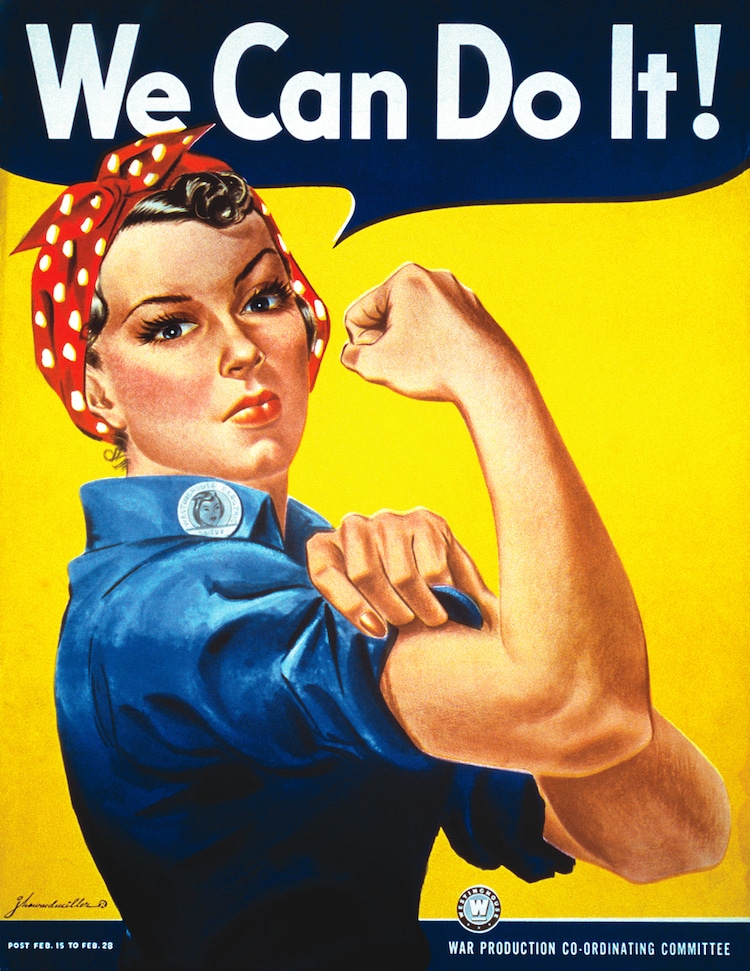
rosie the riveter poster

Image: [Public Domain] via Wikimedia Commons
This post may contain affiliate links. If you make a purchase, My Modern Met may earn an affiliate commission. Please read our disclosure for more info.

The woman who inspired Rosie the Riveter has passed away at age 96. Naomi Parker Fraley was just 20 years old when she went to work at a Naval Air Station in Alameda, California, after the attack at Pearl Harbor in 1941. She was just one of the millions of women who entered the workforce, many for the first time, filling gaps left by men on the frontlines and, in many cases, outperforming them at their old jobs. In fact, over the course of World War II, the percentage of American women working outside the home went from 29% to 36%. Increasingly, being a working woman was seen not only as respectable, but patriotic, a far cry from stereotypes of female workers as unskilled and unfeminine.

But it would take over 70 years for Fraley to receive the credit she deserved as the inspiration for the Rosie the Riveter depicted in the “We Can Do It!” poster created by J. Howard Miller in 1942. In the interim, her image served as a beacon of inspiration for all women looking to shatter the glass ceiling and bridge the gender gap. As such, it seems only fitting that she passed on January 20, the same day as the Women’s March.

American Women During WWII

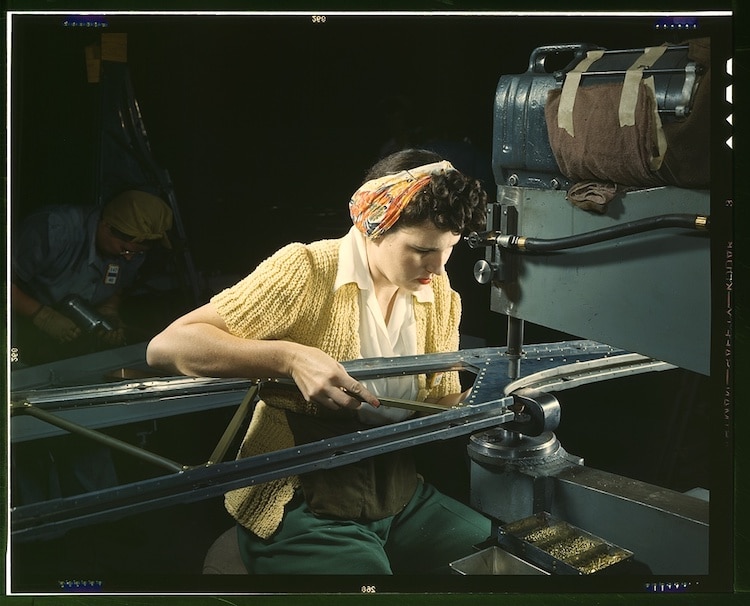
A girl riveting machine operator at the Douglas Aircraft Company in Long Beach, California. 1942. (Photo: Albert T. Palmer / Library of Congress)

Who was the “real” Rosie the Riveter?

The answer isn’t as straightforward as one would think, only because Rosie the Riveter appeared in more than just Howard’s poster. Riveting was one of many factory jobs that women excelled at during the course of World War II, with three million women entering the workforce for the first time. Indeed, the U.S. government encouraged women to work and spent large sums of money on campaigns to push the idea and change cultural norms.

Rosie the Riveter first appeared in song, in a hit written in 1942 by Redd Evans and John Jacob Loeb. The lyrics depict Rosie as a strong assembly worker showing her patriotism by working tirelessly. Rosalind P. Walter, who worked a night shift helping build fighter aircrafts, inspired the song. And from that moment forward, Rosie the Riveter was seen as a symbol for women in the workforce.

Later, in 1944, Rosie the Riveter was released in cinemas. The film was inspired by Rose Will Monroe, a riveter who worked at an aircraft factory in Michigan. And in 1943, Norman Rockwell interpreted the Rosie the Riveter theme for his iconic cover of the Memorial Day issue of the Saturday Evening Post. His model was known to have been Mary Doyle, a telephone operator who lived close to Rockwell, and the pose was inspired by the Prophet Isaiah as depicted on Michelangelo’s Sistine Ceiling.

All this brings us to the most iconic of all Rosie the Riveters. A 1942 photograph distributed by the Acme photo agency, and published in several newspapers at the time, showed a young woman—polkadot bandana in place—leaning over an industrial lathe. It was one of many photographs that circulated at the time, all showing the power of women taking charge and working to aid in the war effort.

https://platform.twitter.com/widgets.js

Picked up by Pittsburgh artist J. Howard Miller, the photograph inspired the look of Rosie the Riveter on the “We Can Do It!” poster, but for most of Fraley’s life, she had no idea about the role she’d played in American feminism. In fact, until 2016, it was commonly accepted that Geraldine Hoff Doyle was the model for Rosie. Doyle, who passed in 2010, saw the photograph in a magazine in the mid-80s and felt she recognized the young girl as herself. After reporting this to a historian, it became the accepted truth for the rest of her life.

Fraley’s connection only came into focus when she happened upon the original image at a convention for women who worked during the war. The only problem was, the caption labeled the girl as Geraldine Hoff Doyle. With no way to correct the error, Fraley let it be, but at the same time, a professor from Seton Hall was digging deeper into the history of Rosie the Riveter. When he came across the original photo in an archive, with Fraley’s name written clearly, he tracked her down and made sure she got her rightful credit.

“I didn’t want fame or fortune,” she told People magazine in 2016, “But I did want my own identity.” It was an identity she was proud to have rediscovered. “The women of this country these days need some icons, if they think I’m one, I’m happy.”

A post shared by People Magazine (@people) on

//platform.instagram.com/en_US/embeds.js

How “We Can Do It!” Became a Symbol of American Feminism

And while Rosie the Riveter is most closely associated with the “We Can Do It!” poster, it’s interesting to note that this symbol of female empowerment wasn’t originally seen by the public. In fact, it wasn’t widely distributed at all during World War II. Though many propaganda posters focused on how women could contribute to the war effort by working, “We Can Do It!” was commissioned by the Westinghouse Electric Company to help boost internal morale. As such, it was only hung at a few factories.

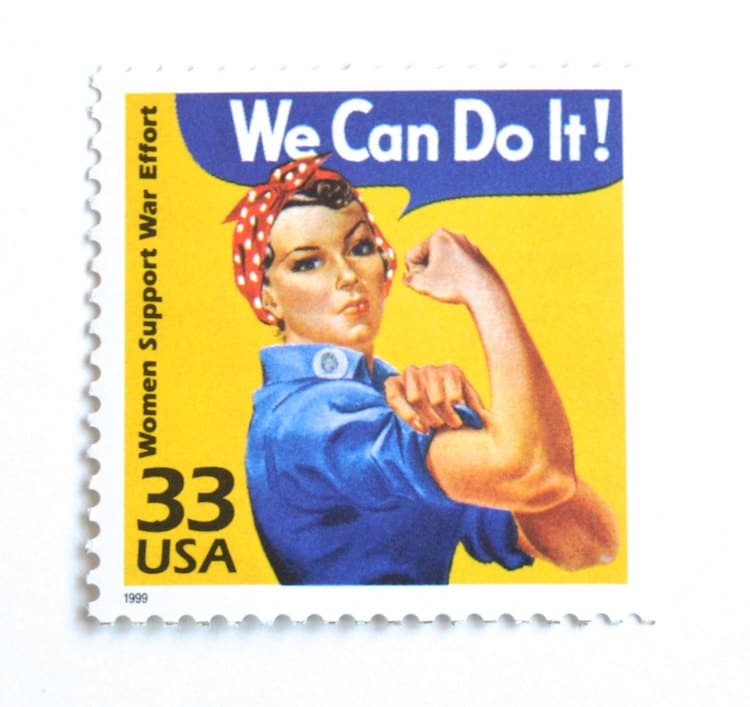
So how did the poster enter into pop culture? In the 1980s, the image was rediscovered and often called Rosie the Riveter due to that figure’s popularity during World War II. From the 1980s, the poster became synonymous with female empowerment and American feminism, even becoming a stamp in 1999.

Rosie the Riveter Stamp

Photo: EdelweissPost

To this day, Rosie inspires women around the world through her style, strength, and determination. More than a single person, she symbolizes a new way of thinking and a movement toward gender equality.

Keep reading to see how, even today, Rosie the Riveter inspires women.

The post The Real Woman Who Inspired ‘Rosie the Riveter’ Dies at 96 appeared first on My Modern Met.

http://ift.tt/2DADUNh

360° Aerial Photos of Barcelona Transform the City Into Small Planets

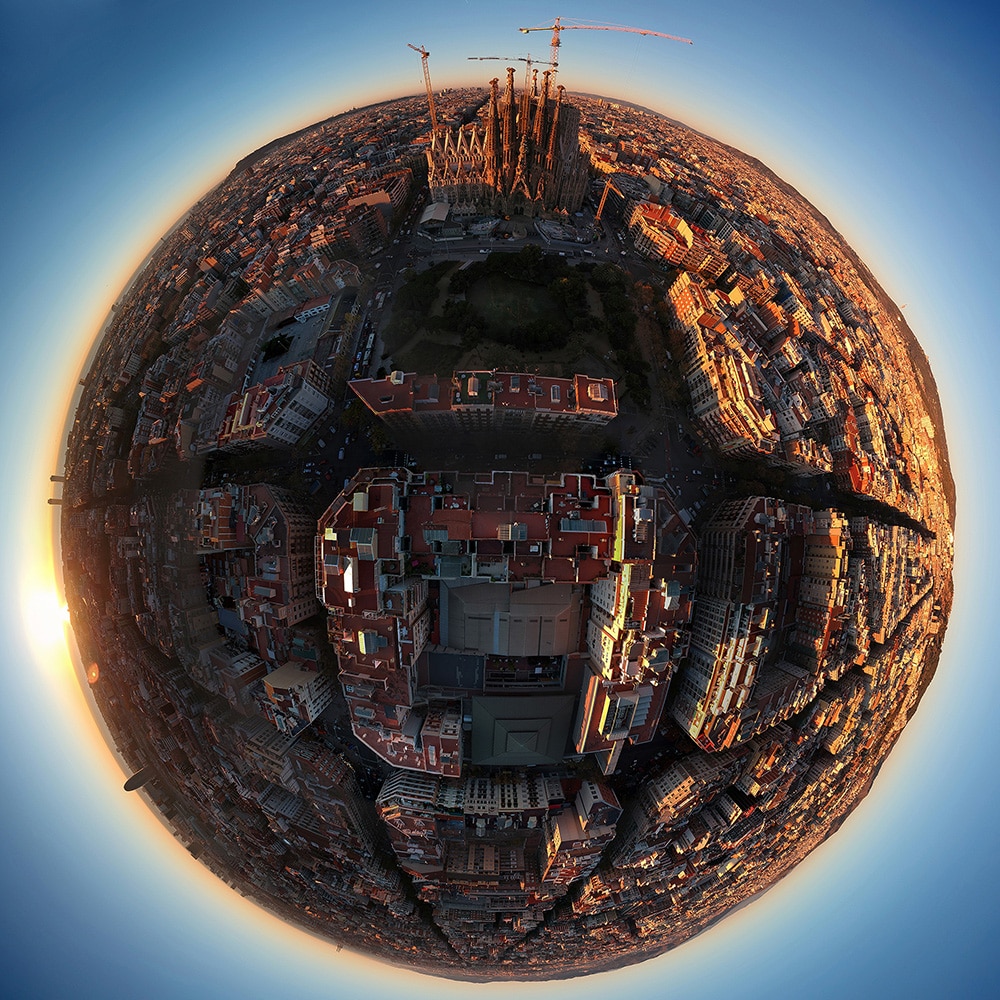
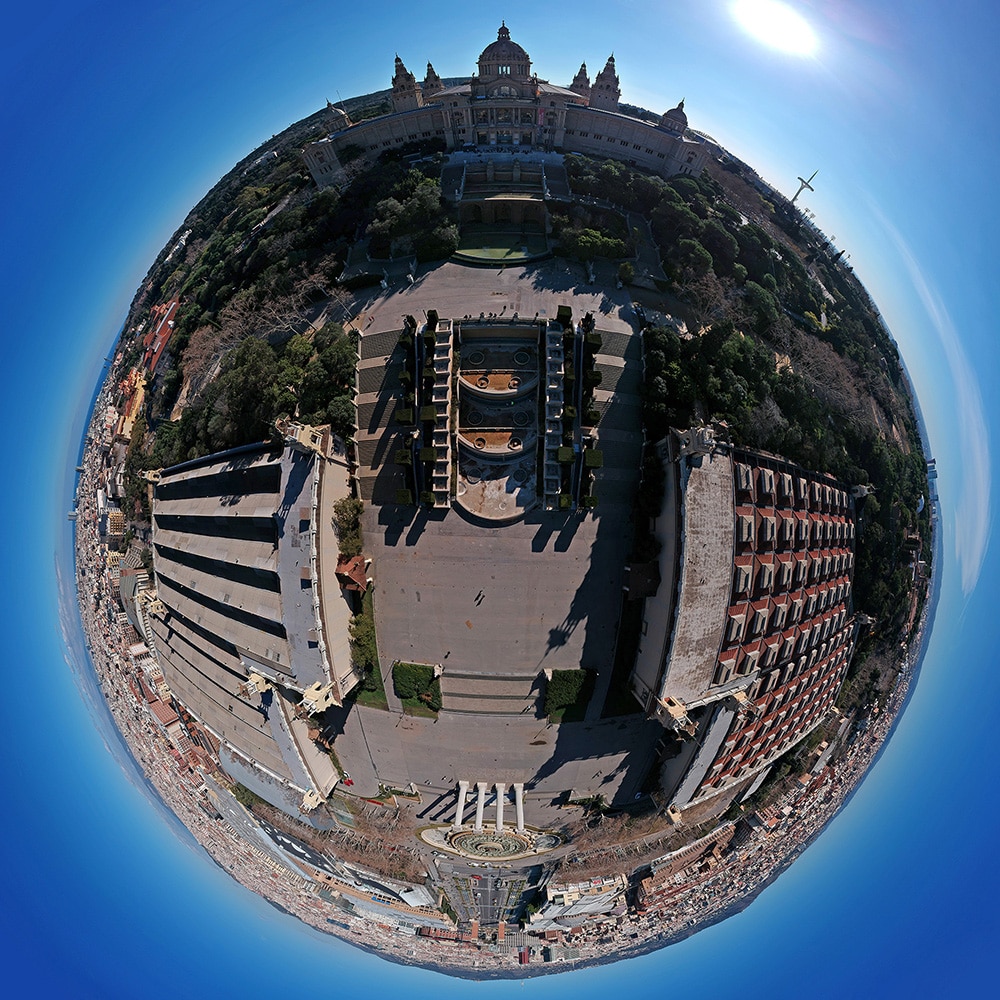
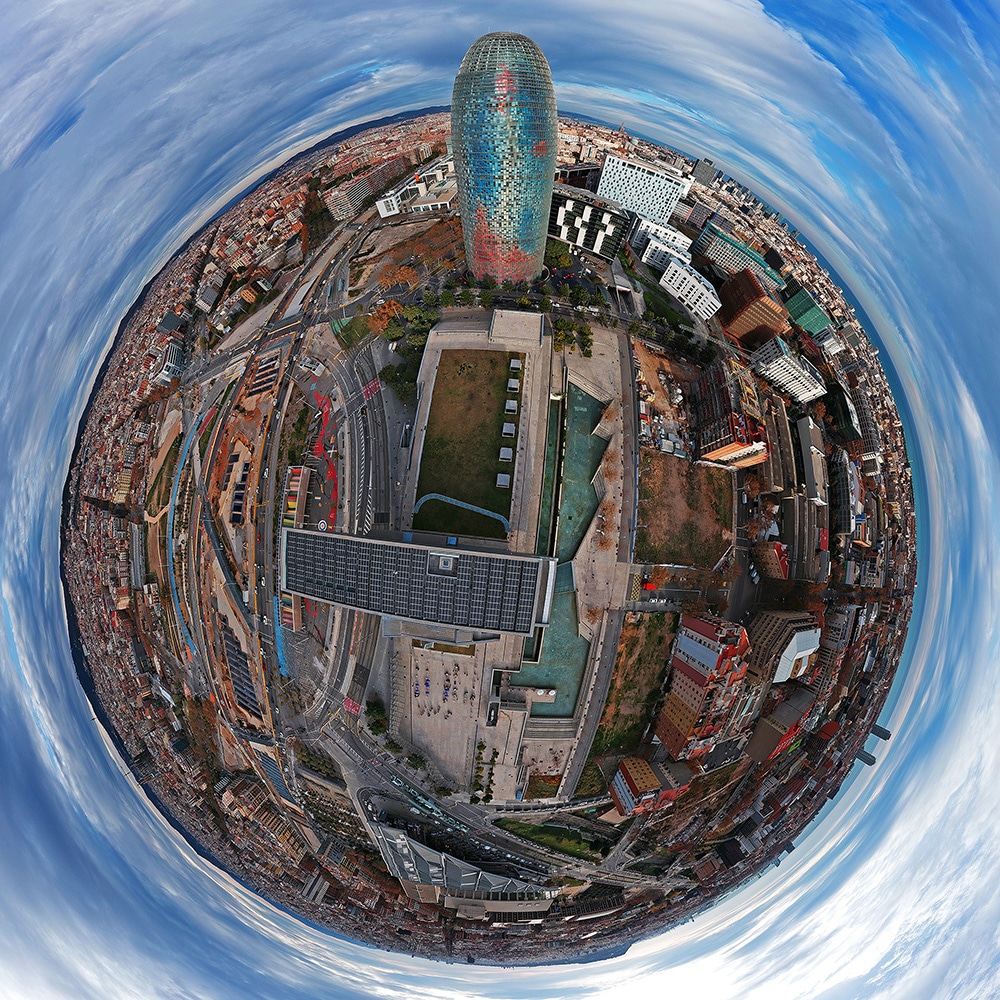
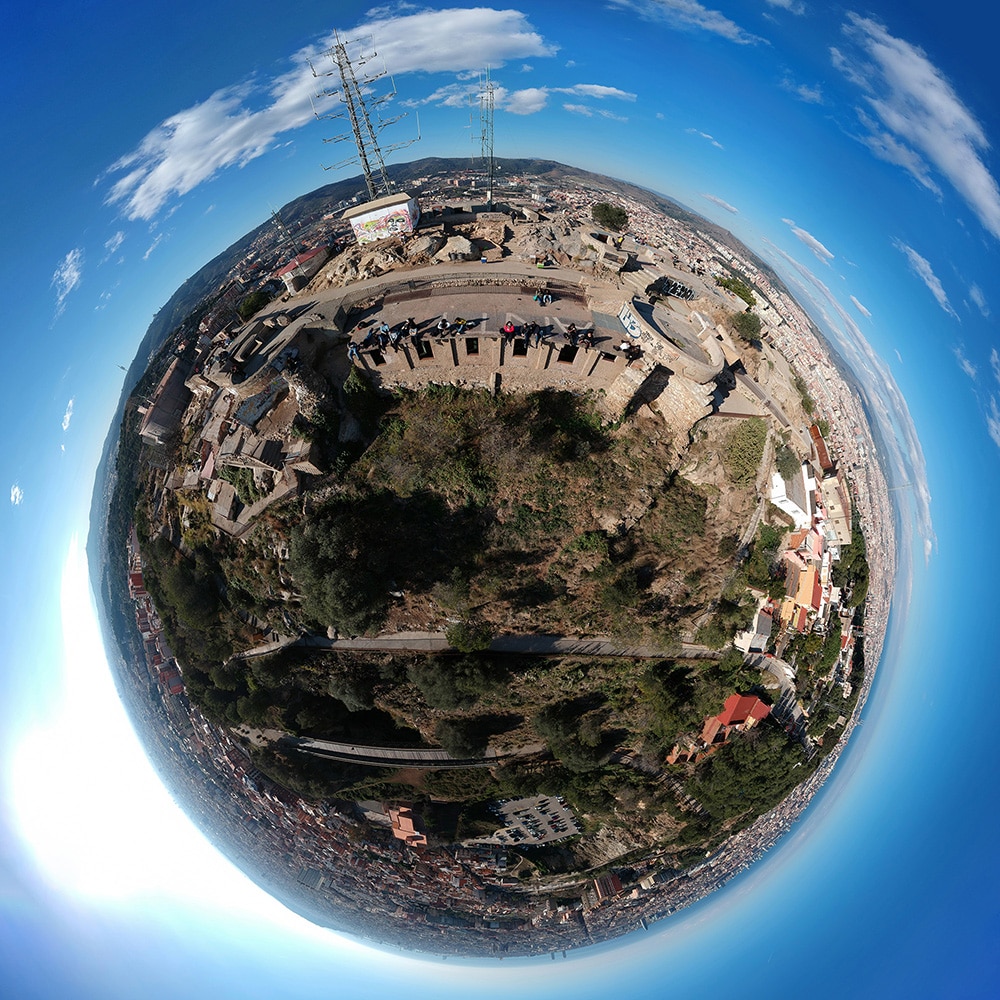
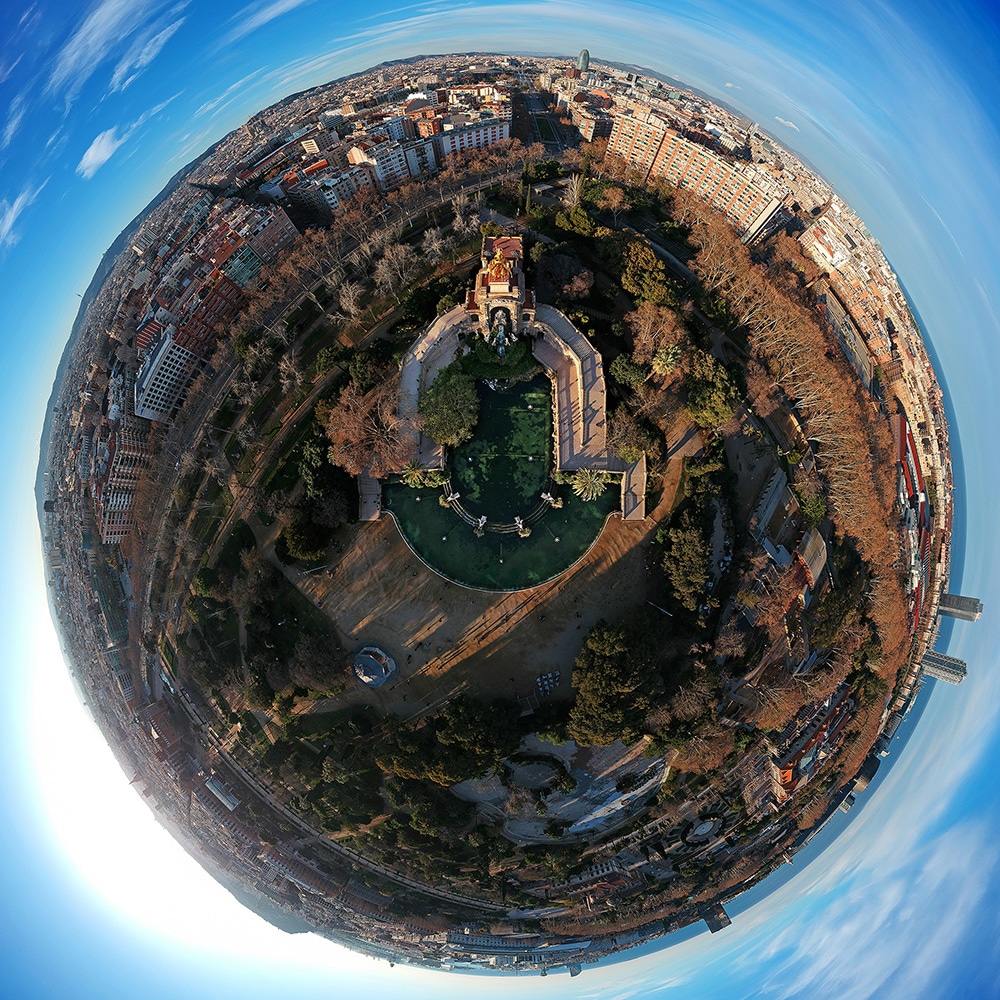
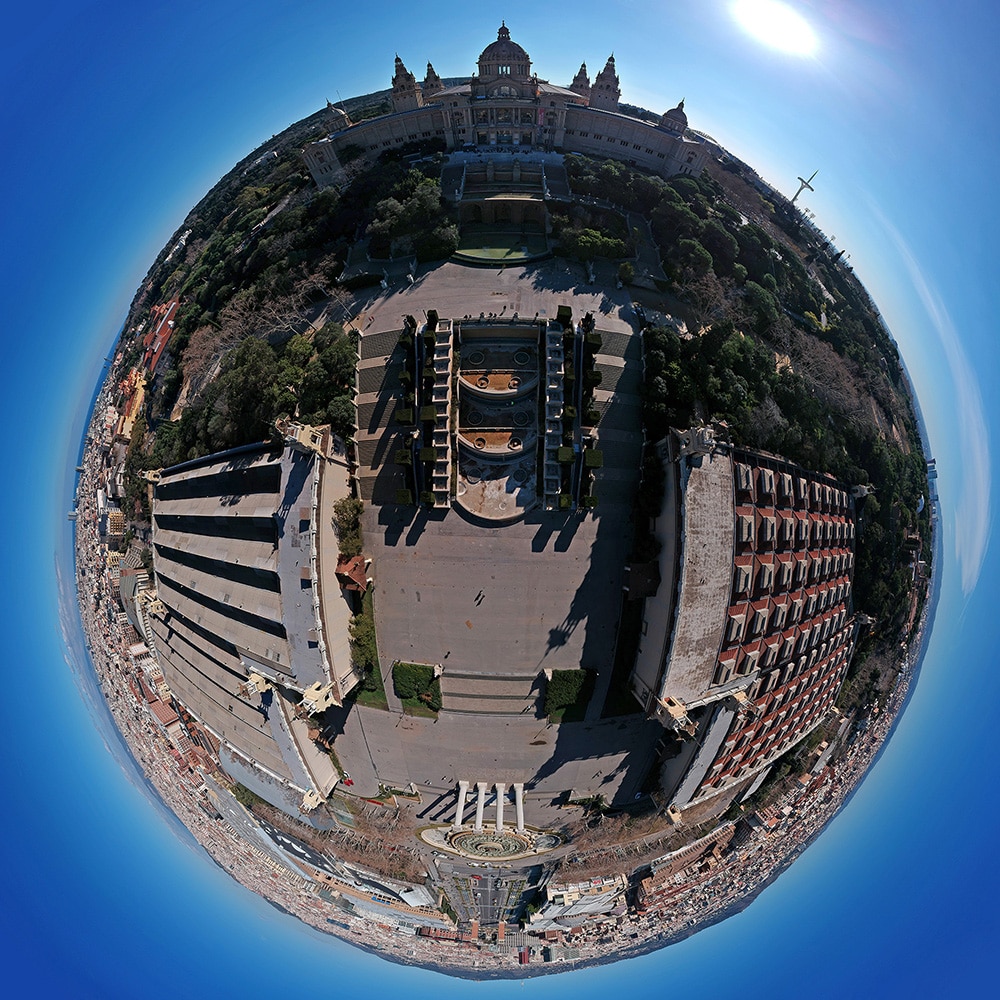
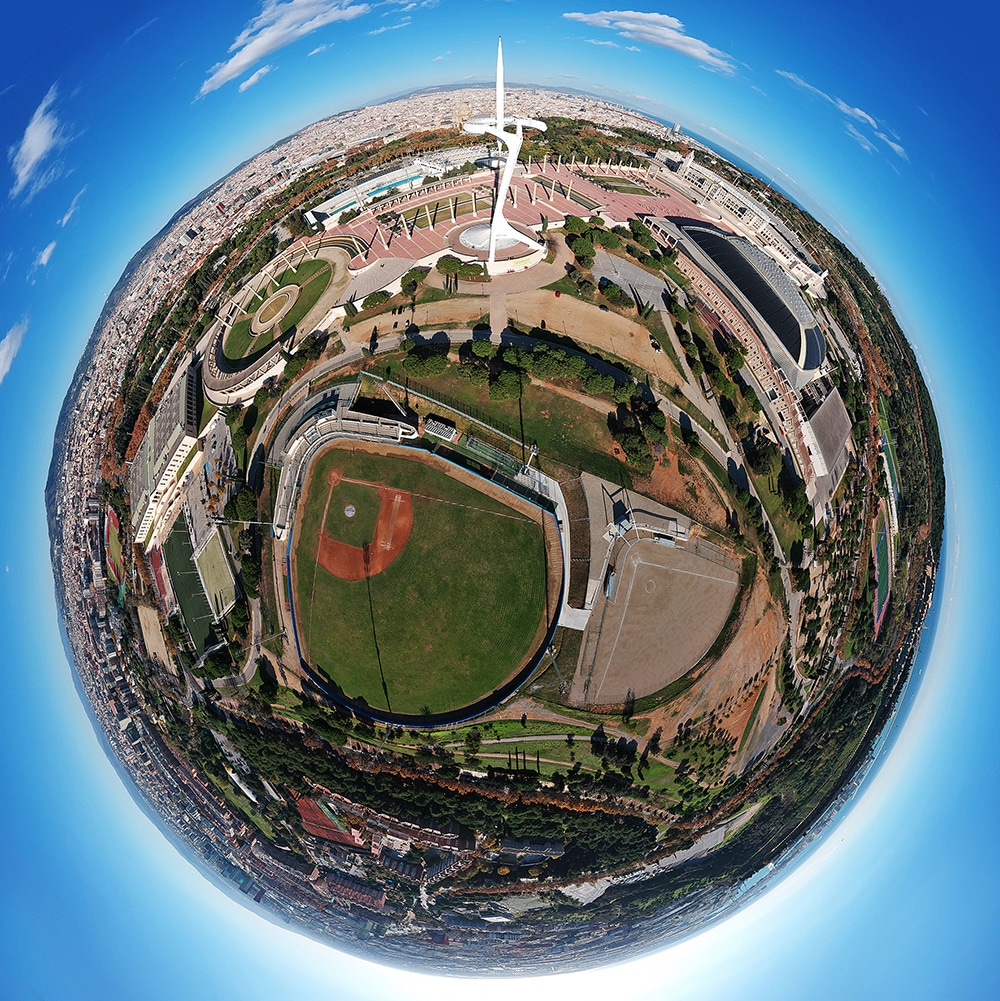
Currently living in Barcelona, Brazilian photographer Bruno Alencastro wanted to capture his experience in Europe by photographing the city from a different perspective. The task wouldn’t be easy, considering millions of travelers flock to the city each year to photograph some of the city’s most well-loved monuments. Thus, Alencastro took to the sky, creating a set of 360-degree aerial photographs that transform areas of Barcelona into small globes.

Alencastro began with Gaudí’s iconic Sagrada Familia, which he just so happened to live next to, giving him a first-hand view of the tourists that poured through the monument daily, all snapping photographs. “I had been looking for a different angle, not to repeat the thousands of almost equal photos that are posted every day on social networks,” Alencastro tells My Modern Met.

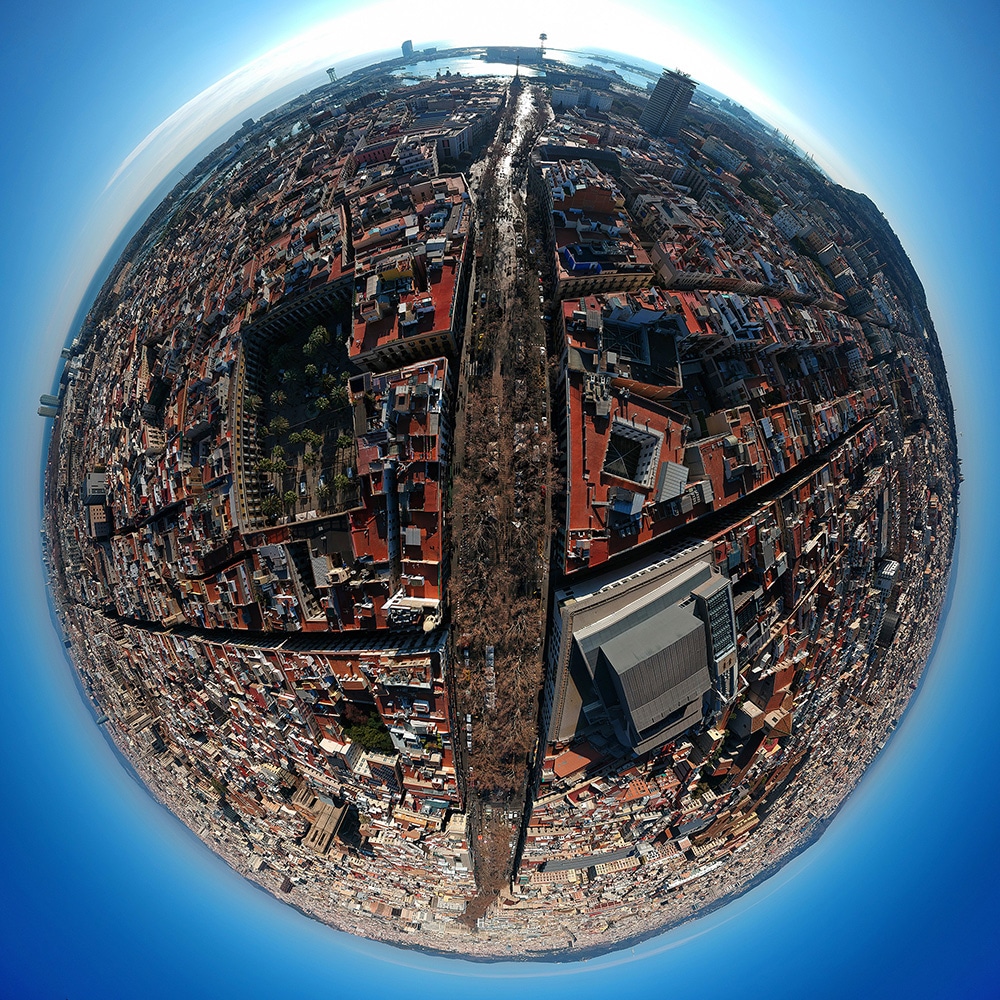
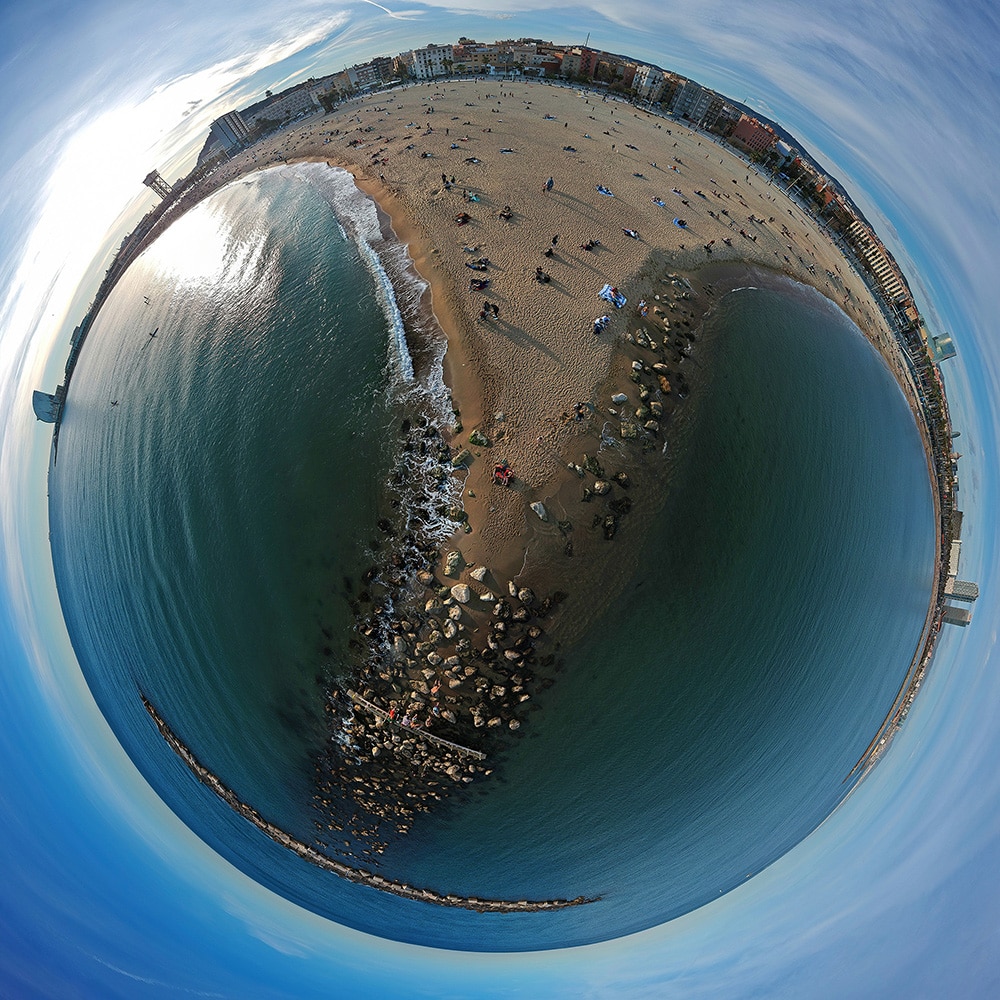
Taking to the sky, he captured 46 aerial photographs, which he then composited together and transformed into a stereographic projection. A stereographic projection allows a sphere to be projected onto a plane—just imagine how flat maps are placed onto spherical globes. In this manner, different neighborhoods and monuments in Barcelona become “small planets” unto themselves.

After tackling the Sagrada Familia, Alencastro was so inspired that he made his way across 9 other sections of the city, from beachy Barceloneta to the Montjuïc hilltop. By going up high with these 360 photos, the Brazilian photographer manages to gain a unique perspective of the streets of Barcelona.

Follow along with Alencastro as he documents his time in Barcelona via #168daysinbcn.

Bruno Alencastro’s 360-degree photos of Barcelona transform the beloved Spanish city into small planets.

Barcelona 360 Photos - Bruno Alencastro

Las Ramblas

360 Photos Barceloneta Bruno Alencastro

Barceloneta

Barcelona 360 Photos - Bruno Alencastro

Tibidabo

360 degree photo Bruno Alencastro

Palacio

Barcelona 360 Photos Bruno Alencastro

Agbar

Barcelona 360 Photos Bruno Alencastro

Bunkers of Carmel

Barcelona 360 Photos Bruno Alencastro

Ciutadella

Barcelona 360 Photos by Bruno Alencastro

Palacio

Barcelona 360 Photos Bruno Alencastro

Montjuic

Bruno Alencastro: Instagram

My Modern Met granted permission to use photos by Bruno Alencastro.

Related Articles:

100 Photos Merge to Form Swirling 360-Degree Landscapes

360-Degree Panoramic Photos Celebrate the Majestic Beauty of Grand Libraries

Amazing 360 Degree Panoramas (9 photos)

Beautiful Kaleidoscopic Photos of Abandoned Buildings in 360 Degrees

The post 360° Aerial Photos of Barcelona Transform the City Into Small Planets appeared first on My Modern Met.

http://ift.tt/2nbM4oU