4 Ways Some People Cope Better Than Others

Ever wonder why some people seem to take things in stride no matter how tough it all gets? These people seem to bounce back from every setback and weather all the storms with what appears to be complete calm and poise.

We all experience hardships in life. Whether it’s loss of a job, divorce, illness, death of a loved one, or a myriad of other unfortunate circumstances – bad things happen to everyone. But some people just seem to be better equipped for handling them. As it turns out, they probably are.

Contributors To Successful Coping

Although temperament and a predisposition to embrace coping mechanisms have a basis in biology and personality, that’s not the whole story. While these play a role in a person’s resilience, it’s really only a small part of the equation. People aren’t born with an innate expert ability to handle stress, it’s something that’s learned and cultivated through the experiences they’ve had in their lives.

The largest contributor to developing effective coping is life experiences, both those in childhood and adulthood. These experiences provide an opportunity for each of us to choose to learn the skills necessary to become resilient. This doesn’t mean a person has to experience trauma and hardship as a child (although they may have), but rather maybe was shown by a trusted adult how to bend but not break when things become difficult.

The same learning can occur as an adult as well. Of course, not all people who are able to successfully cope with stress and trauma have had the benefit of how to do so modeled for them. Some have had to discover these things on their own.

Everyone has encountered stressful events throughout their lives, some more difficult than others. With this comes the opportunity to discover the best ways to cope. While some people may naturally embrace coping mechanisms more fully than others, it’s the experience of stressful circumstances that allow every one of us the chance to learn the practices that foster resilience. Consequently, this gives us the ability to handle things and move on more effectively.

Among the most common and useful things that active copers do are the following:

Cultivate a social support system

support group

Having people around you that you trust, care about, and care about you is crucial to effective coping. In fact, it seems to be one of the most important factors when it comes to handling stressful or traumatic situations in the healthiest manner.

When stressed or in crisis, it’s the people you trust and love that can often provide a sounding board and perspective that help keep you grounded. They can also limit the tendency to isolate, which can be a common response for some when dealing with difficult circumstances.

Actively problem solve

The most resilient people are also active problem solvers. When things are tough, they automatically think, “How can I fix this?” and begin looking for solutions to their situation.

Recognize and accept help when needed

The world doesn’t rest on one person’s shoulders alone. Effectively coping with difficulty means knowing when you need help and accepting the help when given. This can be difficult for people who have trust issues and struggle with personal relationships. It can also be extremely difficult for those who feel isolated and possibly responsible for their own unhappiness.

Look for larger context

coping with stress

I knew a man once who, in the face of any difficulty, would say, “Well, they can’t kill me.” In this way he was looking at the larger picture of his own circumstances – things may be tough, but he’ll survive. People who cope well can generally put their situation in perspective and calm themselves by seeing things in a greater context. One common way people do this is through religion.

There are many other practices that effective copers do, but these are some of the most reliable.

Not All Things Can Be Solved

Probably the biggest secret of those who handle stressful situations well is their understanding that not everything can be fixed. We put a great deal of emphasis on working through things, dissecting them, fixing them, and agreeing on what to do next. The truth is that not all problems can be solved, some just have to be accepted.

Being able to get past things rather than fixing them (or fixating on them) is a difficult ability to cultivate, and it’s a slippery slope. It can be easily confused with the desire to ignore a problem or put your head in the sand when what you need to be doing is facing things head on. That being said, understanding the difference between what you have the ability to fix (or control) and what you need to accept and move past can be a very useful skill when it comes to coping.

If you are struggling with something and finding it difficult to cope, you’re not alone. The skills it takes to do this effectively take practice and sometimes coaching. If you find yourself in need of help then refer to point three above – recognize your need for help and seek it. If your social support system isn’t providing what you need, counseling with a professional who is experienced with your particular issue can be a great alternative.

The post 4 Ways Some People Cope Better Than Others appeared first on Dumb Little Man.

https://ift.tt/3phYY39

“The middle class has become more like poor people than they were 30 years ago.” -Jimmy Carter.

Are there 300 million Gods? NASA Says About 300 Million Habitable Planets Could Exist in the Milky Way

NASA Says About 300 Million Habitable Planets Could Exist in the Milky Way

Habitable Exoplanet

Illustration of Kepler-186f, the first validated Earth-size planet to orbit a distant star in the habitable zone. (Photo: NASA Ames/JPL-Caltech/T. Pyle)

Humans have long wondered if there were other planets like Earth where life could thrive. This age-old question began to resurface as more and more exoplanets were discovered in recent years. Thanks to a new study, we have an idea of just how many planets might support life, and the number might shock you.

Using data from the now-retired Kepler space telescope, a group of researchers has estimated that there are about 300 million habitable planets just in the Milky Way. And several might even be in our neighborhood. So what makes a planet habitable in the eyes of astronomers? First, the planet needs to be rocky and capable of supporting liquid water on the surface. And second, it needs to have a nearby star that is the correct temperature. To be precise, these stars need to be a similar temperature to the Sun, give or take 1,500 degrees Fahrenheit.

Interestingly, a few exoplanets relatively close by meet the criteria. In fact, at least four are within 30 light-years of our Sun, with the closest only 20 light-years away. Of course, nothing is for certain, but this research helps us understand what exoplanets have the potential to have the right ingredients to support life. The results come about after the researchers closely examined four years of research from the Kepler space telescope.

GIF of Exoplanet in Rotation

Illustration of the possible appearance of the planet Kepler-452b, the first near-Earth-size world to be found in the habitable zone of a star similar to our Sun. (Photo: NASA Ames/JPL-Caltech/T. Pyle)

“Kepler already told us there were billions of planets, but now we know a good chunk of those planets might be rocky and habitable,” says the lead author Steve Bryson, a researcher at NASA’s Ames Research Center in California’s Silicon Valley. “Though this result is far from a final value, and water on a planet’s surface is only one of many factors to support life, it’s extremely exciting that we calculated these worlds are this common with such high confidence and precision.”

Until it ran out of fuel and was retired in 2018, the Kepler space telescope was on a mission to find out how many habitable planets exist in our galaxy. For this study, the information it collected was combined with data from the European Space Agency’s Gaia mission. The Gaia mission provided important information about how much energy falls on a planet from its host star, opening up a world of possibilities. In fact, taking into account the atmosphere of these planets, they found that about half of Sun-like stars have rocky planets capable of hosting liquid water on their surfaces.

Before you start thinking that we’ll be jetting off to these exoplanets anytime soon, more work must be done to see if the researchers’ predictions are correct. Still, it’s a big breakthrough for all those involved in trying to unravel the mysteries of the universe. “To me, this result is an example of how much we’ve been able to discover just with that small glimpse beyond our solar system,” said Bryson. “What we see is that our galaxy is a fascinating one, with fascinating worlds, and some that may not be too different from our own.”

h/t: [Science Alert]

https://ift.tt/2JYrbvI

Ruth Bader Ginsburg

Ginsburg has never spoken louder than now.

S.N

Photo: CNN

If you’re looking for wide open spaces and not many…


If you’re looking for wide open spaces and not many people, we might suggest a camping trip along the Blackfoot River in Idaho. The Bureau of Land Management maintains five campgrounds where rugged ridges and grassy hills slope down to the Blackfoot’s rushing waters. Opportunities abound for fishing, camping and non-motorized boating. Waterfowl hunting is permitted outside of the campgrounds in accordance with Idaho laws. We’re fans of the late summer sunsets, too. Photo by Jeff Cundick, Bureau of Land Management.


17th-Century Sculpture Captures Unbelievable Lace Details in Hand-Carved Marble

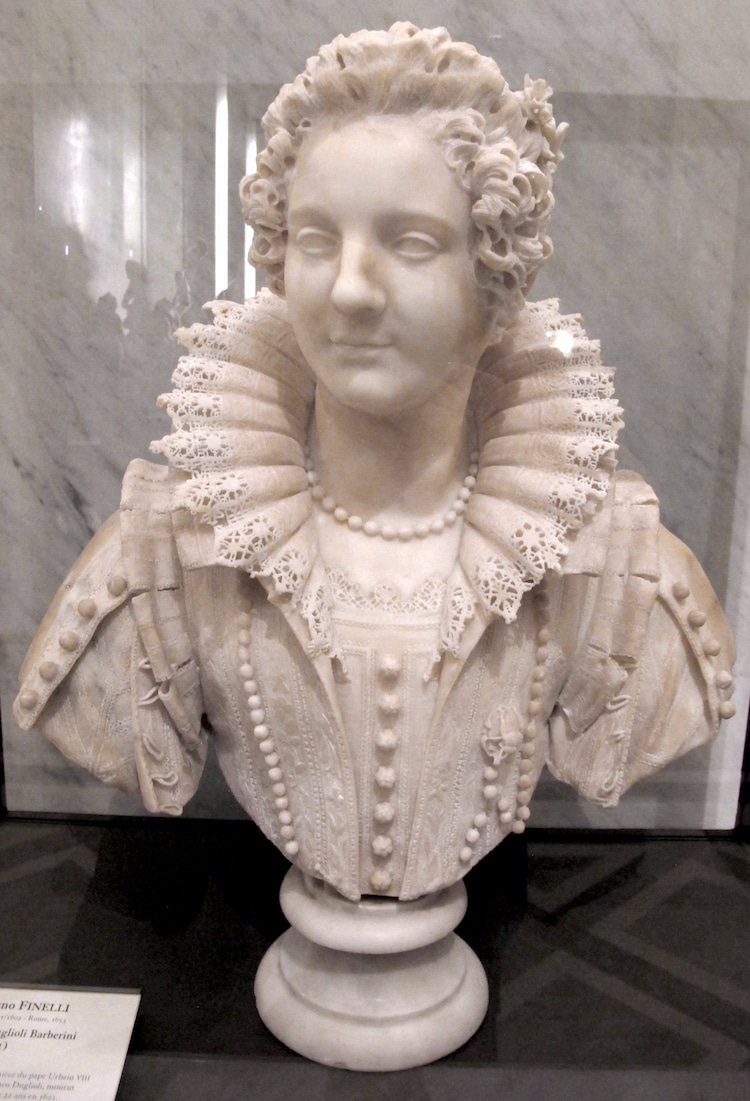
The Baroque Period is known for its decadent theatricality, with European artists continuing the classical trends of the Renaissance and shaping them into dramatic paintings and sculptures. Italian sculptor Gian Lorenzo Bernini’s work is particularly revered by art historians. Yet, the work of his lesser known apprentice, Giuliano Finelli, are just as breathtaking. Finelli was born in 1601 in Torrano di Carrara, Italy and received formal training in sculpting in Naples. Moving to Rome in 1622, the budding artist’s prowess with carving live figures attracted the renowned Bernini, and he chose Finelli as his assistant.

Under Bernini’s tutelage, Finelli grew his artistic ability and his political connections. Since Bernini was often commissioned by Pope Urban VIII, the most powerful political figure in Italy during the period, Finelli was able to work on incredibly significant pieces. One of these sculptures was a bust of Pope Urban VIII’s niece, Maria Duglioli Barberini, who had died in 1621 from labor complications.

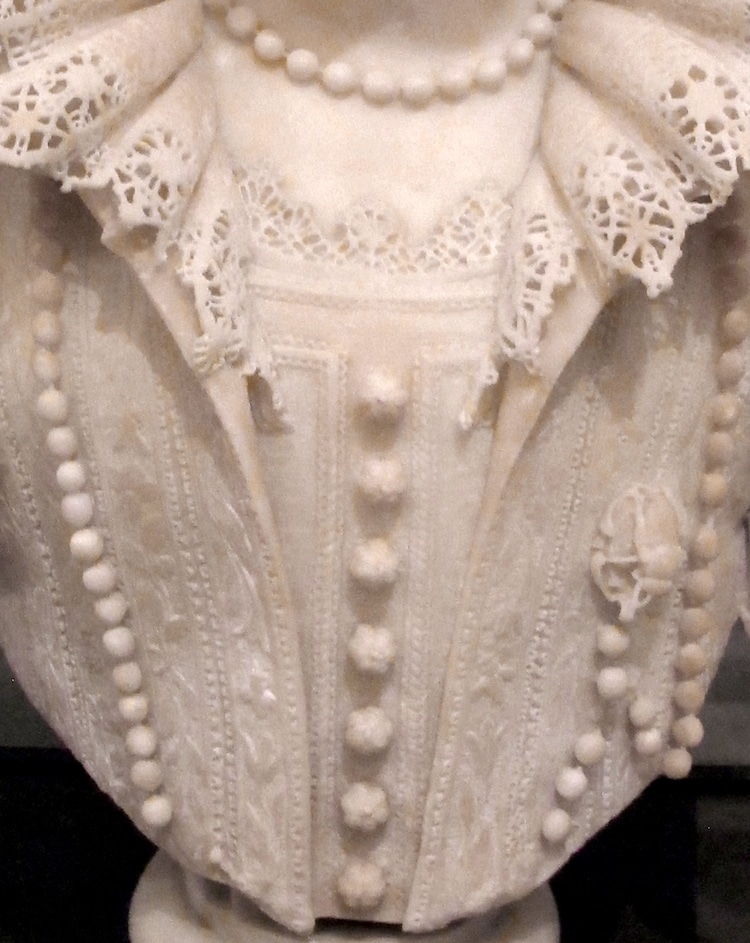
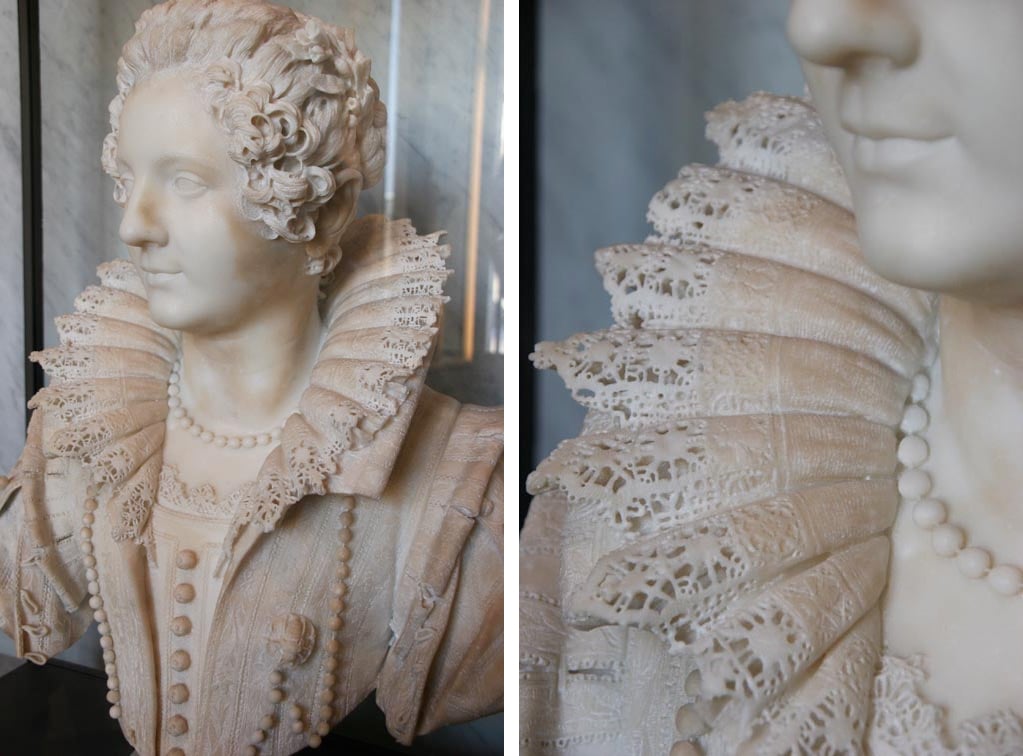
Finelli’s attention to detail translated well in bringing her visage back to life in the bust that was commissioned around 1626. The sculptor was so precise in carving the details of her dress that the insertion lace surrounding the bust’s ruff is deceptively realistic—one would think it’s actually made of textile, when in reality it’s all marble. Even the minute string which binds the beads of the figure’s necklace is visible.

Unfortunately, Bernini could not share the spotlight with Finelli and refused to allow his assistant the chance to present the commission to the Pope in Rome. Finelli’s other contributions to Bernini’s work were also overshadowed by the artist’s popularity, and so he broke from Bernini’s workshop in 1629. His skill in portraying the most minute of details in all his commissions makes his work distinguishable from Bernini’s and beautiful to behold.

Baroque sculptor Giuliano Finelli created this exquisite, life-like carving of Pope Urban VIII’s niece, Maria Duglioli Barberini.

Bust of Maria Duglioli Barberini by Giuliano Finelli

Bust of Maria Duglioli Barberini in the Louvre (Photo: Wikimedia Commons [CC BY 3.0])

His attention to detail was remarkable. You’d think he used real lace for the bust’s ruff. But it’s all marble.

Bust of Maria Duglioli Barberini by Giuliano Finelli

Detail of the bust of Maria Duglioli Barberini in the Louvre (Photo: Wikimedia Commons [CC BY 3.0])

Bust of Maria Duglioli Barberini by Giuliano Finelli

Detail of the bust of Maria Duglioli Barberini in the Louvre (Photo: Wikimedia Commons [CC BY 3.0])

Bust of Maria Duglioli Barberini by Giuliano Finelli

Beautiful lace details on the bust of Maria Duglioli Barberini (Photos: Kim Rempel)

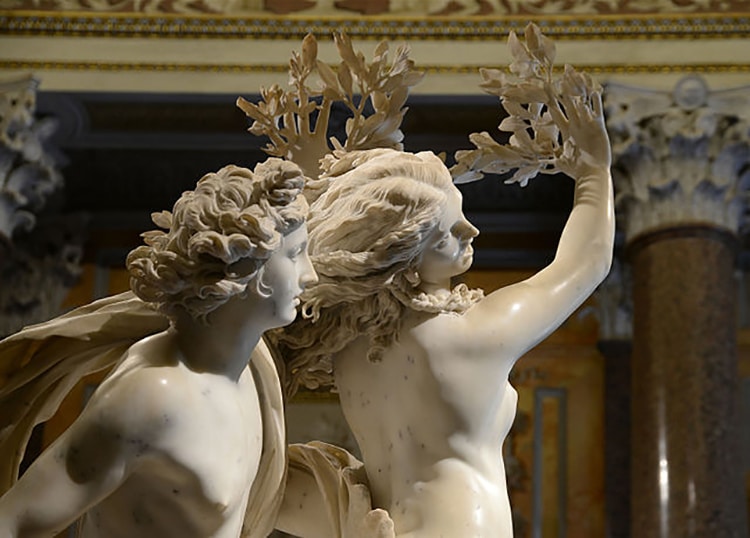
Finelli’s craftsmanship is also found in many of the famed Bernini’s works, like his sculpture Apollo and Daphne.

Baroque Sculpture of Two Lovers

“Apollo & Daphne” by Bernini (Photo: Wikimedia Commons [CC BY-SA 4.0])

The post 17th-Century Sculpture Captures Unbelievable Lace Details in Hand-Carved Marble appeared first on My Modern Met.

https://ift.tt/32XlQdy

How Different Types of Exercise Improve Your Mental Health

Exercise has been shown to have a great effect on your mental health and well being. There are many types of physical activities that will positively impact your mood and the chemicals which influence your feelings and outlook on life. 

Running 

Running is one of the easiest activities to begin. It requires little equipment and you can go at your own pace. Humans have evolved to be naturally great at running. Once you push past the difficulty of beginning a running habit, the overall feeling during your workout can be positive for your mental health. Aerobic activities like running have been shown to improve symptoms of depression and anxiety. It also has the immediate benefit of boosting endorphins, which can change your outlook and mood for your day. Likewise, running improves your focus. Running also leads to a better night’s sleep, which can be great for having a clear head when you wake up in the morning. Finally, it’s an easy activity to do alone, with friends, or in a group.

Swimming

Swimming, because it is in the water, has been shown to have a positive impact in helping reduce anxiety and aiding relaxation. It can also be a great way to bond with your family and enjoy activities together when the weather warms. Many people favor swimming as their preferred form of cardio and even install pools in their own backyards. For instance, if you reside in Virginia, a simple internet search for “inground pools Virginia” can provide you with companies in your area that specialize in estimating and building pools to fit within your budget and space. Building a swimming habit can be an incredibly relaxing way to improve your mood, cool off, and get in shape at the same time. 

Yoga

Practicing yoga on a regular basis has many positive effects on your mood, mental health, and emotional state. Yoga shifts you from a state of sympathetic nervous system to parasympathetic, bringing you into a relaxed mode instead of being on edge, or in fight or flight mode. Additionally, yoga can help you heal emotionally from traumatic events in your past by addressing them mentally in a calm environment. Another added benefit is the mental peace you achieve with yourself. Try taking a break from the hassle of your day and spending a few minutes practicing yoga. 

Zumba

Zumba is a stimulating aerobic activity. It’s been increasingly popular in the past few years, and for good reason. The activity is usually practiced in a group setting, such as a class, with a combination of music and exercise, cultivating a positive environment that can boost mood. Both of these things have also been proven to relieve symptoms of mental illnesses such as anxiety and depression. Practicing something with happy music, along with the group effort of accomplishing a common goal, can have incredibly benefits on your mental health as well. Many gyms and fitness centers offer Zumba classes for every level and age group. 

Weight Training

Lifting is also incredibly important for a well-rounded exercise regimen. It also assists your body in building muscle. Not only has regular weight lifting been shown to alleviate both anxiety and depression, but in addition, it can have positive impact on your self-esteem. Studies have revealed that it also improves cognitive function when combined with brain exercises. If you want to improve your self-image, feel better about yourself and your life, and gain muscle while you are at it, consider a gym membership to lift weights regularly.

There are many types of exercise that can improve your mental health. With these tips, you’re guaranteed to start feeling better, both physically and mentally. 

You’ve read How Different Types of Exercise Improve Your Mental Health, originally posted on Pick the Brain | Motivation and Self Improvement. If you’ve enjoyed this, please visit our site for more inspirational articles.


>

A Tale of Two Churches

It is an enduring fact of American life that church worship remains deeply segregated. It was something that Dr. Martin Luther King Jr. addressed, just days before he was assassinated in 1968. As recently as 2012, a survey found that eight in ten American congregants still worship at a place where a single racial group makes up at least 80 percent of the congregation. But in 2016, a very unusual experiment began in North Carolina. Pastor Jay and Pastor Derrick announced that their two churches, one white, their other black, would be merging. Could their model for The Refuge be one that heals our nation, I asked Pastor Derrick. “It doesn’t mean we have to agree on everything,” he said. “But it means that we have to embrace and accept and walk in love. That’s what a healed America looks like.” 

https://ift.tt/2Owk4t4

Glamorous Photo Shoot for Girl Who Was Banned from School Picture Day

Marian Scott Photoshoot by Jermaine HortonSchool Picture Day gives kids a chance to preserve memories from one of the most important times in their lives. However, when 8-year-old Marian Scott turned up at her school—Paragon Charter Academy in Jackson, Mississippi—to be photographed, she was turned away for having red hair extensions. 

The school-based its harsh decision on a student handbook policy, which states that pupils’ hair color must be of “natural tones.” Understandably, the situation knocked Marian’s confidence and left her parents confused and frustrated. “If she’s not a disruption to the class,” says her father, “why is she a disruption to the picture?”

Luckily though, Marian’s luck turned around when photographer Jermaine Horton heard about what happened to her. “When I heard about this story I was furious as a parent because the first thing I thought about was the impact of what this would do to such a beautiful little girl,” he wrote on Facebook. “I reached out to Nicole Joy of WILX News 10 who covered the story, and she got me in contact with the parents.” Horton organized a personal photo shoot for Marian, complete with creative costumes, donated from Rich Girl Candy.

The resulting images are far beyond standard school photos, and Marian of course got to keep her red hair extensions. She’s captured posing proudly, with a big smile on her face, showing that individuality should be celebrated. Horton says, “I’m so blessed to have been apart of this [and] to give her an amazing day that showed her that she truly is beautiful and her hair color was the BOMB!” The experience even inspired Horton to continue helping empower other young kids through creative photo shoots, an initiative he calls the Art of Confidence project. He says, “Marian Scott was just the first, but there are so many!”

Scroll down to see Scott’s stunning photo shoot and see more from Horton’s portfolio on his website.

Photographer Jermaine Horton put on a professional photo shoot for 8-year-old Marian Scott after she was denied school pictures for having red hair extensions.

Marian Scott Photoshoot by Jermaine Horton

The situation understandably left Marian feeling singled out, but this creative photo shoot gave her the confidence she deserves.

Marian Scott Photoshoot by Jermaine Horton

And of course, she wore her amazing red hair with pride.

Marian Scott Photoshoot by Jermaine HortonMarian Scott Photoshoot by Jermaine Horton


First on My Modern Met.

https://ift.tt/34b6FNM

Beauty in Ingenuity: The Art of Science

The complex, sometimes conflictual, relationship of man and machine is a constant thread in “The Art of Innovation,” at London’s Science Museum. Recalling how the mechanical telling of time itself became contested during the Industrial Revolution, as the historian E.P. Thompson described in a famous 1967 Past & Present article, “Time, Work-Discipline, and Industrial Capitalism,” here is a handsome double-dialled clock from a Macclesfield mill, dating from 1810. In the catalog, the curators tell us that while the lower dial showed the actual time, the upper dial was connected to the silk mill’s waterwheel: if the waterwheel ran slowly, or stopped, “mill time” was slowed or suspended, and the workers would have to make up the lost production time, “ruled by the pace of their machines.” Paradoxically, machines could also make men and women feel free as never before.

https://ift.tt/2OyqNTm