4 Ways Small Business Can Become More Efficient Through Cloud Computing

In today’s business world, it is important that business have access to what they need when they need it. Whether through phones, tablets or computers, there is a need for convenience and reliability as far as access to information is concerned. Cloud computing facilitates all these. Without a doubt, it has transformed how several businesses operate.

For those who are entering the arena for the first time, it is important to note that cloud computing is an umbrella term that includes:

  • Cloud storage
  • Cloud hosting
  • Software as a service
  • Cloud backup

By migrating the cloud, your business can use this technology to enhance your operations in a couple of ways. In essence, cloud computing guarantees several benefits.

Enhanced collaboration

cloud computing collaboration

Provided there is reliable internet access, it is possible to access cloud-based programs any time using a couple of devices. For a business with remote employees, nothing facilitates greater collaboration than this.

In today’s economy, we have a substantial number of small and medium-size businesses which rely on remote productivity as a critical aspect of their operation. Using various cloud-based software, different teams in various locations can collaborate on the same documents without the need to email attachments, schedule calendars, and share task lists.

This reduces the need for physical meetings. Participants only need to sign up for the services and pick up their tasks online without the need to install new programs or download other software.

Secure data backup

Businesses have always relied on data. The only difference is that businesses are more dependent on data now than before.

Losing essential data can be detrimental to a business or an organization. For smaller businesses, you might not have the resources or time to implement an effective backup strategy.

With cloud computing, you can easily retrieve the latest version of your data in case of an onsite system failure. Such system can also come handy in case of a disaster, such as fire.

Remember, you have the option of using cloud-based services to back up your business data automatically. In case of any unforeseen interruptions, your business will be back up and running in a couple of minutes.

Several firms offering cloud services provide geo-redundant backup. That implies that your data is saved in multiple centers across various locations to enhance data security.

Improved reliability

We all understand that cloud-based services are often more reliable compared to promised services. This is particularly true in instances where the servers and other hardware components used in service delivery are aging.

Cloud service providers boast of dedicated and highly experienced IT staff. When it comes to resolving various IT issues, you can rely on such team to provide better services in terms of reliability and speed.

For any business, nothing is more important than knowing that there is a team you can always rely on in case of anything. With the kind of support offered by cloud service providers, you won’t always have to worry about your data.

Better resource management

small business cloud computing

When you opt for cloud service, one huge burden lifted off of your shoulder is that of hosting the servers. Since the servers will be located off-site, you can sit back knowing that their management is an experienced IT staff.

Since there is easier access to resources as needed when dealing with the cloud, there will be less time involved in starting these services. It is also clear that several smaller businesses have limited IT experts and resources.

Outsourcing cloud computing services give them an opportunity to concentrate on the other aspects of their business while cloud service providers handle the rest. For smaller businesses that are out to edge or rival the big names in the market, cloud computing provides an opportunity to be more competitive and claim their fair share of the market.

Don’t ignore the details

While it is true that cloud computing comes with multiple benefits, it will not be fair to ignore the possible setbacks that can come with this technology. Just like any other technology, it takes time to set up and adapt to a new system. You will need to train your personnel, even in the slightest ways possible.

In addition to that, there is also the need to establish a very effective troubleshooting system during and after the system is launched. Always remember to never ignore security risks when considering cloud computing services. The rate of cyber crimes is at an all-time high.

If you are going to use any cloud service provider, make sure that they have all the answers to any security concerns you have. Try to understand the contingency plans they have in place in case of a security breach. Only after that should you sign on the dotted lines.

See Also: How Cloud Technology Can Help Your Business Grow

The post 4 Ways Small Business Can Become More Efficient Through Cloud Computing appeared first on Dumb Little Man.

http://ift.tt/2AZHhMs

6 Reasons Why an E-Commerce Website Needs a Blog

You’re reading 6 Reasons Why an E-Commerce Website Needs a Blog, originally posted on Pick the Brain | Motivation and Self Improvement. If you’re enjoying this, please visit our site for more inspirational articles.

Increasing traffic to your site is the key to success! Blogging is one way of routing humungous traffic to your site. Unfortuitously, while all brands comprehend the viability of the first part, they gail to grasp the vitality of the second! They give in to the idea that engaging in direct sales is their secret to generating sales. Nurturing your Email list, handling inventory, and calling to acquire customers, will only take you up to a certain point. If you dedicate all your precious time struggling to convert customers,  you will soon start overlooking the reasons for customers to actually unearth your brand in the first place. This is where blogging comes in to play!

As for any web-based business, an e-commerce website is in dire need of a blog that could speak for their offerings online,. And in all the positive ways possible that paid advertising won’t be able to accomplish. We understand that running a full-term business is exhausting to say the least, and a blog must be the last thing on your mind. But did you know that 92% of E-commerce businesses with a successful running blog, acquire most of their customers through their blog? With the ubiquitousness of blog in this era, failing to include a blog on your e-commerce website is like choosing not to get it endorsed when there were opportunities up for grasp.

If you are still not persuaded enough to incorporate a blog to your e-commerce website, here are 6 reasons to change your mind:

Blogging builds credibility

Ever heard of a business that claims to have had dressed thousands in your vicinity but in reality, you never saw anyone wearing the brand? Same is the case with online businesses. Since a website is an intangible medium where you cannot find real people to glean reviews from, blogging saves the day for you by subsiding the fact that you do not have real people talking on your forum. Testimonials are an exception, since they also contribute to building credibility, but still cannot parallel the benefits of blogging. Through a blog, you not only build credibility for your eCommerce web development, but extend a value addition to your target market that can be done by purchasing your products online.

It helps in growing your market

Blogs are not meant for lead generation. They exist for lead nurturing. Blogs provide informational content to your users, and if the content happens to trigger their interest, they might as well provide a lead or subscribe to the blog to stay abreast of latest updates.

Blogging for e-commerce websites could also lead to building lasting relationships with your customers. When you write about the value that your products bring to your customers, you create an invisible connection. This spark works in myriad ways, and lets your e-commerce brand etch a lasting impression in the minds of your consumers.

Works for business generation

Adding a blog to your e-commerce website opens up paths towards incremental customer reach. You already know that a blog post builds the much needed credibility for your brand. In addition to allowing you to flaunt your product to a wider audience through your blog, a blog cultivates the effort by sharing it on your social profiles. By promoting your product offerings on your blog, you actually answer queries of your target market. This makes the entire sales process easier to complete.

Blog content will boost your SEO efforts

Blog content is a great way of supporting your SEO efforts. When you instill keywords in your SEO content, you actually lure the search engine crawler towards you. Thus, boosting your chances of visibility against industry-specific keywords. When your page starts showing against popular search terms, the chances of customers landing on your e-commerce website increases. This enhances your overall business generation.

A Blog is a multi-marketing channel in itself

A blog is not a place where you only talk about your products; your blog can work as a multi-marketing channel for you. It allows you to link its posts with social forums and on blogs that you post on other websites. This helps build the overall online credibility for your content. This diversely spread content will pave way for incremental traffic landing on your e-commerce website. This leads to better business generation in the long run.

It’s a way to scale your content marketing efforts

Through targeted blog posts, you can launch campaigns that help in streamlining your marketing efforts towards a certain event. For example, Christmas related blogs are put up on various e-commerce websites to allow customers to land on websites through targeted keyword searches. By reading the relevant content, they get a chance to make valuable purchasing decisions.

Call-to-action

Alternatively, there are eCommerce developers that exist to help you set up your blog. You can get in touch with them if you have a similar idea in your mind.

You’ve read 6 Reasons Why an E-Commerce Website Needs a Blog, originally posted on Pick the Brain | Motivation and Self Improvement. If you’ve enjoyed this, please visit our site for more inspirational articles.

>

6 Reasons Why an E-Commerce Website Needs a Blog

You’re reading 6 Reasons Why an E-Commerce Website Needs a Blog, originally posted on Pick the Brain | Motivation and Self Improvement. If you’re enjoying this, please visit our site for more inspirational articles.

Increasing traffic to your site is the key to success! Blogging is one way of routing humungous traffic to your site. Unfortuitously, while all brands comprehend the viability of the first part, they gail to grasp the vitality of the second! They give in to the idea that engaging in direct sales is their secret to generating sales. Nurturing your Email list, handling inventory, and calling to acquire customers, will only take you up to a certain point. If you dedicate all your precious time struggling to convert customers,  you will soon start overlooking the reasons for customers to actually unearth your brand in the first place. This is where blogging comes in to play!

As for any web-based business, an e-commerce website is in dire need of a blog that could speak for their offerings online,. And in all the positive ways possible that paid advertising won’t be able to accomplish. We understand that running a full-term business is exhausting to say the least, and a blog must be the last thing on your mind. But did you know that 92% of E-commerce businesses with a successful running blog, acquire most of their customers through their blog? With the ubiquitousness of blog in this era, failing to include a blog on your e-commerce website is like choosing not to get it endorsed when there were opportunities up for grasp.

If you are still not persuaded enough to incorporate a blog to your e-commerce website, here are 6 reasons to change your mind:

Blogging builds credibility

Ever heard of a business that claims to have had dressed thousands in your vicinity but in reality, you never saw anyone wearing the brand? Same is the case with online businesses. Since a website is an intangible medium where you cannot find real people to glean reviews from, blogging saves the day for you by subsiding the fact that you do not have real people talking on your forum. Testimonials are an exception, since they also contribute to building credibility, but still cannot parallel the benefits of blogging. Through a blog, you not only build credibility for your eCommerce web development, but extend a value addition to your target market that can be done by purchasing your products online.

It helps in growing your market

Blogs are not meant for lead generation. They exist for lead nurturing. Blogs provide informational content to your users, and if the content happens to trigger their interest, they might as well provide a lead or subscribe to the blog to stay abreast of latest updates.

Blogging for e-commerce websites could also lead to building lasting relationships with your customers. When you write about the value that your products bring to your customers, you create an invisible connection. This spark works in myriad ways, and lets your e-commerce brand etch a lasting impression in the minds of your consumers.

Works for business generation

Adding a blog to your e-commerce website opens up paths towards incremental customer reach. You already know that a blog post builds the much needed credibility for your brand. In addition to allowing you to flaunt your product to a wider audience through your blog, a blog cultivates the effort by sharing it on your social profiles. By promoting your product offerings on your blog, you actually answer queries of your target market. This makes the entire sales process easier to complete.

Blog content will boost your SEO efforts

Blog content is a great way of supporting your SEO efforts. When you instill keywords in your SEO content, you actually lure the search engine crawler towards you. Thus, boosting your chances of visibility against industry-specific keywords. When your page starts showing against popular search terms, the chances of customers landing on your e-commerce website increases. This enhances your overall business generation.

A Blog is a multi-marketing channel in itself

A blog is not a place where you only talk about your products; your blog can work as a multi-marketing channel for you. It allows you to link its posts with social forums and on blogs that you post on other websites. This helps build the overall online credibility for your content. This diversely spread content will pave way for incremental traffic landing on your e-commerce website. This leads to better business generation in the long run.

It’s a way to scale your content marketing efforts

Through targeted blog posts, you can launch campaigns that help in streamlining your marketing efforts towards a certain event. For example, Christmas related blogs are put up on various e-commerce websites to allow customers to land on websites through targeted keyword searches. By reading the relevant content, they get a chance to make valuable purchasing decisions.

Call-to-action

Alternatively, there are eCommerce developers that exist to help you set up your blog. You can get in touch with them if you have a similar idea in your mind.

You’ve read 6 Reasons Why an E-Commerce Website Needs a Blog, originally posted on Pick the Brain | Motivation and Self Improvement. If you’ve enjoyed this, please visit our site for more inspirational articles.

>

5 Ways to Keep Moving Forward When You’re Scared to Death

You’re reading 5 Ways to Keep Moving Forward When You’re Scared to Death, originally posted on Pick the Brain | Motivation and Self Improvement. If you’re enjoying this, please visit our site for more inspirational articles.

Fear is the most powerful factor that prevents you from being able to realize your full potential. Most often, it’s a result of your own thoughts and imagination, instead of actual real world causes. In other words, you’re afraid of a fantasy – something that doesn’t exist.

You may be going down an untrodden path, but don’t lose faith. Don’t listen to your fears and also of those around you. Don’t let your shortcomings and setbacks make their way into your present frame of mind. And most importantly, never give up on what matters to you.

It’s okay to feel a bit uncomfortable, a little confused. It’s totally fine if you don’t know what lies ahead or whether you can handle it. As long as you keep moving slowly and steadily, you’ll figure out what you need to know. As you get more and more involved in what you’re doing, you’ll lose track of your fears and realize that things are not as bad as you had imagined. In fact, they’re much better.

Here are 5 ways to steer your life around all the unnecessary fears and uncertainties in life, and keep moving forward.

1. Envision what you want and declare it

Whether you’re afraid or there are actual real-world barriers, if you want to achieve something, you must envision it and declare it. This will enable you to stay focused on what you want. It’s impossible to accomplish anything or get anywhere if you haven’t declared it as your sole mission.

The first step is to understand that what you want is already a huge part of you. For example, if you ‘want to’ run a marathon, you’re already a marathon runner. You just need to take the next step, and run.

Whatever you want to do, imagine yourself doing it, and declare it out loud, “I will …”. Do this the first thing in the morning for a couple of minutes everyday and you’ll begin to see the difference within a 2-3 weeks.

“If you can imagine it, you can achieve it. If you can dream it, you can become it.” – William Arthur Ward

2. Know the consequence of staying where you are

Fear stops us from leaving our comfort zone, and persuades us to maintain status quo.

However, inaction based on fear only leads to laziness and lack of confidence. Initially, it will stop you from achieving. Eventually, it will stop you from doing anything.

Just as your present is based on your past, your future is dependant on what you do today. The fear of failure can be immense but it’s nothing compared to the regret of missed opportunities that you’ll encounter in future. Life is movement. Don’t stay where you are hoping that things will improve on their own.

“Life Is Like Riding a Bicycle. To Keep Your Balance You Must Keep Moving” – Albert Einstein

3. Believe in yourself

The foundation of every successful venture is self-belief.

What you believe will strengthen or weaken you. We tend to think that success depends on where we live, or a certain level of accomplishment, or a bunch of external factors; it’s simply a mindset. Success is a habit that is developed through powerful beliefs and thoughts.

What you think about your life will influence your feelings, your actions and your achievements.

Growing your self-belief takes time and requires practice. Spend a couple of minutes everyday thinking about the top 2-3 achievements of your life. They can even be about simple things such as how you learnt to drive, cook, paint, or anything that you love doing. If you are capable of accomplishing them, you’re definitely capable of doing greater things.

“Whether you think you can or whether you think you can’t, you’re right.” – Henry Ford

4. Take it slow, but keep going

Focus on taking one step at a time, and giving it your best shot every time. Don’t think too much about the end or the future. Just keep going.

When you focus only on one step at a time, things appear to be much more doable, and you won’t get overwhelmed by the long journey ahead. Every once in awhile, look back at how far you’ve travelled to stay motivated.

However, you’ve got to start today. Don’t wait for the right time or the perfect plan. There are no such things.

Remember that nothing will ever result in a 100% failure. You may experience occasional setbacks and might need to do course correction. The good news is that each setback can be fixed with a minor adjustment, and you can keep going.

Every step you take will make the next one easier, and what once seemed unreachable, will be standing right in front of you.

“A journey of a thousand miles begins with a single step” – old Chinese proverb


5. Be open to change

When we set out to achieve something, we tend to have a preconceived plan, an imagination of how we’ll accomplish it, and what we’ll encounter along the way. As we work towards our dreams, we find that the reality is not as expected and that we’ve to face unforeseen obstacles.

The key is to keep an open-mind that fosters learning new things and refining our journey based what you learn. However, under no circumstances, be willing to compromise or change your goals.

“When it is obvious that the goals cannot be reached, don’t adjust the goals, adjust the action steps.” – Confucius

Wrapping up

Don’t be afraid to face your fears. They’re not as scary as you imagine them to be. They’re certainly not here to stop you from realizing your dreams. They’re only there to tell you that what you’re doing is really important and worth fighting for. Take each day as it comes.

“Do one thing every day that scares you”. – Eleanor Roosevelt

You’ve read 5 Ways to Keep Moving Forward When You’re Scared to Death, originally posted on Pick the Brain | Motivation and Self Improvement. If you’ve enjoyed this, please visit our site for more inspirational articles.

>

1940s Streets of Chicago Captured through the Eyes of a Young Photographer

street photography Chicago John Vachon

In the throes of World War II and the Great Depression, the American government created the Farm Security Administration to help impoverished farmers get on their feet. As part of the process, they formed a now legendary set of photographers—Dorothea Lange and Walker Evans among others—to document life for these everyday Americans.

At just 21 years old John Vachon joined the FSA, first as a messenger while attending college. He later took up photography after being inspired by the documentary photography team. Like fellow FSA photographer Edwin Rosskam, Vachon arrived in Chicago in 1941. While Rosskam covered the experience of African Americans in the city’s Southside, Vachon, still a rookie photographer, took a different approach.

His pulled back view belies his status as a young photographer gaining experience, but there is a fresh, spontaneous approach to his photography that makes the work uniquely his. Vachon’s Chicago vacillates between the home of well-heeled ladies on shopping trips to depictions of abject poverty, as men sit slumped on sidewalks or stand outside the local bar. From the glossy exterior to the gritty underbelly, the young photographer deftly captures the multi-faceted face of 1941 Chicago.

FSA photographer John Vachon was in his early twenties when he traveled to Chicago to document living conditions in the city.

John Vachon 1940s Chicago street photography
old photos of Chicago John Vachon
street photography Chicago John Vachon
photos of Chicago in the 1940s
street photography Chicago John Vachon
photos of Chicago in the 1940s
John Vachon 1940s Chicago street photography
photos of Chicago in the 1940s

His 1941 images depict a multifaceted city, bursting with vibrance while also containing a gritty underbelly.

street photography Chicago John Vachon
black and white photos of Chicago
street photography Chicago John Vachon
old photos of Chicago John Vachon
black and white photos of Chicago
street photography Chicago John Vachon
fsa photography chicago 1940s

h/t: [Design You Trust]

All images via the Library of Congress.

Related Articles:

Yale University Unveils 170,000 Fascinating Photos Documenting the Great Depression and WWII

The Story Behind the Iconic ‘Migrant Mother’ Photo that Defined the Great Depression

Interview: Legendary Photographer Spends 70 Years Documenting American History

Once-Censored Photos of the WWII Japanese Internment Camps Are Finally Revealed

Striking B&W Photos Capture the Black Experience in 1940s South Side Chicago

The post 1940s Streets of Chicago Captured through the Eyes of a Young Photographer appeared first on My Modern Met.

http://ift.tt/2CBdrOz

Photographers Gain Entry into Traditional African Village Where Every House Is a Work of Art

Artistic African Village Burkina Faso

Photo: Rita Willaert

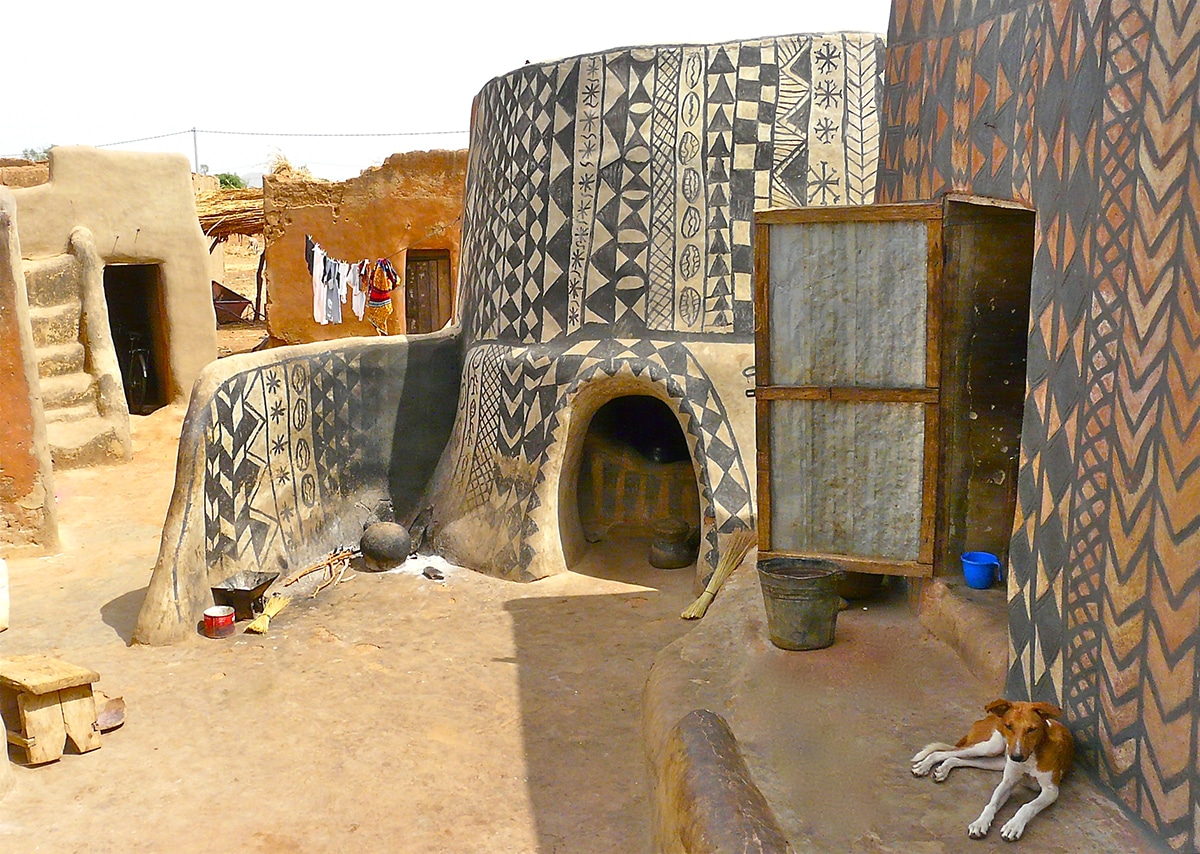
Nestled at the base of a hill, overlooking the Savannah, lies Tiébélé—an African village in Burkina Faso. First settled in the 15th Century, the 1.2-hectare commune is home to the Kassena people, their chief, and royal court—together making up one of oldest ethnic groups in Burkina Faso. In 2009, photographer Rita Willaert and travel blogger Olga Stavrakis were lucky enough to be some of the few people ever allowed to visit the isolated site.

Willaert’s photos document the villagers’ untouched, unique way of living, where local traditions have been protected for centuries. Stavrakis recounts their experience, explaining how before they arrived they were even given a dress code: “We were told in advance that we must not wear anything red and we may not carry an umbrella. Only the chiefly noble family is permitted that privilege and to do so would constitute a great affront to our hosts.”

Although a royal village might sound opulent, this village is anything but. The Tiébélé royal residence is made up of a series of small clay houses that are hand-painted in different geometric patterns and symbols using clay paints. These patterns are one of the visual indicators that differentiates the royal homes from that of the “ordinary people.” Another difference is the huts’ door sizes: the chief for example, has the house with the smallest door, for protection. While most of the structures are homes, some of the most elaborately decorated are mausoleums, where the dead are laid to rest.

Inside the royal clay homes are simple kitchens kitted out with just a few clay and iron pots. “Most meals are cooked in one pot over a brazier,” explains Olga, who says meals usually consisted of “a starch foofoo or thick paste like porridge which is then dipped into a sauce of vegetables and peppers. The richer the family the more goes into the sauce.”

You can find more images from the team’s West-African adventures on Willaert’s Flickr, and read more about their experiences on Stavrakis’ blog, Travel with Olga.

The African village of Tiébélé is home to the Kassena people—one of oldest ethnic groups in Burkina Faso.

Artistic African Village Burkina Faso

Photo: Rita Willaert

Artistic African Village Burkina Faso

Photo: Rita Willaert

Artistic African Village Burkina Faso

Photo: Rita Willaert

The village’s chief and royal court live in small clay houses that are hand-painted in different geometric patterns that symbolize a person’s importance.

Artistic African Village Burkina Faso

Photo: Rita Willaert

Artistic African Village Burkina Faso

Photo: Rita Willaert

Artistic African Village Burkina Faso

Photo: Rita Willaert

Artistic African Village Burkina Faso

Photo: Rita Willaert

Artistic African Village Burkina Faso

Photo: Rita Willaert

While most of the structures are homes, some of the most elaborately decorated are mausoleums, where the dead are laid to rest.

Artistic African Village Burkina Faso

Photo: Rita Willaert

Artistic African Village Burkina Faso

Photo: Rita Willaert

Artistic African Village Burkina Faso

Photo: Rita Willaert

Artistic African Village Burkina Faso

Photo: Rita Willaert

Artistic African Village Burkina Faso

Photo: Rita Willaert

Artistic African Village Burkina Faso

Photo: Rita Willaert

Artistic African Village Burkina Faso

Photo: Rita Willaert

Artistic African Village Burkina Faso

Photo: Rita Willaert

Artistic African Village Burkina Faso

Photo: Rita Willaert

Artistic African Village Burkina Faso

Photo: Rita Willaert

Artistic African Village Burkina Faso

Photo: Rita Willaert

Artistic African Village Burkina Faso

Photo: Rita Willaert

Artistic African Village Burkina Faso

Photo: Rita Willaert

Rita Willaert: Flickr
Travel with Olga: Website
h/t: [Messy Nessy]

All images via Rita Willaert.

Related Articles:

You Can Stay Overnight in This Bird Nest Villa Built Above the African Wilderness

Interview: Photographer Captures Honest and Open Spirit of Children in Africa

Eye-Opening Aerial Photos Explore the Division Between Wealth and Poverty in South Africa

Genius Beehive Fences in Africa Naturally Protect Farms From Raiding Elephants

The post Photographers Gain Entry into Traditional African Village Where Every House Is a Work of Art appeared first on My Modern Met.

http://ift.tt/2CXmESi

Powerful Bronze Sculptures Tell the Story of European Migrants in Search of Utopia

Bronze Sculptures by Fredrik Raddum

Oslo-based Norwegian artist Fredrik Raddum is known for his imaginative figurative sculptures and installation art, which often explore political themes. His previous work mixes tragedy with humor, depicting surreal, dystopian cartoon figures that encourage the viewer to “think beyond the initial encounter.” Raddum’s most recent collection of bronze sculptures—titled Hacienda Paradise – Utopia Experiment—was exhibited earlier this year at Galleri Brandstrup, and sheds light on a true story of human immigration that’s now referred to as “The Galapagos Affair.”

In search of their new Eden, a group of world-weary Europeans left their homes to live on the Galápagos Islands in the 1930s. The first of the island expats to arrive was Friedrich Ritter, a German physician, and his younger lover, Dore Strauch, who settled on one of the most remote islands, Floreana. Next came the Wittmer family from Germany, and soon after came Baroness Eloise von Wagner, who arrived from Paris with her “two companions.” It wasn’t long after they arrived that the Baroness and one of her lovers disappeared. The case remains a mystery to this day.

Raddum’s sculptures show the pioneers in surreal, mysterious circumstances. In one piece, a bird tries to fly away with the brass body of a man. In another, a female figure stands atop two human heads, and seems to exhale a strange golden liquid. One giant turtle-shaped piece depicts the island legend of a turtle who could read the minds of the visitors. In Raddum’s piece, the shell is used as a place to make a fire. According the the artist, the exhibition reminds us that “we can change our surroundings, but we cannot escape from ourselves.”

If you’re a murder mystery fan, The Galapagos Affair story was made into a movie, directed by Dayna Goldfine and Dan Geller. You can also find more of Raddum’s work via his website and Instagram.

Artist Fredrik Raddum’s bronze sculptures tell the story of Europeans who left their homes and fled to the Galápagos Islands in the 1930s.

Bronze Sculptures by Fredrik Raddum

Their new utopia soon turned sinister when two of the pioneers went missing. The case remains a mystery to this day.

Bronze Sculptures by Fredrik Raddum

Fredrik Raddum: Website | Instagram
h/t: [Gaks Designs]

All images via Fredrik Raddum.

Related Articles:

New Bronze Sculpture of Little Girl Defiantly Faces Charging Bull on Wall Street

Surreal Bronze Sculptures of Fractured Figures Visualize Emotional Despair

Surreal Bronze Sculptures Reflect Heavy Human Emotions

Lifelike Bronze Sculptures Capture Expressive Faces and Playful Energy of Children

The post Powerful Bronze Sculptures Tell the Story of European Migrants in Search of Utopia appeared first on My Modern Met.

http://ift.tt/2kGMYb2

John Crowley

Some novelists produce like clockwork: every year or three, a new work ripens and is ready for the harvest. But there are many whose output can’t be resolved against a calendar. Consider the famous case of Thomas Pynchon, who fell silent (at novel lengths, anyway) for seventeen years between Gravity’s Rainbow (1973) and Vineland (1990). William Gaddis took twenty years to leap from The Recognitions (1955) to JR (1975). After Catch-22 (1961), Joseph Heller made readers wait thirteen years until releasing Something Happened (1974). In these cases, and many others, you just can’t rush quality.

The exceptionally gifted John Crowley has published his work at a respectable pace — twelve novels in forty-two years since his first, The Deep, in 1975. But there have been sizable time gaps between some, such as the seven-year wait between the third and fourth books of the Ægypt Cycle. So news that he would debut a new novel just one year after we saw The Chemical Wedding: by Christian Rosencreutz: A Romance in Eight Days by Johann Valentin Andreae in a New Version, his recreation of a gnostic fable, was cause for wild rejoicing. But the anticipation was further heightened by the prior release of a small collection of stories and essays. So as not to delay our enjoyment any further, let’s look at both books now.

The essays and short stories reveal small slices of Crowley’s genius, which the novel manifests in dazzling fullness. Crowley’s signature gifts come in paradoxical pairs. He is noted for his soaring lyricism, which somehow produces a keen, often melancholy gravitas. He is a master of naturalism, and yet uses his mimetic skills to discern and depict the veins of the fantastical running underneath our consensus reality. He believes in the unrivaled power of true love, over which death has no dominion — and yet death frequently seems to have the last word. He is an embracer and champion of tradition, almost basking in nostalgic, yet revels in the doings of rebels and nonconformists. He argues for the inevitability of change, yet highlights those elements of existence that remain eternal. This synthesis of opposites grants all his work a unique ambiance and charm.

PM Press is primarily a nonfiction publisher with a progressive bent. But starting in 2009, SF writer Terry Bisson began curating a series of fiction titles for them under the rubric Outspoken Authors, featuring such standouts as Ursula K. Le Guin, Norman Spinrad, and Elizabeth Hand. The latest offering in this line is Totaltopia, by Crowley, and it serves perfectly to introduce any newcomers to Crowley’s particular flavor, while also serving as an appetizer to those awaiting the novel’s banquet.

The book opens with a quietly nostalgic yet cosmic tale original to this volume, “This Is Our Town,” in which the Catholic childhood of a young girl who is lucky enough to see and converse with her guardian angel exfoliates to color human existence. “Prayer is how the world is managed.” Two other excellent stories will be familiar to those who have seen Crowley’s collection Novelties & Souvenirs.

The nonfiction work shows a piercing mind at work, as well as an expansive sense of compassion, as the author investigates the roots and methods of literary futurism (the title piece), Russian “cosmism” (“Everything That Rises”), and the fiction of fellow fantasist Paul Park (“Paul Park’s Hidden Worlds”). The concluding dialogue with Bisson, a signature feature of this series, finds Crowley wryly and gratefully assessing his career and nodding hopefully toward what he feels might very well be his “last full-dress novel,” Ka: Dar Oakley in the Ruin of Ymr. What better segue could a reviewer ask for?

Crowley’s new book is something utterly unique when considered within his oeuvre, yet also totally allied to landmark works of his such as Beasts, Engine Summer, and Little, Big. As such, and if it is indeed his “last full-dress novel,” it stands as a worthy summation and knotting together of his eternal main themes: life as story and stories as life; the relations between nature and humanity; the meaning of and transcendence of death; the teeter-totter between social duties and rogue outsiderly freedoms; and the value of families.

The biggest and most obvious category into which the bountiful Ka can be stuffed is that of the “animal fantasy.” In it’s purest form, this sort of tale brings consciousness and language to its nonhuman characters but leaves them in a recognizably natural world — the most famous example of this mode is perhaps Watership Down by Richard Adams, which set the gold standard by not only conjuring up a riveting Homeric tale set within a small parcel of land, but also by creating an entire mythos and culture for its keenly delineated rabbit protagonists, who, while “human,” are never not also animals. A more recent fine example is The Bees by Laline Paull.

With Ka, Crowley provides a new benchmark in the canon of great animal fantasy. His species spotlight focuses on Crows, his hero being one Dar Oakley, who is representative in many way of the traits, predilections, and capacities of his kind but is also unprecedented. Dar Oakley sees more, thinks deeper, is bolder and more contrarian than his fellows. Moreover, he cannot die. Whenever his mortal form is extinguished, he reincarnates in some future era. These characteristics will guide and shape his uncanny biography. But at the same time, Dar Oakley is all Crow, sharing his nature with his compatriots. (This animal nature, especially in the sphere of a Crow’s fancy for eating corpses, is neither glorified nor denigrated but simply taken as evolutionarily correct, without demanding any apologies.) And Crowley — of course, the author’s surname nominates the Crow as his totem — provides unstintingly the details and realities of a Crow’s life. From mating to nesting, traveling to eating, the details of a Crow’s daily rounds are rendered in colorful and extensive verisimilitude.

Of course, given that the reader is inhabiting the mind of a Crow, a place no microscope can peer into, some of the scientifically unobservable details have to be invented: for instance, the four cardinal directions that Crows perceive are given names, and emotional associations and desires and fears are attached to their visible behaviors. But Crowley’s inventions consort so well with what we know of these birds that the reader never feels any artificiality. And just as Adams did for his bunnies, Crowley creates an etiquette and culture and back-story for his birds. Although unlike the rabbits, the Crows are not given to worshipping deities or time-binding with myths, being rather, well, flighty and mired in the present.

So, on this not unimportant surface level we discover a novel full of animal-based adventures, loves, losses, triumphs, and quotidian pleasures, all of them at once “other” yet humanly relatable. Dar Oakley pioneers new territories, helps his tribe, falls in love, and seeks solace for his restless soul.

If this were the entirety of Ka, it would be a plentitude. But there is much more, and it lies in the frametale, and also in the interior tales and philosophical underpinnings.

We open the book with a human testament. Our unnamed narrator is a failing widower living in some near-tomorrow where civilization itself seems imperiled and on the point of extinction. He finds a sick Crow in his yard, nurses it, and learns improbably to communicate. This is Dar Oakley, and we receive the Crow’s autobiography through the lens of the human amanuensis, whose interstitial interpolations occur throughout.

Immediately we are thrust into speculation about the unreliability of our narrator. Are Dar Oakley and his entire story manufactured by this decadent, dying End Times Scribe? It’s an entirely plausible interpretation. In this case, the book reads as the sputtering, last-gasp attempt by a grieving humanity to selfishly re-inspire itself and vainly reconnect with the natural world our species has destroyed.

Valid as this angle of attack might be — and I can foresee future academic papers pursuing it — I cannot endorse it, for it discounts the third layer of the book, which is its resonant, poignant metaphysics. Believing that our human scribe has invented everything undercuts the obvious textual and thematic importance of the supernatural events in the book.

For Dar Oakley is a liminal figure, a psychopomp who can facilitate passage to various underworlds and afterlives. In his extended encounters with various sympathetic humans, from the circa-Neolithic times to the imagined near future, the Crow serves as a kind of flawed Virgil. For although he is conversant with other realms, he is not expert, frequently becoming lost and confused as he seeks in his Crow-like fashion to understand the riddles of existence. This shared vision quest between humans and birds serves as subtext and counterpart to the more mundane activities of the book. Ultimately, Dar Oakley reaches an acceptance and wisdom that the humans can see only partially.

A couple of other aspects of the novel bear mentioning. The nested stories within the main narrative echo such collections of folklore as The Mabinogian or Native American Trickster cycles. There is a cornucopia of stand-alone mini-tales herein that all serve to propel the major themes and plots while they also deliver independent joys. A definite flavor of T. H. White’s The Once and Future King obtains as well. And the Wellsian “history of mankind” panorama which Dar Oakley’s eternal existence allows us to witness has the kind of multi-generational view-from-a-height sweep that a book like Walter M. Miller’s A Canticle for Leibowitz also displays.

And although it’s a given with those who know Crowley’s books, I would still be remiss if I did not comment on the sheer agile beauty of his prose. His voice — Dar Oakley’s voice — blends simplicity with complexity, gravitas with humor, sensuality with interiority. Here is a longish passage that I think illustrates all these points.

The Crows don’t remember, and neither do People, when farmers first tried to scare them off by making those false People to stand and stare, bowing a little in the breeze but never changing place. Dar Oakley tells how he’d stand watch and call, Watch out, watch out when one appeared as though suddenly standing up, with big eyes like the bird-costumed specter of the Wolves gang. It was enough to make most Crows stand off a ways from one, the braver ones still snatching a corn sprout here and there behind its back, then taking off . . .

The Crows finally came to delight in the figures; though Crows can’t recognize the many images of People that People make, the use of this one is so evident they can, and it has the effect on their sense of humor that a pun has on some People. They still like to pretend a little fear at first, then go settle on its outstretched arms, and crow in its face — for Crows do crow, in delight at wit and surprise: a sound you’ll come to know if you watch them. As the corn grew high the comical People were propped up higher, or they were left standing and hidden by the yellowing stalks; come late summer when the farmers and the hands, the women and children, came out to cut and shock the corn, the scarecrows fell amid the stalks and waste, lost their heads and hands. Dar Oakley was alone in seeing in them all the gaunt skeletons in his story, the bones of One Ear’s brother, the ragged men on the ground in Na Cherry’s old homeland. He could be startled coming unaware upon one, as though it might lift itself on its skinny arms and turn up its face to him.

Here we have the encapsulated essence of Crowley and this phenomenal book. Love and death, fear and fun, artifice and nature, all holding hands and dancing around some cosmic maypole to the eternal music of the spheres.

The post John Crowley appeared first on The Barnes & Noble Review.

The Barnes & Noble Review http://ift.tt/2oDJo6F

15+ Culturally Unique Christmas Dinners From Like Around the World

traditional Christmas dinner

For many people, one of the best parts of Christmas is the delicious, traditional homecooked meals that signify the season. Sitting down with your loved ones and feasting together is a classic way to celebrate the holidays around the world. While some cultures center their big meal on Christmas Day, for others it’s Christmas Eve. But no matter what the date, the sentiment is the same.

These dishes are steeped in tradition and the love and warmth of the holidays, no matter what the ingredients. Recently, Buzzfeed asked its users to share what’s on the menu at their holiday table, making for a mouthwatering holiday voyage around the globe. Meat is a big trend in many countries, including Denmark where flæskesteg (a pork roast with crackled skin) is served as the main component of the Christmas Eve meal. According to mettekirkk, it’s served with “potatoes, warm red cabbage, gravy, small caramelized potatoes, and chips.”

By contrast, it’s interesting to see how countries with warmer climates, like New Zealand, differ from the hearty Nordic tables of Finland and Sweden. Let’s take a look at some of the plates that make the holidays special in homes around the world.

Check out some of the most interesting Christmas dinner traditions around the world, from a Swedish smörgåsbord to a New Zealand barbecue.

Switzerland

traditional Christmas meal

In Switzerland, families gather around the table to enjoy a Fondue Chinoise, where thin slices of meat are dipped with skewers into boiling broth. This particular meal is popular both for Christmas and New Year’s Eve dinner.


Netherlands

traditional Christmas meal

Gourmetten is the typical holiday meal of the Netherlands, with most families having a “gourmet set” for the occasion. In this tradition, small meats and vegetables are cooked on a tabletop hotplate by the whole family.


Mexico

Christmas Dinner Around the World

While Christmas meals can differ from region to region, the traditional stew pozole is a common feature on the table. Made with hominy and meat—usually pork—it’s accompanied by a wide variety of condiments like shredded cabbage, chile peppers, avocado, and lime. There are several different varieties of pozole—white, green, or red.


Guatemala

typical Christmas dinner

Tamales are a large part of the traditional Guatemalan Christmas. They can be red (colorado) or black (negro), and are eaten from Christmas Eve through New Year’s Eve.


Sweden

typical Christmas dinner

A Swedish holiday feast means julbord, a smörgåsbord consisting of hot and cold dishes like ham, spare ribs, a variety of fish, potatoes, meatballs, and boiled cabbage. In the south, it’s typical to also have eel on the menu.


Slovakia

traditional Christmas meal

A Slovakian Christmas starts with a big meal on December 24 and continues through Christmas Day. One typical dish is sauerkraut soup with mushrooms eaten on Christmas Eve, with pork being added in on December 25 as meat is placed on the menu.


Botswana

traditional Christmas meal

According to mommagen, the Christmas meal in Botswana is similar to that served at any important occasion, such as a wedding and consists of rice, salad, and fried chicken.


Japan

//platform.instagram.com/en_US/embeds.js

Millions of people in Japan celebrate Christmas with KFC (Kentucky Fried Chicken). The fried chicken chain restaurant has almost become synonymous with the holiday. Since the fast food restaurant first opened in Japan in the 1970s, it has marketed itself around Christmas, creating a unique tradition of eating a bucket of fried chicken with loved ones.

The post 15+ Culturally Unique Christmas Dinners From Like Around the World appeared first on My Modern Met.

http://ift.tt/2Cy2LjR

America’s largest national park is also one of its most…

America’s largest national park is also one of its most beautiful. Wrangell-St. Elias National Park and Preserve in Alaska is open all winter, and snowmobiles (Alaskans call them snowmachines) are a popular way to see this breathtaking landscape. Visitor centers and ranger stations are closed, so park goers should be well prepared and self-sufficient. Photo by National Park Service.