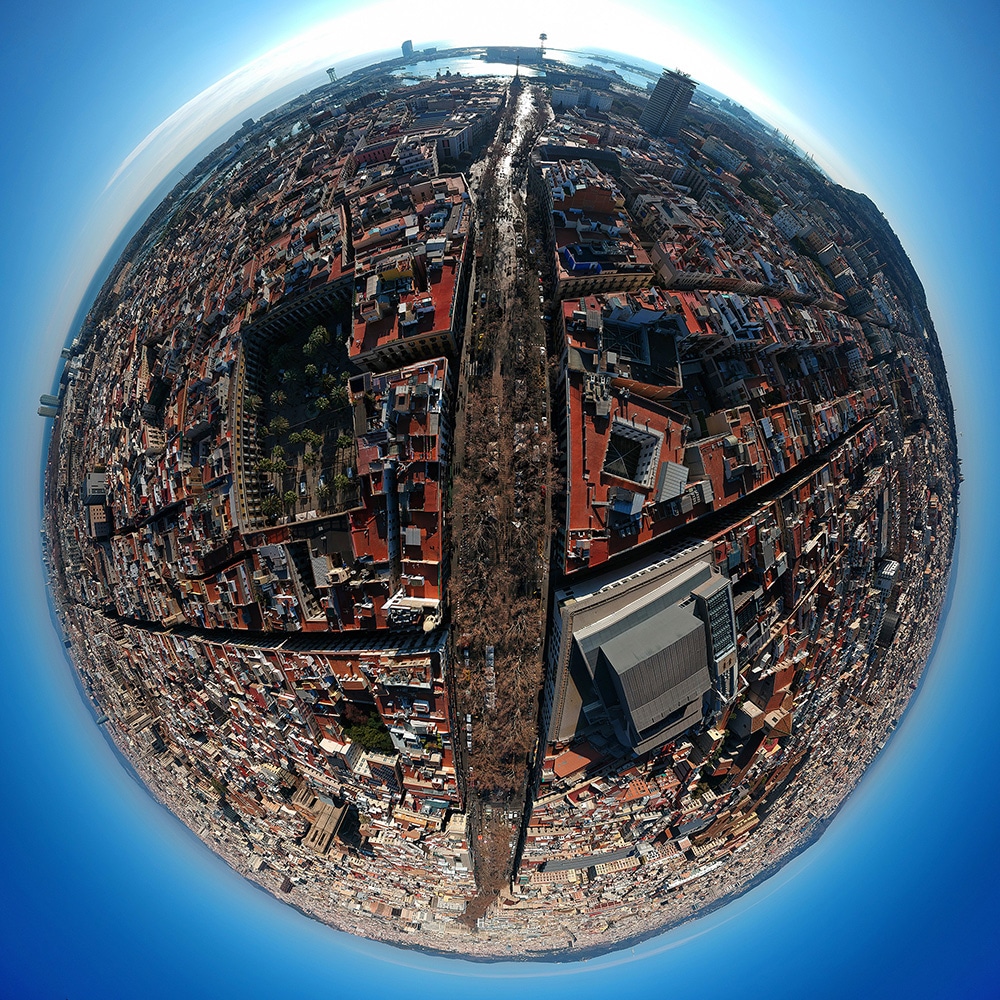
360° Aerial Photos of Barcelona Transform the City Into Small Planets

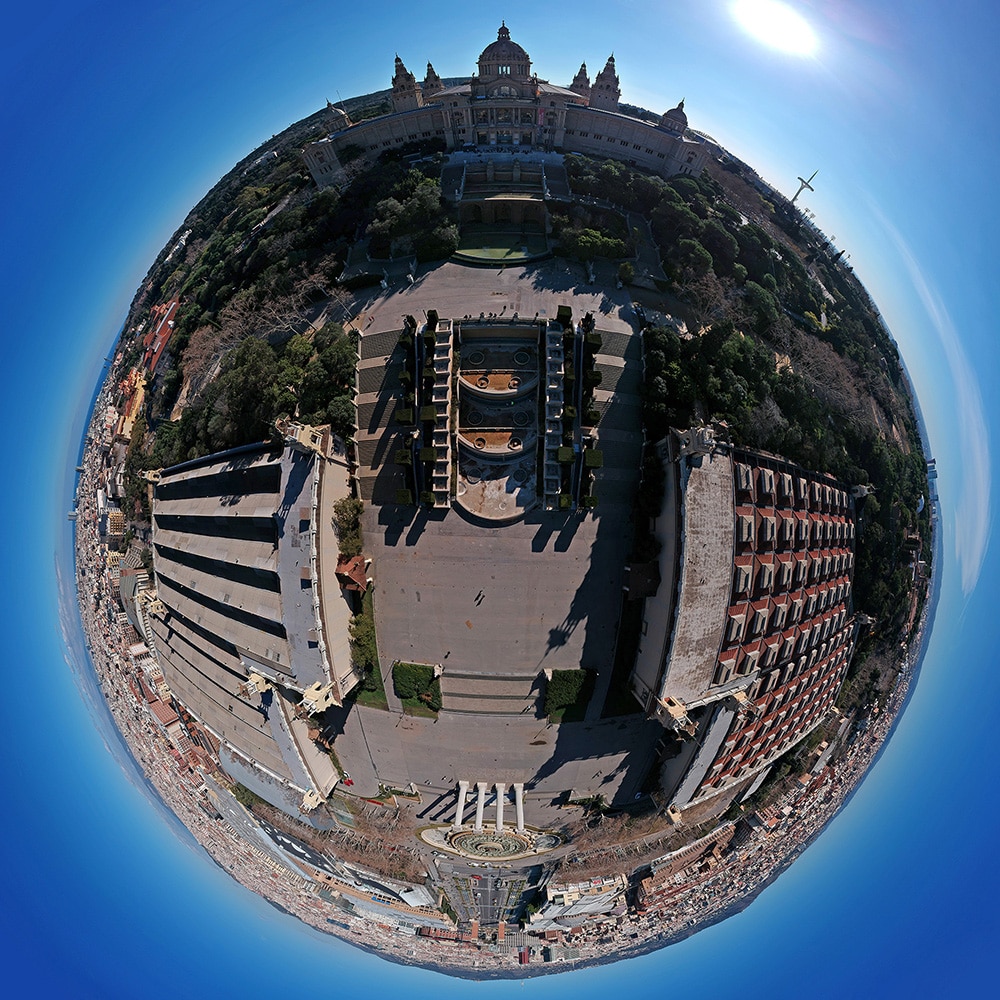
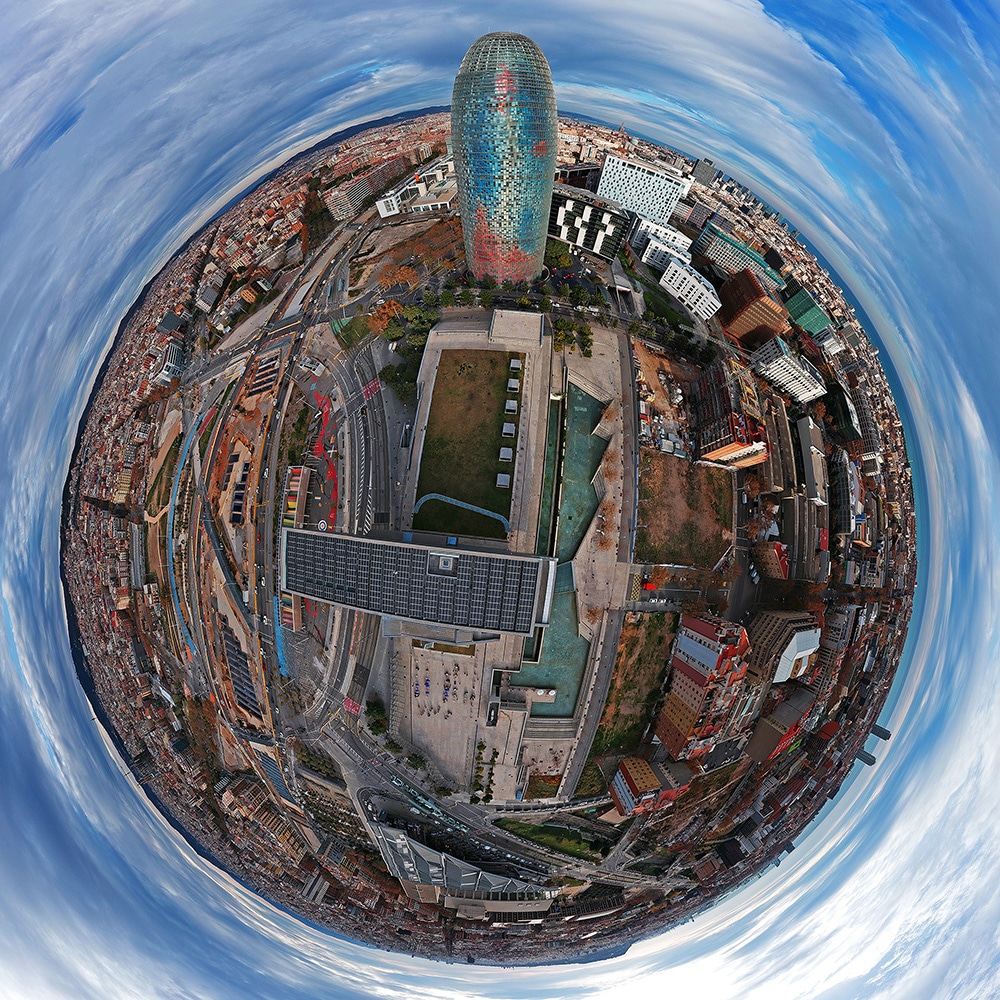
Currently living in Barcelona, Brazilian photographer Bruno Alencastro wanted to capture his experience in Europe by photographing the city from a different perspective. The task wouldn’t be easy, considering millions of travelers flock to the city each year to photograph some of the city’s most well-loved monuments. Thus, Alencastro took to the sky, creating a set of 360-degree aerial photographs that transform areas of Barcelona into small globes.

Alencastro began with Gaudí’s iconic Sagrada Familia, which he just so happened to live next to, giving him a first-hand view of the tourists that poured through the monument daily, all snapping photographs. “I had been looking for a different angle, not to repeat the thousands of almost equal photos that are posted every day on social networks,” Alencastro tells My Modern Met.

Taking to the sky, he captured 46 aerial photographs, which he then composited together and transformed into a stereographic projection. A stereographic projection allows a sphere to be projected onto a plane—just imagine how flat maps are placed onto spherical globes. In this manner, different neighborhoods and monuments in Barcelona become “small planets” unto themselves.

After tackling the Sagrada Familia, Alencastro was so inspired that he made his way across 9 other sections of the city, from beachy Barceloneta to the Montjuïc hilltop. By going up high with these 360 photos, the Brazilian photographer manages to gain a unique perspective of the streets of Barcelona.

Follow along with Alencastro as he documents his time in Barcelona via #168daysinbcn.

Bruno Alencastro’s 360-degree photos of Barcelona transform the beloved Spanish city into small planets.

Barcelona 360 Photos - Bruno Alencastro

Las Ramblas

360 Photos Barceloneta Bruno Alencastro

Barceloneta

Barcelona 360 Photos - Bruno Alencastro

Tibidabo

360 degree photo Bruno Alencastro

Palacio

Barcelona 360 Photos Bruno Alencastro

Agbar

Barcelona 360 Photos Bruno Alencastro

Bunkers of Carmel

Barcelona 360 Photos Bruno Alencastro

Ciutadella

Barcelona 360 Photos by Bruno Alencastro

Palacio

Barcelona 360 Photos Bruno Alencastro

Montjuic

Bruno Alencastro: Instagram

My Modern Met granted permission to use photos by Bruno Alencastro.

Related Articles:

100 Photos Merge to Form Swirling 360-Degree Landscapes

360-Degree Panoramic Photos Celebrate the Majestic Beauty of Grand Libraries

Amazing 360 Degree Panoramas (9 photos)

Beautiful Kaleidoscopic Photos of Abandoned Buildings in 360 Degrees

The post 360° Aerial Photos of Barcelona Transform the City Into Small Planets appeared first on My Modern Met.

http://ift.tt/2nbM4oU

The craggy arms of a large, red mangrove stretch out to greet…

The craggy arms of a large, red mangrove stretch out to greet the morning sun at Florida Keys National Wildlife Refuges Complex. Rising above the water line on aerial prop roots and thriving on tropical coastlines, mangroves provide shelter for plants and animals. They’re just one of the many interesting sights you’ll see near the continental United States’s southernmost point. Photo by U.S. Fish and Wildlife Service.

Personal Line of Credit: From Basics to Benefits

Even in a fluctuating financial market, you can always find a way to avail credit and access funds. The catch lies in choosing the right lender or financial product. If you are looking for a relatively flexible option with a lower interest rate, consider a personal line of credit.

What is a Personal Line of Credit?

A personal line of credit allows the borrower to use only the money he/she needs. Its variable rate of interest is typically lower than the interest rates on fixed loans.

While the lender approves your entire loan amount at once, the borrower only pays interest on the amount transferred for use. A personal line of credit lets you maintain a maximum loan balance account and gives you instant access to funds. This is a continuous revolving credit account and includes a maximum borrowing limit.

The credit limit will depend on the CIBIL score, which reflects the borrower’s creditworthiness. It’s based on his income and credit history. As the borrower repays a part of the amount, the interest is then charged on the remaining balance, which keeps reducing every month.

Personal Loan vs. Personal Line of Credit

personal line of credit loan

A personal loan provides the borrower access to a fixed amount of cash for a predefined period where the repayment timeline remains fixed and pre-payment attracts an additional fee.

A personal line of credit, on the other hand, is available for use at any time. Its interest is not charged on the entire amount allocated to you. In a personal loan, the lump sum amount is disbursed to the borrower for one-time use and the interest is charged on the entire amount, regardless of the amount used.

Another major difference between a loan and a line of credit is the rate of interest.

The interest rate of a personal line of credit is generally higher than a personal loan. Yet, if you compare the closing costs of both, a personal line of credit would prove to be an affordable option. A personal line of credit is flexible, open-ended, and can be used for any purpose.

Interest Rates and Processing Fees

Banks and non-banking financial businesses are now offering financial products with the benefits of a personal credit line.

The generic charges and fees of such funds typically include:

Activation Fees – This is a one-time joining fee that lending institutions charge at the time of approving a personal line of credit or on withdrawal of funds.

Interest Rates – A line of credit has a variable rate of interest that depends on the borrowers’ CIBIL score and typically ranges between 16-25% annually.

Processing Fees – The lender may charge an annual maintenance fee of 1 to 2% of the approved amount. Certain lenders don’t charge an annual fee, but they do charge a processing fee every time the borrower withdraws money.

Applicable Taxes – Government taxes are levied on a personal line of credit wherever applicable and they include the interest rate.

Who Should Leverage a Line of Credit and When

Having a line of credit helps when you don’t need a fixed amount. It’s also useful when your monetary needs are spread over a timeline of a few months. It proves beneficial in case of medical emergencies, home improvement, vacation or a family wedding where you can never be certain of the amount you would need.

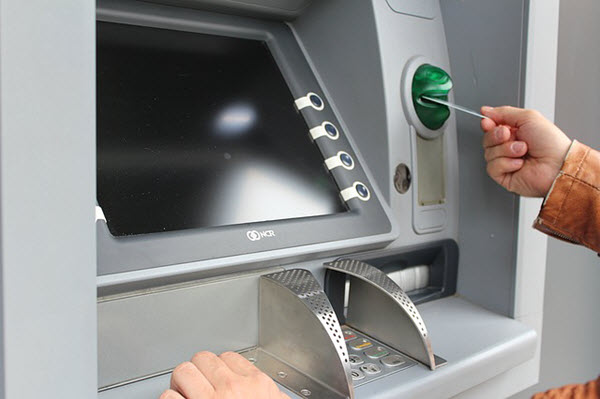
Both self-employed individuals and professionals who do not have a fixed income can benefit greatly with a line of credit. Borrowers can instantly access cash through the ATM, mobile banking or checkbook and get the needed amount any time, anywhere.

atm machine

The Benefits of Using a Personal Line of Credit

Fast and Flexible– Borrowers can tap into funds as and when the need arises with a personal line of credit. While they have access to a large credit amount, they also have the freedom to use only what they need and pay interest on that amount only. Also, the repayment terms are relatively flexible for both part and lump sum payments.

Affordable– Since borrowers don’t need to pay interest on the entire amount that is disbursed, the cost is reduced significantly if the funds aren’t utilized completely.

No Charges on Withdrawal– Generally, there are no charges for withdrawing money.

Higher Limits– A personal line of credit usually comes with a higher limit as compared to personal loans and credit cards. This makes it a perfect solution for funding large expenses.

No Collateral Required– A personal line of credit needs no collateral backing. Even if you don’t have any financial reserve, you can make use of a line of credit.

The Limitations

Fluctuating Interest Rates– Being an unsecured product, the interest rates of a personal credit line keep fluctuating as bank interest rates go up and down. Borrowers may end up paying much more than what they had expected.

Revolving Account– This means that borrowers need to keep track of the amount due.

Stringent Approval– A personal line of credit is approved on the basis of the borrower’s CIBIL score. Those with a poor credit history may not be able to take advantage of it.

Maintenance Cost– Some banks and NBFCs levy closing costs or maintenance charges on a personal line of credit.

No Tax Deductions– The interest charged on a personal line of credit is not tax-deductible. A line of credit is a flexible instrument fulfilling the dreams of many professionals today. So, if you are planning to make the most of this financial product, make sure you are well-informed with the right knowledge.

The post Personal Line of Credit: From Basics to Benefits appeared first on Dumb Little Man.

http://ift.tt/2BtGORR

What Happens If You’re A Passenger In An Uber Accident?

Travel has recently undergone quite a revolution and Uber is one of the most visible trends to have sprung up in the past decade. The rideshare app allows individuals to request rides from nearby drivers through their phones. It’s much cheaper than conventional taxi services and often much quicker due to the proximity-based matching system and state-of-the-art GPS technology.

Despite those features, however, Uber is not free from criticism and its drivers are not infallible. Accidents can still happen.

As a passenger in an Uber car, what do you do if you get in an accident?

Uber’s Insurance Policy

Uber will probably give you a refund for your trip if you inform them of the accident. You can do that by leaving a comment, submitting a feedback report or alerting the company through the “Help” option. Once they receive your feedback, an insurance agent will contact you to verify the details.

If you didn’t suffer any physical injuries, the process will be easy. However, if you were hurt, you should be aware of your next move.

First, it is important to understand the system of insurance at play with Uber rides. The Uber driver must have his own personal auto insurance policy in order to drive for the company. However, Uber provides all its drivers with a policy that varies depending on the status of the driver.

When the driver has the app on and is waiting for a customer to request a ride, he is covered for up to $50,000 in liability damage. From the time a customer requests a ride and until he reaches his destination, the policy increases to $1,000,000 and that also extends to you as a passenger.

James River Insurance is the carrier for Uber. The reason Uber provided its drivers with this policy is because personal auto insurance coverage will not honor claims that occurred during commercial or paid driving.

Initially, Uber claimed that its drivers were independent contractors and the company wasn’t responsible for any of their actions. This changed after the introduction of a law in the wake of an accident involving a 6-year-old girl.

A New Danger

uber app

What makes Uber dangerous for passengers?

It’s the potential for distraction.

The Uber app can only work on a smartphone. This means that a driver must routinely take his eyes off the road and his hand off the wheel to use the app. He needs to do this every time he has to accept customers, reroute a location, change settings or call a rider.

There is also a chance that an Uber driver will not report the accident to the company. This can confuse passengers, particularly when they expect to receive a certain compensation only to find out that there’s no record of the accident.

Filing a Claim

If an accident happens while you’re in an Uber vehicle, you’ll receive compensation for your injuries. If another driver caused the accident, you can file a claim with his insurance company. In case the crash was the fault of your Uber driver, you would be able to pursue compensation from him or from Uber.

It doesn’t really matter who was at fault for the accident. Whether it was your Uber driver or another driver, the passenger is protected.

“A passenger is considered an innocent party and it does not matter who caused the crash,” said Kevin Adkins, an Uber accident attorney based in Los Angeles.

But this rule is subject to a caveat:

“If the passenger was somehow responsible for the accident, his compensation might be reduced based on how much his negligence caused the accident,” continued Mr. Adkins.

Imagine this:

A drunk and unruly passenger somehow distracts the driver to the point that the driver loses control and gets into an accident. Without those exceptional circumstances, the passenger is protected.

Uber offers a small section on what to do in the event of an accident but not for passengers. Fortunately, the protocol is similar.

You should immediately seek medical treatment even if you feel like you didn’t suffer any injury. Adrenaline can waylay a lot of the pain and you may have invisible or internal damages that only a healthcare professional will be able to identify.

Additionally, take photos or videos of the accident and of your injuries. Those photos will be useful when submitting a claim.

What You Can Pursue

vehicular accident

By filing a claim, you’ll receive payment for your hospitalization expenses, surgery fees, medication costs, and physical therapy.

Lost income from days you weren’t able to work because of the injury or recovery time will be paid, too. This includes both past and future days’ wages. Any personal items you had that may have been damaged or lost in the accident are covered as well.

Because of the rise of Uber and other rideshare companies, legislators are starting to craft new laws. Those laws are more accurate and easier to understand.

See Also: Do You Know What To Do In A Ride Sharing Accident?

The post What Happens If You’re A Passenger In An Uber Accident? appeared first on Dumb Little Man.

http://ift.tt/2Dyj40Q

Munich

During the first hour of Robert Harris’s new novel, Munich, a young British civil servant, lunching with his wife, is summoned to the prime minister’s office by news of impending war. “It looks as though the talking’s over,” Hugh Legat is told. “Our man is flying home.” Hanging up the phone, Legat wonders, “Was this what History felt like? Germany would attack Czechoslovakia. France would declare war on Germany. Britain would support France. His children would wear gas masks. The diners at the Ritz would abandon their white linen tablecloths to crouch in slit trenches in Green Park.” It is Tuesday, September 27, 1938. In Berlin, Adolf Hitler has told the British emissary that German forces will mobilize at two o’clock the next day. In London, Prime Minister Neville Chamberlain prepares to address the nation. And in Munich, Robert Harris recreates the four days that follow in such penetrating detail that each moment of the drama holds us captive. A suspense thriller within a historical drama, Munich is one of Harris’s leanest and most dexterous novels. It is also a welcome return to the historical period that inspired, most memorably, the outstanding Fatherland (1992), which imagined Nazi-occupied England after an Allied defeat, and Enigma (1995), which revolved around the breaking of German codes during the Second World War. (Harris is also the author of the excellent Cicero trilogy set in ancient Rome and of contemporary thrillers such as The Ghost Writer.)

At the core of Harris’s novel is the Munich Conference of September 1938, the now-infamous example of an exhausted Europe’s weakness in the face of fascism. We know the outcome. But that knowledge only intensifies the sense of contained desperation that Harris creates in a narrative that is, from the outset, both airtight and charged with menace; a menace heard before it is seen. “He had listened to it on the BBC as it was delivered,” Legat notes of Hitler’s September 26th speech, “Metallic, remorseless, threatening, self-pitying, boastful . . . it had been punctuated by the thumps of Hitler’s hand pounding the podium and by the roar of fifteen thousand voices shouting their approval. The noise was inhuman, unearthly. It had seemed to well up from some subterranean river and pour out of the loudspeaker.”

As the novel’s plot uncoils and as the action moves from London to Berlin and Munich, Hitler comes gradually into focus — on the Chancellery balcony, in a roomful of generals, at the conference negotiations, terrorizing dinner guests — and here, as with Chamberlain, Harris conjures up a character rather than a cliché. This, for example, is Hitler receiving a foreign press summary: “He took the two sheets and started reading, rocking gently up and down on the balls of his feet. Hartmann had the impression of great energy barely suppressed . . . When he reached the bottom of the first page he stopped and flexed his head as if he had a crick in his neck, then read aloud in a tone of intense sarcasm: ‘Mr. Chamberlain’s description of his last meeting with Herr Hitler is agreeable proof that his strong candor was rewarded with liking and respect.’ He turned the page back and forth. “Who wrote this shit?” Paul von Hartmann, the civil servant delivering the summary, contemplates Hitler’s “fragile head — bent oblivious, reading. If he had known, he would have brought his gun.”

Soon he will. A German military coup seems imminent, and when Legat receives a secret message from Hartmann, a friend from their student days, he too is drawn into the web forming around the Munich Conference. “A car was driving slowly down North Street . . . ” Legat observes from his London flat. “The glow of its headlights lit up the ceiling, projecting an outline of the window frame across the opposite wall; the dark lines swung like the shadow on a sundial.” The stench of fear — for oneself, for the world — swiftly pervades the civilized, the everyday. And Hartmann, contemplating his office mates, sees how this has happened. “He had mixed with their type all his life: patriotic, conservative, clannish. For them, Hitler was like some crude gamekeeper who had mysteriously contrived to take over the running of their family estates: once installed, he had proved an unexpected success, and they had consented to tolerate his occasional bad manners and lapses into violence in return for a quiet life. Now they had discovered they couldn’t get rid of him.” Hartmann is the conscience of Munich and Legat its innocent heart, but Harris is too subtle a portraitist to draw them, or the history they embody, in bold colors. Here the past bleeds into the present and those maimed by the last war will soon face the next.

The post Munich appeared first on The Barnes & Noble Review.

The Barnes & Noble Review http://ift.tt/2rHHGmw

Peter Hujar’s Downtown

Peter Hujar’s photographic subjects were not specimens of American male perfection; his nude figures were idiosyncratic yet erotic. In one of his signature nude studies, Bruce de Ste. Croix (1976), the subject is seated in a chair, contemplating his erection. This portrait represents Hujar’s conscious attempt to reintroduce male genitalia into Western art, and he was taking it a step further: the erection had never before been photographed with such aesthetic regard.

http://ift.tt/2Gj1cck

The Top 5 Tips To Turn Mistakes Into Teachable Moments

You’re reading The Top 5 Tips To Turn Mistakes Into Teachable Moments, originally posted on Pick the Brain | Motivation and Self Improvement. If you’re enjoying this, please visit our site for more inspirational articles.

Taking action is one of the most important parts of all the learning processes because everything in life is learned by actually doing it. You can read thousands of books on guitars, learn about its different parts, know the technology used, watch thousands of videos on guitar lessons, but you will never be able to learn guitar if you will never try to play it with your own hands.

Think about some of the most common things which you have learned in your life like walking, cycling, cooking, dancing, etc, all these things were eventually learned because of your mistakes. When you first started to learn walking, you must have fallen many times but instead of becoming discouraged from each fall, you woke up again every time, learned from your mistake and then started walking again. So, if you are taking endeavors and making mistakes, then you don’t need to worry as mistakes are a part of the actions you take and it happens so that you can learn from it and use it as a tutor in your next attempt.

That’s why, in this article, we will be looking at the top 5 tips which you can apply in your life for using your mistakes as a self-improvement tool.

Start accepting your faults

Lying to others makes you a liar but lying to yourself makes you a weak blindfolded man. You should always be truthful to yourself because if you will start lying to yourself then you can’t expect yourself to grow any further in life. Start accepting your small mistakes and take responsibility for it. This habit will let you know your own mistakes because deep in your heart, even you know that it was your mistake but you keep lying to yourself and restrict yourself from improvement.

Turn your mistakes into a learning tool

No one is a better teacher than your mistakes. Every mistake holds the secret key to unlock the door of your flaws, through which you can enter into the world of learning. Mistakes are a part of human nature and instead of getting demotivated and depressed, you should start learning from your faults. It will help you to know which part of your attempt stopped you from achieving it. Every mistake will teach you a new lesson and every lesson learned will bring you closer towards your goal.

Don’t be afraid of failure

Everything is not perfect in the world, and so does human actions, nature and thinking. Do you think that the greatest speaker of the world got praised for his first speech? Do you think that the best footballer player of the world scored the goal on his first attempt? Absolutely not. Most of the people don’t get the chance to taste success in their initial attempts because an ideal success or achievement is a mix of endeavors, willpower, determination, and faults as well. So don’t be frightened to fail and don’t be frightened to make mistakes because if you are not making mistakes then you are not on the right path.

Learn from others mistakes as well

Since your own mistakes are not enough to learn all the lessons of your life, therefore, you should learn from other’s faults as well. Most of the people only see the successful side of famous personalities, friends, relative and neighbor but they miss the most valuable chapter of their life and that is the chapter of mistakes. You can learn from others faults and can try to never let it happen in your life again. Watching and learning from others faults is also a very valuable lesson of your life which can make you much wiser and good learner as well.

Don’t get stuck on your mistakes

Getting stuck at a mistake and then regretting it for your whole life is the worst thing which you can do. You should never get stuck at one phase of your life, attempt or endeavor. Think of mistakes as the place where you go daily for your singing classes. You go there, learn and then come back to your home but the one thing which everyone carries from that class is lessons and the same goes for your faults. You should face your faults, learn important lessons and then move on with your life.

So instead of being afraid of failures, start learning from your mistakes because teachers can teach you lessons through other’s case studies but mistakes teach you lessons from your own case study.

Saurabh Gupta is a technical content writer at Cloudwalks, which provides accounting solutions like QuickBooks hosting, Drake hosting,etc. His area of expertise includes software, cloud computing, cybersecurity and life lessons.

You’ve read The Top 5 Tips To Turn Mistakes Into Teachable Moments, originally posted on Pick the Brain | Motivation and Self Improvement. If you’ve enjoyed this, please visit our site for more inspirational articles.

>

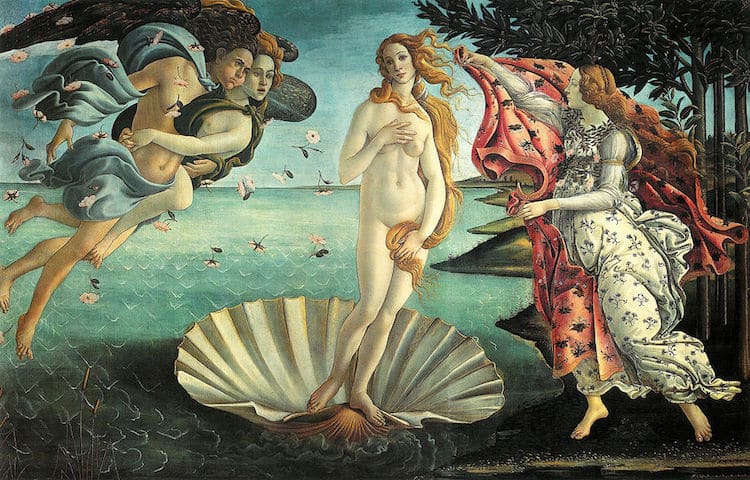
The Significance of Botticelli’s Renaissance Masterpiece ‘The Birth of Venus’

Botticelli Birth of Venus Painting Botticelli Venus Italian Renaissance Art

‘The Birth of Venus’ (c. 1486) (Photo via Wikimedia Commons)

An early master of the Italian Renaissance, Sandro Botticelli is celebrated for his painterly contributions to the major art movement. While the artist’s oeuvre features secular portraits and Biblical depictions, he is most well- known for his larger-than-life, mythological scenes—namely, The Birth of Venus.

Created in the late 15th century and exhibited in Florence’s famed Uffizi Gallery since the early 1900s, the monumental painting has been admired and analyzed for centuries. Today, along with famous pieces like Leonardo da Vinci’s Mona Lisa and Michelangelo’s Sistine Chapel ceiling, it is regarded as a key work of the Italian Renaissance.

So, why is this painting so famous? In addition to stylistic qualities—like color and brushwork—Botticelli’s approach to subject matter is what sets The Birth of Venus apart from other Renaissance depictions. Before examining these characteristics, however, it is important to understand the context of the prominent painting.

Context

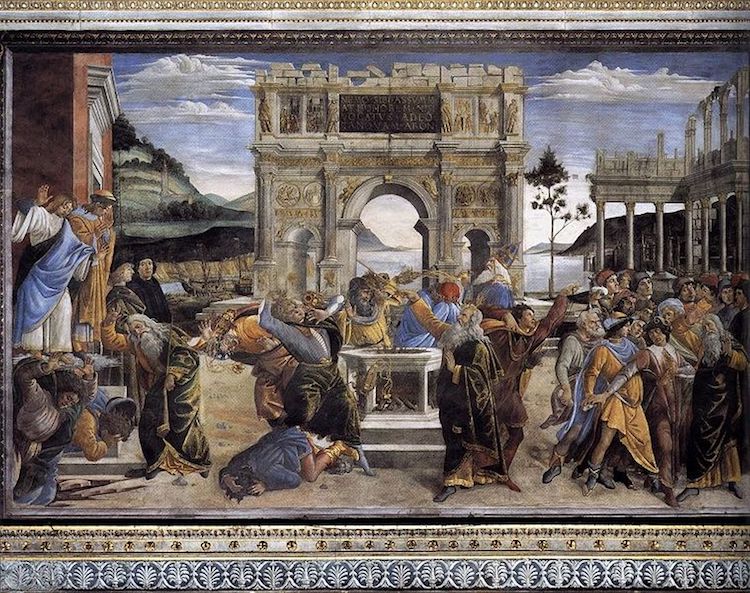
Though the exact dates of creation are not known, art historians believe that The Birth of Venus was likely painted between 1482 and 1485. At this time, the High Renaissance in Italy was less than a decade away, and Botticelli was working in Florence—the city of his birth—after a stint in Rome, where he was commissioned to create frescoes in the Sistine Chapel. Upon returning to Florence, he resumed regularly painting Roman Catholic depictions. However, he also began to dabble in new subject matter: Greek and Roman mythology.

Botticelli Birth of Venus Painting Botticelli Venus Italian Renaissance Art

‘Scenes from the life of Moses’ -in the Sistine Chapel (c. 1480) (Photo via Wikimedia Commons)

As a result of his newfound interest in this ancient iconography, he produced two large-scale paintings: Primavera and The Birth of Venus. Though not a pair, these pieces are often viewed simultaneously due to their similar subjects, style, and scale. Additionally, both pieces are rendered in tempera paint, a traditional medium made of pigment and egg yolk. Unlike Primavera, however, which was painted on panel, The Birth of Venus is a work on canvas—the first of its kind in Tuscany.

Subject Matter

In addition to its context, The Birth of Venus is remarkable for its content, which stands out from other Renaissance scenes.

The Birth of Venus shows the recently-born Venus, the Roman goddess associated with love and beauty. Standing nude in an enlarged scallop shell, she is flanked by three figures from Classical mythology. While the intended identities of these individuals are not clear, they are widely believed to be Zephyr, the god of wind; Chloris, Zephyr’s wife and a nymph associated with flowers; and an Horae, a Greek goddess related to the seasons. Together, Zephyr and Chloris push Venus toward the shore with their breath, while Horae waits to cover her with a cloak.

Botticelli Birth of Venus Painting Botticelli Venus Italian Renaissance Art

Detail of Venus

Botticelli Birth of Venus Painting Botticelli Venus Italian Renaissance Art

Detail of Zephyr and Chloris

Botticelli Birth of Venus Painting Botticelli Venus Italian Renaissance Art

Detail of the Horae

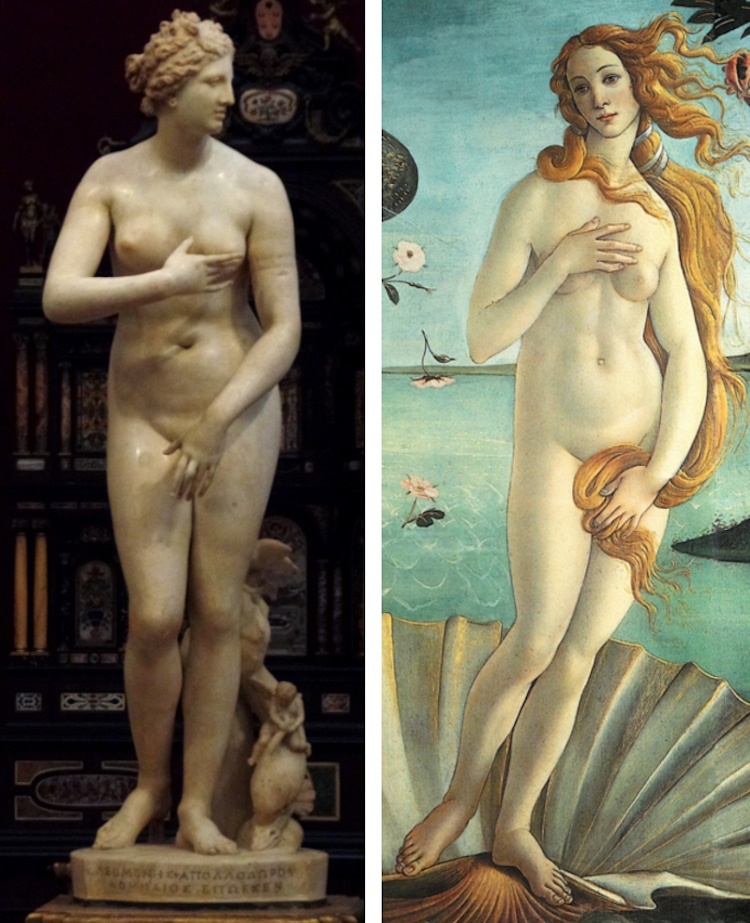
According to the Uffizi Gallery, this scene showcases several influences, including Ovid’s Metamorphoses, Agnolo Poliziano’s poem, Stanzas, and Venus Pudica, a pose found in Classical art.

Similar to the contrapposto (s-shaped) stance of Michelangelo’s David, the Venus Pudica is a pose characterized by asymmetry. Unlike the former, however, which is employed only to convey naturalism, the Venus Pudica bend occurs when a figure uses his or her hand to conceal their nudity. The Venus de’ Medici, a Hellenistic sculpture, illustrates this.

Botticelli Birth of Venus Painting Botticelli Venus Italian Renaissance Art

Left: ‘The Venus de’ Medici ‘ (first century BCE) (Photo: Wai Laam Lo via Wikimedia Commons)

The post The Significance of Botticelli’s Renaissance Masterpiece ‘The Birth of Venus’ appeared first on My Modern Met.

http://ift.tt/2E9U01z

In many parts of the country, it’s rare to catch a glimpse of a…

In many parts of the country, it’s rare to catch a glimpse of a bald eagle, but imagine seeing scores of them in a single day. Welcome to Lake Coeur d’Alene in the winter! With a plentiful supply of spawned-out kokanee salmon, this lake is a favorite wintering spot for eagles. From November to February each year, the Bureau of Land Management records the eagle migration – a record 240 eagles were spotted in just one day in 2013. The spectacle becomes a regional attraction, with activities, tours and boat rides on the lake. Photo by Bureau of Land Management, @mypubliclands