Woman Leaves Behind Her Office Job to Become Accomplished Wildlife Photographer

Hennie van Heerden Wildlife Photographer

Dutch wildlife photographer Hennie van Heerden has transformed her passion into a career, traveling far and wide to capture stunning images of the natural world. After joining Flickr in 2006 and conversing with a tight-knit community of wildlife photographers, van Heerden left a successful career as an executive assistant in 2010. Since that time, she’s focused on honing her craft as a professional wildlife photographer.

Her love of animals runs deep and started during her childhood. “I grew up at what you could call a mini-zoo. We had dogs, cats, cows, pigs, chickens, parakeets, hundreds of little colorful ducks (my father bred them as a hobby), pheasants, rabbits, fish, geese, canaries,” van Heerden shares with My Modern Met. “We lived in a farmhouse and although my parents weren’t farmers, both their parents were. Can’t remember that we—my sister and I—were ever indoors. We were always doing something outside; swimming in the nearby stream, playing hide and seek at the equally nearby forest, playing with the animals….”

This love of nature and animals has stayed with van Heerden through adulthood, leading her on frequent journeys to Africa, where she’s able to photograph big game and small animals on nature reserves. It’s challenging work, something that requires patience, precision, and technical skill. But for van Heerden, that’s part of the attraction. “I like the challenge of wildlife photography. An animal moves, blinks, flies, and often does unexpected things which makes it harder to get a shot exactly right. And I like being challenged.”

Hennie van Heerden Wildlife Photographer

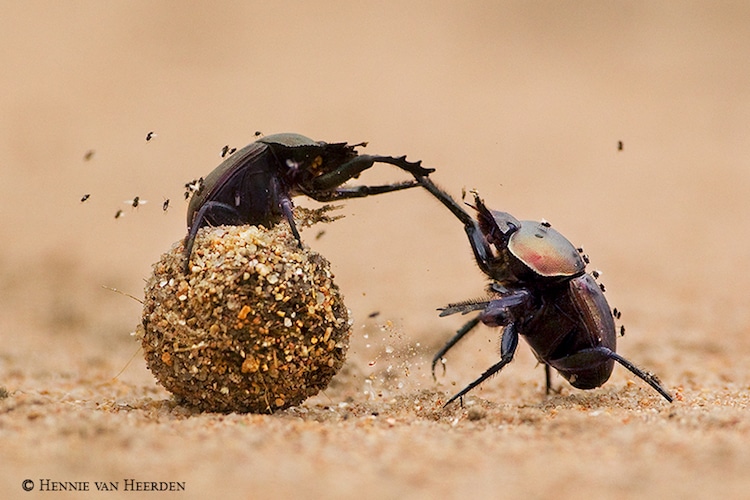
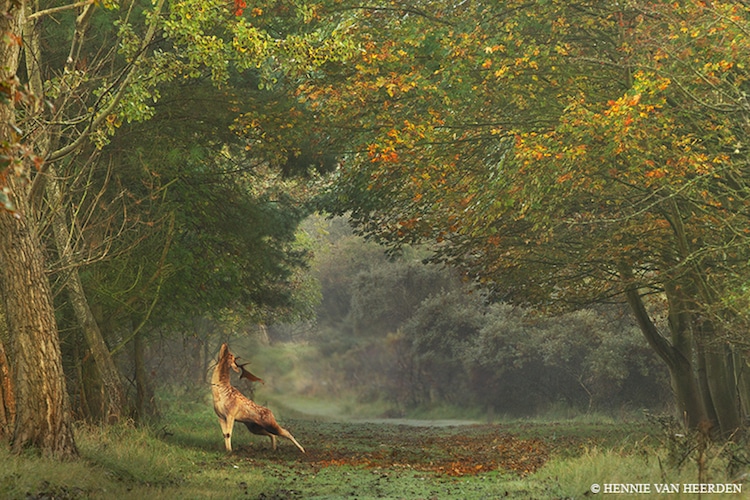
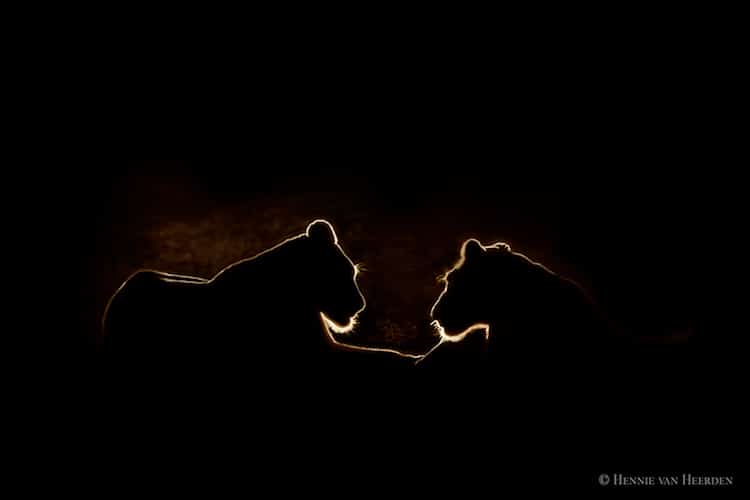
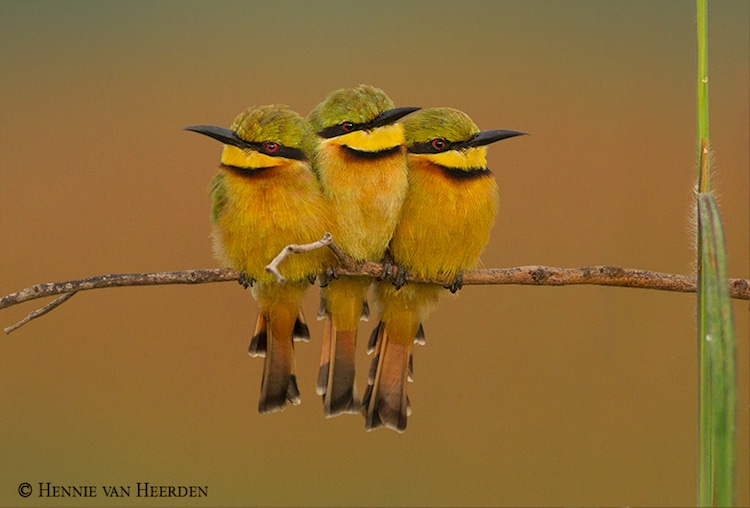
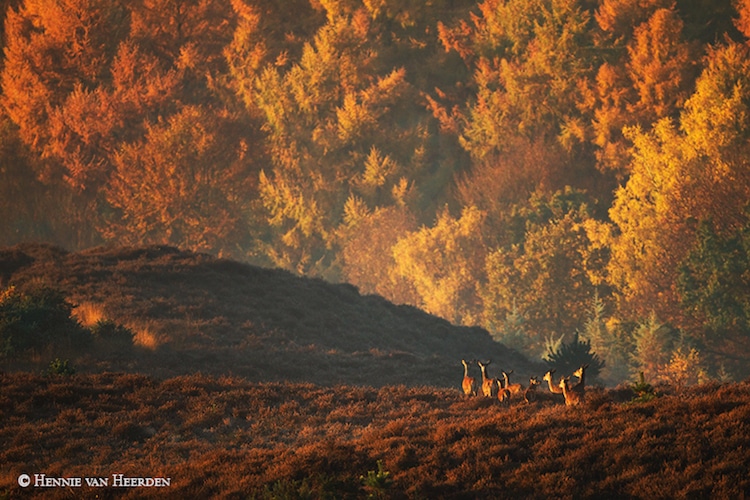
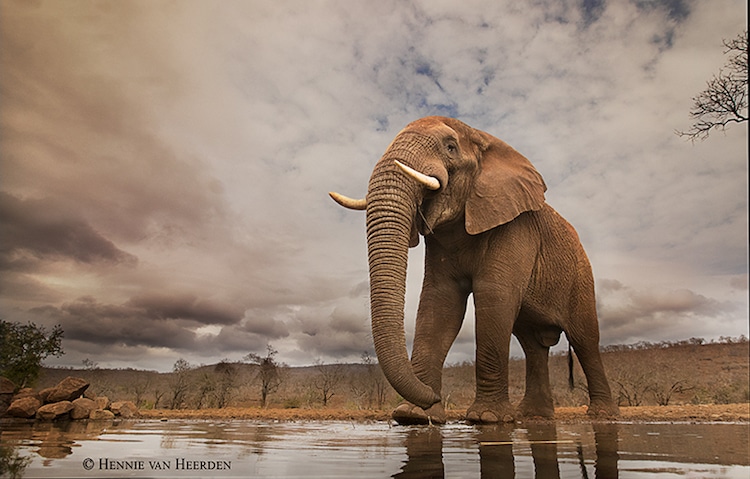
From close-up portraits of delicate birds and tiny insects to stunning captures of leopards or elephants framed in their environment, her artistic compositions and style have allowed her to create a name for herself as a skilled wildlife photographer. Whether in Costa Rica or Gambia, she’s able to capture the moment and magic of the country’s wildlife from a unique perspective.

Now, in between working with Canon Japan and chairing one of Holland’s largest nature photograph association, she also works with her husband on their own nature reserve. For the past 25 years, they’ve been buying up land adjacent to their property and work diligently on returning it to its wild state. It’s hard work that’s seen them plant over 15,000 trees, but one that brings great satisfaction.

As a photographer who made the career leap later in life, what advice would she give to those thinking of doing the same? Take your time, know what you’re in for, and if you think there’s a demand for your work, go for it. “Here in Europe, you can’t make a living out of selling photographs alone anymore. Even stronger, the profession ‘professional photographer’ hardly exists anymore nowadays. There’s always another element involved, like giving workshops, organizing photography tours, giving lectures etc,” she shares. “So I would do a lot of research if there is a demand for your specific art-form and if that is photography, ask yourself if you would be willing to engage in those other activities as well. And do try it out part-time. If that works, go quit your day-time job and be happy!”

Hennie van Heerden is an accomplished wildlife photographer who travels the world to capture unique images of animals.

Wildlife Photography by Hennie van Heerden

Photo of a Leopard by Hennie van Heerden

Hennie van Heerden Wildlife Photographer

Wildlife Photography by Hennie van Heerden

Hummingbird photograph by Hennie van Heerden

Wildlife Photography by Hennie van Heerden

Wildlife Photography by Hennie van Heerden

Wildlife Photography by Hennie van Heerden

Hennie van Heerden Wildlife Photographer

Hennie van Heerden: Flickr

My Modern Met granted permission to use photos by Hennie van Heerden.

Related Articles:

Interview: Up and Coming Wildlife Photographer Captures the Spirit of the Natural World

Steve Irwin’s 13-Year-Old Son is an Exceptionally Talented Wildlife Photographer

Remarkable Finalists of the 2017 Wildlife Photographer of the Year Contest

Photographer Captures Softer Side of Elusive and Feared Leopard Sleeping Peacefully

The post Woman Leaves Behind Her Office Job to Become Accomplished Wildlife Photographer appeared first on My Modern Met.


http://ift.tt/2FSkQdS

College Student Didn’t Like Dorm Life, So He Built a Tiny Home on Wheels for $15,000

Tiny Mobile Homes

As the cost of attending college goes up in the U.S., students are coming up with creative ways to save money on (and for) their schooling. A college student named Bradley from Jacksonville, Florida has avoided the dorm life by opting to build his own tiny home on wheels. Nestled among trees with a creek nearby, he calls his 230-square-foot abode Rolling Quarters. The cozy space is perfect for one person and comes complete with a large porch so that he can enjoy the outdoor serenity that’s just a few steps away.

Rolling Quarters started out as more a financial need than a desire to downsize. “Right out of high school I went and paid a year’s worth of rent and decided that wasn’t for me,” he tells Living Big In A Tiny House. “So I moved back home to save some money and pay for it all in cash to build it.” Bradley first secured a 27-foot-long flatbed trailer and then began collecting things from Craigslist. For the items and materials he couldn’t find used, like the vinyl siding, he bought new.

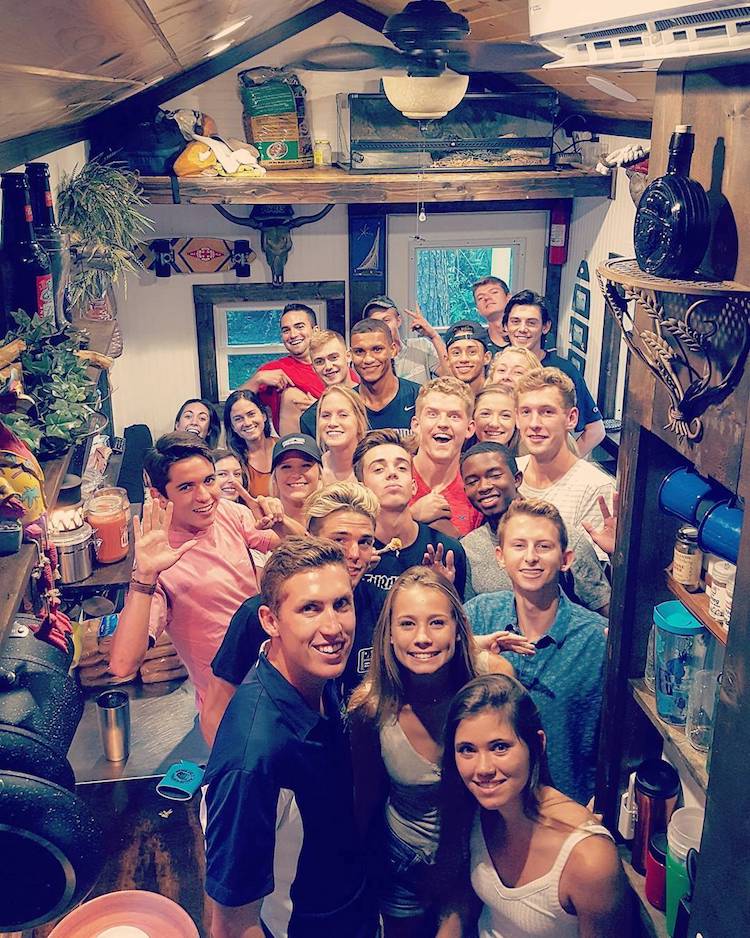
The interior of Rolling Quarters has a cabin-like feel. Branches and greenery line the walls, and the ceiling is left as its natural color. The design has space-saving details that are synonymous with tiny homes, like storage underneath the stairs, a lofted bedroom, and a foldable table that Bradley uses for studying. This still leaves him room for things like a TV and couch—as well as the ability to host 25 people in his air-conditioned space and still have room for a selfie.

Building Rolling Quarters gave Bradley more than just a place to live—it gave him confidence in his own abilities. “It taught me I can do more than I think I can. Before doing some of the things, such as electrics, I thought I might contract that out but after I got my hands dirty and went through the whole process it seems a lot simpler now.”

With the amenities, gorgeous landscape, and the fact he doesn’t have to live in a cramped dorm room, Bradley’s $15,000 cost to build Rolling Quarters was certainly worth it. If you’d like to experience the tiny home for yourself, Rolling Quarters is now available to book through Airbnb.

A college student named Bradley has avoided the dorm life—and saved money—by building his own tiny home on wheels called Rolling Quarters.

Incredible Tiny Homes

He started with a 27-foot flatbed trailer and constructed the 230 square foot abode on top of it.

Incredible Tiny Homes
Rolling Quarters Tiny Home on Wheels

The interior of the home features some space-saving characteristics, like storage underneath the stairs.

Rolling Quarters Tiny Home on Wheels

For just $15,000, Bradley now has a cozy home.

Rolling Quarters Tiny Home on Wheels
Incredible Tiny Homes
Rolling Quarters Tiny Home on Wheels
Incredible Tiny Homes
Tiny Mobile Homes

And although he lives there by himself, Rolling Quarters is equipped with a large porch that can easily host Bradley and his friends.

Rolling Quarters Tiny Home on Wheels

Take a tour of Rolling Quarters in the video below.

Rolling Quarters: Instagram

My Modern Met granted permission to use photos by Rolling Quarters. 

Related Articles:

Mobile Tiny Home Comes Equipped with Its Own Detachable Green House

People Are Masterfully Transforming School Buses into Mobile Tiny Homes

Seniors Are Buying Tiny Homes to Live Their Golden Years Off the Grid

Tiny Home Village Offers Travelers a Pint-Sized Getaway in the Mountains

Fully-Customizable Tiny Homes Start at an Affordable $22,000

The post College Student Didn’t Like Dorm Life, So He Built a Tiny Home on Wheels for $15,000 appeared first on My Modern Met.

http://ift.tt/2BOHFRU

How To Clear Your Thoughts And Why Do It

Our thoughts are helpful. We need them to make sense of the information around us and to take action.

I used to believe this wholeheartedly, but is it really true? Is the stream of words in our heads really necessary?

As far as we know, animals don’t talk to themselves and they seem to manage. Some of our actions are prompted by our thoughts but most of them are the results of outside stimuli and our feelings.

Your Mind in Action

mind in action

When something triggers a response in us, our subconscious tries to come up with a proper course of action. Its final decision is reinforced by feelings and thoughts that leak into the conscious. These 2 combine to form the motivation for your response.

For example, let’s say you found a mountain of dishes in your sink.

Your brain (the subconscious) analyzes the situation and comes up with a solution (leave them). Your feelings guide you towards the couch and you start thinking about your favorite show.

Again, your thoughts worked against you.

But this is not always the case.

Sometimes, the subconscious comes up with the decision to clean your dishes and so do your thoughts.

Also, you are not at the mercy of your subconscious. You can say no to certain “solutions” by recognizing the feelings and thoughts that are rejecting them.

See Also: The Profound Effects Of Meditation On The Mind

Don’t Argue with the Mind

When you feel like doing something you shouldn’t, become aware of this fact. Take a deep breath, relax your body, and start focusing on your task.

Most of us try to argue with our minds and the brain always wins.

Stop arguing.

When you’re feeling and thinking something you shouldn’t, simply ignore it.

If you think you can’t, you are wrong.

You’ve done it before. At one time or another, something triggered a messed up thought in you, like murder, suicide or rape. It happens to all of us.

We cannot control the thoughts we have, as they are simple reactions to the outside world.

If you watch enough news about murder and rape, these thoughts will inevitably end up in your mind. But they are disgusting, so we reject them immediately.

That’s what keeps us sane.

However, we do not reject thoughts of donuts and coca cola which make us fat. We do not reject thoughts of television and YouTube that keep us mediocre.

So, how do we do it?

How to Control Your Thoughts

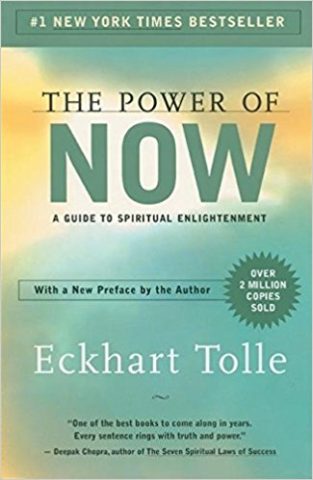
To fully understand how this works, I recommend reading “The Power of Now” by Eckhart Tolle.

the power of now eckhart tolle

An incomplete summary of what he speaks about is the following:

  • Thoughts come and go but you don’t have to accept and ruminate over all of them.
  • Close your eyes and take a deep breath. Open them and become deeply aware of your surroundings. Become present.
  • In this state, you have no thoughts. You enjoy being. When one comes into your head, make a quick decision: Is this thought useful/necessary or not? If it’s not (most of them aren’t), eliminate it and return to the present.

These steps will not only remove the pointless thoughts in your head but they can also force your subconscious to come up with better, superior ideas. What you’ll basically be doing is analyzing your thoughts, keeping only the good ones, and terminating the rest.

See Also: The Secret Mind Hacks That Can Change Your Life Today

Thinking vs. Being

Most people are stuck in their heads. Instead of admiring the sunset or having a moment with their friends and family, they’re busy thinking about nonsense.

Are you doing the same?

If you are, accept it and start working on it. You can try it out right now or when you’re taking a walk or a shower. If there’s nothing useful going on in your head, simply focus on the now and the present.

By training yourself to get rid of the useless thoughts in your head, you will build the discipline you need to succeed at work and your daily life. The more you do it, the easier it will be to remain in the present.

So, stop thinking. Just listen. Just see. Just be.

The post How To Clear Your Thoughts And Why Do It appeared first on Dumb Little Man.

http://ift.tt/2EoSRp9

Damaged people…

http://ift.tt/2FS3Kgc

4 Lessons from Oprah’s Golden Globes Speech You Need to Remember Each Morning

The Golden Globes was more electrifying than ever this year and it wasn’t the flashy outfits, comedic host or latest Hollywood scandal that took the show.

This year it was Oprah Winfrey’s Cecil B. DeMille Award speech that shot everyone out of their seats into a standing ovation. It was an ovation that was heard around the world.

The award may be for outstanding contributions to entertainment but her speech went beyond the industry. It’s filled with lessons that one can apply in every aspect of his life, particularly when it comes to career.

If you’re curious to know, below are some of the most important points she made that day.

Remember the career that built you

career success

“And I tried many, many, many times to explain what a moment like that means to a little girl, a kid watching from the cheap seats as my mom came through the door bone tired from cleaning other people’s houses.”

Climbing up the ladder to success is exhilarating. As you knock out each goal, it becomes easier to forget the small victories that came early in your career.

It’s those moments that shaped you into the person you are today. Every success, failure, hardship, and victory is crucial to your story.

Take a moment to consider your first real job.

Think about how you felt that first day, how many mistakes you made, the joy of getting acknowledged for a job well done, and how you felt moving into your first promotion or a new career.

Expand your leadership skills and try to become a more empathetic and approachable leader. When employees make mistakes, need words of encouragement or are hoping for that next big promotion, have a higher understanding of what they need.

See Also: 7 Power Habits of Great Leaders, Business Icons and Inspirational Achievers

Look at your defining moments every day

“She opened the envelope and said five words that literally made history: ‘The winner is Sidney Poitier.’ Up to the stage came the most elegant man I had ever seen. I remember his tie was white, and of course his skin was black—and I’d never seen a black man being celebrated like that.”

We all have those moments that define us down to the core. Some are major moments in history, like Oprah’s. Others are understated, but no less important.

What’s yours? What’s that moment that made you say, “I want to do that”?

Once you’ve identified that moment, write it down on a sticky note and place it somewhere you’ll see every day. Writing and seeing it makes its impact on your leadership skills even more concrete.

When you lose confidence in yourself or are struggling to hit a goal, go back to your note. Use it to remember where your passion radiates from.

Celebrate those around you

“Each of us in this room are celebrated because of the stories that we tell, and this year, we became the story.”

No matter what you do, other people are involved in your journey. Don’t forget them.

When you don’t listen to employees’ stories, your leadership skills become limited because you can’t fully understand how to manage them. In each person’s story lies the key to their motivation, what encourages them, and how they’ll react to certain situations.

Get to know your own team, employees in other departments, and your customers. Ask them what their goals are or if they have special skills or interests. Get to know their favorite activities outside of work.

Incorporate all the information you’ll get into team bonding activities and future projects.

See Also: 9 Traits of a Great Leader

Push for a brighter tomorrow

brighter tomorrow

“…but the one quality all of them seem to share is an ability to maintain hope for a brighter morning, even during our darkest nights.”

Being a leader provides plenty of challenges.

As your leadership skills develop, so will your need to participate in some unhappy moments. From firing or laying an employee off to letting a client know a mistake has been made on his project, there will be tough tasks.

Don’t let these moments define you.

Instead, maintain hope for yourself and for the people you’re leading. Take a moment to acknowledge and accept those dark moments. Then, move onto the solution and new morning.

Remember, you’re not alone in those tough times. Don’t be afraid to reach out and ask for help.

The post 4 Lessons from Oprah’s Golden Globes Speech You Need to Remember Each Morning appeared first on Dumb Little Man.

http://ift.tt/2Eb659J

Ranging over 4 million acres in southwest Alaska, Lake Clark…

Ranging over 4 million acres in southwest Alaska, Lake Clark National Park & Preserve offers excellent opportunities for adventure, exploration, learning and just plain fun. However, it can be hard to get a lot done when all you want to do is stare at the epic views. Photo along the Telaquana River by J. Mills, National Park Service.

Slavery and the American University

According to the surviving records, the first enslaved African in Massachusetts was the property of the schoolmaster of Harvard. Yale funded its first graduate-level courses and its first scholarship with the rents from a small slave plantation it owned in Rhode Island (the estate, in a stroke of historical irony, was named Whitehall). The scholarship’s first recipient went on to found Dartmouth, and a later grantee co-founded the College of New Jersey, known today as Princeton. From their very beginnings, the American university and American slavery have been intertwined, but only recently are we beginning to understand how deeply. In part, this can be attributed to an expansion of political will.


http://ift.tt/2Em6o0V

To Fight Against This Age: On Fascism and Humanism

In Thomas Mann’s novel The Magic Mountain, the naive protagonist, Hans Castorp, serves as the rope in a tug-of-war between two ideologues, Naphtha and Settembrini, each of whom wants to shape the young man in his own image. Settembrini is a well-meaning humanist and cosmopolitan, an heir to the nineteenth-century tradition of liberal rationalism; everything he says is morally admirable. Naphtha, on the other hand, is a proto-fascist, an irrationalist and totalitarian who claims that the future belongs to mass movements and their cruel leaders; everything he says is dire and ominous. The problem is that Settembrini is a weak man spouting tired platitudes, while Naphtha has the ferocious charisma of a true believer. What is a liberal to do, Mann asks, when the devil has all the good tunes?


This question was prophetic when Mann posed it in 1924; now, almost a hundred years later, it feels frighteningly relevant once again. Liberals in Europe and America are in a justified panic. Writers like Timothy Snyder, Masha Gessen, and Yascha Mounk are issuing urgent warnings about the return of populism and nationalism, the decay of international institutions, the pollution of the public sphere by lies and propaganda. They are completely right; meanwhile, the public continues to vote for Brexit in the UK, Victor Orban in Hungary, the Law and Justice Party in Poland — and, of course, Trump in the United States. As in the 1930s, the best lack all conviction, while the worst are full of passionate intensity.


Rob Riemen, author of the earnest new book To Fight Against This Age (Norton), undoubtedly belongs on the right side of this political and cultural battle. As the founder of the Netherlands’ Nexus Institute, he has spent his life bringing liberal intellectuals together to talk about the great problems of the day. His previous book, also a short tract, had the unimpeachable title Nobility of Spirit: A Forgotten Ideal. Alas, To Fight Against This Age suggests that Riemen has not found a way to overcome Settembrini-ism: for all his rectitude, he leaves the reader feeling depressed and discouraged. One even begins to wonder if this is how all liberals and cosmopolitans sound to their enemies — rhetorical, simplistic, and self-righteous.


To Fight Against This Age is a pamphlet-length volume made up of two parts. The first is an essay, originally published in 2010, titled “The Eternal Return of Fascism”; the second is a parable or fable titled “The Return of Europa,” in which we overhear a kind of idealized Nexus symposium, where a group of wise men debate the future of Europe. Both pieces were written by a European for a European audience, and take for granted a set of beliefs about the value and nobility of the European idea that outsiders, including Americans, might greet with a certain amount of skepticism. Essentially, Riemen believes there is nothing wrong with Europe that the best traditions of Europe can’t cure; and his book is a tract or sermon recalling Europeans to the “Judeo-Christian tradition” and “spiritual, universal values” that alone can save them from creeping fascism and/or the dominion of technology.

Riemen knows that, in today’s Europe, anyone who invokes the Judeo-Christian tradition is likely to be seen as a conservative, and specifically as an Islamophobe. That is why he takes pains to distance himself from figures like the Netherlands’ Geert Wilders, for whom European values are best expressed by hating Muslim immigrants. “In the Netherlands,” Riemen writes, “what the Party for Freedom [Wilders’s party] actually offers is the shameless opposite of the Judeo-Christian and humanist traditions: vulgar materialism, oppressive nationalism, xenophobia, ammunition for resentment, a deep aversion to the arts and the exercise of spiritual values, a suffocating spiritual bigotry, a fierce resistance to the European spirit, and continuous lies as politics.”

Western values, Riemen believes, need to be defended against their defenders. After all, Hitler came to power promising to protect European values against the menace of Bolshevism. But if fascism is on the march in Europe today, as Riemen believed in 2010, and as there is even better reason to fear today, the question is what makes it so attractive. What can liberals offer the public to defuse fascism’s appeal? One obvious answer to this question might be economic: fascism is a version of plutocracy, while social democracy aims to empower individual citizens. Perhaps there is a connection between the erosion of social-democratic rights over the last two generations and the rise of desperate, angry people eager to find a scapegoat for their problems.


Riemen is probably in sympathy with this view — he writes acidly about the “business elite” that has “poisoned society with the idea that earning a lot of money is the most important thing in life.” But even this suggests that it is ideas, not money or power, that really concerns him. Fittingly, for an intellectual, he believes that the cure to Europe’s problems is intellectual. It involves such things as “spiritual and moral training,” “moral and cultural foundations,” “living in truth, doing what is right, creating beauty, and other such radiantly vague phrases.

None of this is politically reactionary, but you don’t have to read too far before you realize that it is culturally reactionary, in the strict sense. Riemen believes that Europe once had a rich and ennobling culture, under the tutelage of great thinkers and artists, and that it can only survive by returning to that elite cultural regime. The real source of fascism, he believes, is what he calls “a kitsch society,” one in which “nothing is absolute, nothing is eternal either: everything is finite and transitory.” In general, he thinks, people are content with pleasure where they should be striving for nobility of spirit. Europe needs to go back to “the humanistic teachings of Socrates and Spinoza.”

These are fascinating examples, almost Freudian slips in the context of Riemen’s argument; what they actually signify is the opposite of what he thinks they prove. For Socrates, of course, was put to death by the people of Athens, and Spinoza, after being excommunicated by the Jews of Amsterdam, saw his writing banned and censored by the Christian authorities. Far from being the founders of European culture, they were outsiders, marginal figures, even saboteurs of European culture, which was — then as now — dominated by the values Riemen derides as “kitsch.” Tellingly, Riemen never gives an actual date for the era when Europe was ostensibly guided by “spiritual values.”

In the second section of the book, Riemen personifies what he thinks of as the true, lost Europe in the figure of Europa, from Greek mythology. If “Princess Europa” returned to her namesake today, she would find that “from this Europe, the European spirit has gone.” The only way to woo her back, Riemen goes on to suggest, is to refuse to bow down to the false idol of science and go back to worshipping “spiritual values,” such as “truth, goodness, beauty, love, and patience.” Who could argue with this? But precisely because they are inarguable, such calls to virtue constitute an ideological mystification of the most naive kind. To really understand where we are and where we’re headed, we need actual thinking, which is usually uncomfortable (as Socrates loved to point out). To Fight Against This Age, despite its title, is more lullaby than call to arms.


The post To Fight Against This Age: On Fascism and Humanism appeared first on The Barnes & Noble Review.

The Barnes & Noble Review http://ift.tt/2GVoYet

Why Lose It If You Can Save It? 3 Simple Ways To Prevent Data Loss

Living in an era of technology, we can say that most of us depend on computers and gadgets. We use them for business and even for recreation. They make our lives more convenient in every aspect.

As we depend so much on computers, files become as important as our bank accounts. Because of that, we need to be cautious and back everything up to prevent data loss.

Here are some simple ways to backup important files on a computer.

Copy Necessary Files on a CD

copy files on cd

This process is old but it’s big when it comes to preventing data loss. For this, you’ll need to follow the steps below:

  • Place a blank CD (should be rewritable) in your CD-RW. See if your PC will recognize the CD.
  • When your PC has already recognized your CD, you can now select the files that you want to save.
  • After selecting the files, press right click. A dialog box will appear, choose “Send To ”
  • then look for the CD-RW item. Click it and the process will start.
  • Wait until copying is complete.

Note:

Using CD for backup is simple but it only provides limited storage.

Use External Hard Drives

Hard drives provide a large storage space that can accommodate all your files.

The components of an external hard drive have the same risk as your computer. It is also vulnerable to fire, theft, and other incidents.

There are different brands of hard drives. The only thing that you need to consider when purchasing one is the right storage space. Once you’ve found the best one for you, purchase it and start the process.

There are two ways to create backup files in your external hard drives- the manual and the automatic process.

  • Backup Manually

This process is simple. You just need to connect your external hard drive right to your computer and select all your essential files then copy it directly to the hard drive.

  • Backup Automatically

You can automatically copy your files using different computer tools that are intended for such process.

For Windows, you can use Windows Backup while you can use Time Machine for Mac OS. when these tools are active, they automatically create a backup of your files.

Backup Files Using Google Drive

google drive
Via socialna-akademija

This process is not applicable offline. You need to have an internet connection to use Google Drive. With this method, you can upload, view, share, and edit your files online.

Here’s how to:

Turn on your computer and go to Google. Make sure that you have an internet connection.
Click Sign in and log into your Google Account. You can create your google account if you don’t have one yet.

After logging in, go to My Drive, click new, then select the files you want to upload.
Upload the selected files and wait until it’s finished.

Uploading files to Google Drive is useful not only for backup purposes but also for convenience.

If you’re traveling from one place to another, you probably can’t bring with you your work files and that is where Google Drive becomes handy. If there is an internet connection, you can manage your work whenever and wherever you are.

Takeaway

Storing computer files is too risky. That’s why you need to create backup files just to make sure you don’t compromise them and to prevent data loss.

There are a lot of ways to do that and each method has its own pros and cons. Consider them when choosing the right backup method for you and your job.

The post Why Lose It If You Can Save It? 3 Simple Ways To Prevent Data Loss appeared first on Dumb Little Man.

http://ift.tt/2E9I13f

Erin’s Things – February 8

You’re reading Erin’s Things – February 8, originally posted on Pick the Brain | Motivation and Self Improvement. If you’re enjoying this, please visit our site for more inspirational articles.

This week for Erin’s Things – I’ve found everything from floating in the Grand Canyon to a galactic light experience – all of which, made my week a little bit better! Discovered something that got you inspired this week? Leave a comment below!

The Zip Line at Grand Canyon West – Located in Hualapai Ranch in Grand Canyon National Park, this zip line flies over a side canyon, letting you take in spectacular views from above. Is it scary? Sure. Is it worth it? Definitely. You don’t’ have go it alone however, and that may ease the anxiety for some. Designed with two ‘quad ziplines’ it allows up to four people to ride side by side from beginning to end- so you can all freak out together. The line measures around 1110 feet across and there is a line that goes downhill taking you 2100 feet downhill…whoa! Finally, something worth lining up for.

LUNA LAMP – Taiwanese designer Acorn has a ‘Moon Lantern’ that comes in several different sizes, ranging from $80 (smallest) to $910 (largest). It comes in a fiberglass structure and is light from within with LED lights hidden inside. There is a deep sense of peace that comes over me when looking a beautiful full moon, now I can enjoy it every night. The large size is simply stunning on the room in a living room space. The light is ethereal and calming. Best gift ever for someone special on your list.

NEW YORK – BEHIND CLOSED DOORS – This Coffee table book offers two things, a peek into the interiors to some fabulously stylish small spaces in the city that never sleeps (NYC, for those who don’t know) and a colorful portrait of the people that reside in them. Personalities inform style and this is a great way to binge on both!

Young Living essential oils – ‘Seed to Seal’ – these essential oils have been around for awhile (1994!) yes, for some reason they are at the peak of their popularity at the moment. They offer around 85 different single bottles that claim to aid with countless ailments and/or mood enhancements. Everything from radiant skin to increased energy is in these little bottles. What sets them apart from the countless other essential oil brands out there is that they produce products based on the ‘seed to seal’ mantra. This means the product must meet their pillars of sourcing, science and standards. And for all you moms of babies, there is a baby oil diffuser that apparently makes the little angels drift off to lala land. Yes, please!

LAUNCH – This podcast just ‘launched’, and it is a great help to anyone thinking of writing a book! Screenwriter John August, leads this podcast which helps those dreaming of or attempting to, or in the midst of writing a book, to make the leap from idea to produced, sold, promoted and marketed product. Structured as a linear documentary narrative model, it helps with everything from story arcs to general writing issues that arise, and well into the business side of things. Recommend.

You’ve read Erin’s Things – February 8, originally posted on Pick the Brain | Motivation and Self Improvement. If you’ve enjoyed this, please visit our site for more inspirational articles.

>